What Is Organic Marketing and How Does It Work?
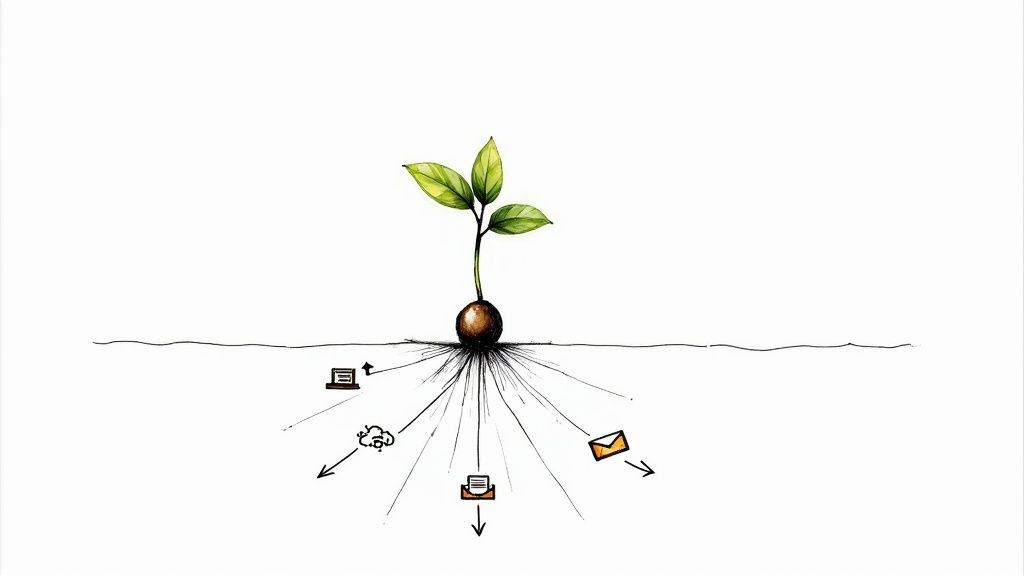
Let's cut the jargon. Organic marketing is the art of attracting customers naturally—no ad budget required.
Think of a local coffee shop. They could run a flashy ad (paid marketing). Or, they could brew incredible coffee, create a killer vibe, and have baristas who remember your name. Soon, people are telling friends, posting photos, and leaving glowing reviews.
That’s organic marketing. It’s a slow burn, but it builds a loyal tribe that sticks around for the long haul.
What Is Organic Marketing in Simple Terms

At its core, organic marketing is about earning attention, not buying it. Instead of interrupting people with ads, you pull them in by giving them something valuable—a helpful blog post, an entertaining video, a killer free tool.
This approach builds a sustainable growth machine fueled by trust and real connection, not your monthly ad spend. You can dive deeper into this strategy with this awesome guide on organic marketing from GrowthRocks.
A paid ad is like renting a billboard. It works as long as you pay the rent. The second you stop, you vanish. An organic strategy is like planting a tree. It takes time and consistent effort, but once it's mature, it attracts people for years with minimal upkeep.
The Foundation of Earning Attention
Organic marketing isn't a tactic; it's a mindset. You're building assets that grow in value.
Every blog post, every video, every answer you drop in a forum becomes a tiny engine working 24/7 to bring people to you. It's about showing up, solving problems, and building real relationships.
The goal? Become the go-to resource in your niche. When someone has a question, your brand should be the first one that pops into their head.
Key Takeaway: Organic marketing isn't "free." It demands time, creativity, and consistency. But the payoff is huge. Its effects compound, building brand equity that ads can't buy.
To nail this, focus on a few simple but powerful ideas. We've broken them down below.
Table: Core Principles of Organic Marketing
Principle | What It Means in Practice |
|---|---|
Solve Problems | Don't talk about your product. Answer your audience's most burning questions. |
Build Community | Jump into conversations on social media and forums. Foster loyalty by actually engaging. |
Establish Authority | Consistently share what you know. Position yourself as the trusted expert. |
Optimize for Discovery | Use SEO to ensure your valuable content gets found by the people who need it. |
Stick to these pillars and you'll create a powerful marketing flywheel. Great content attracts an audience, engagement turns them into a community, and that community amplifies your message for you.
That’s how you build a brand that lasts.
Organic Marketing vs Paid Marketing
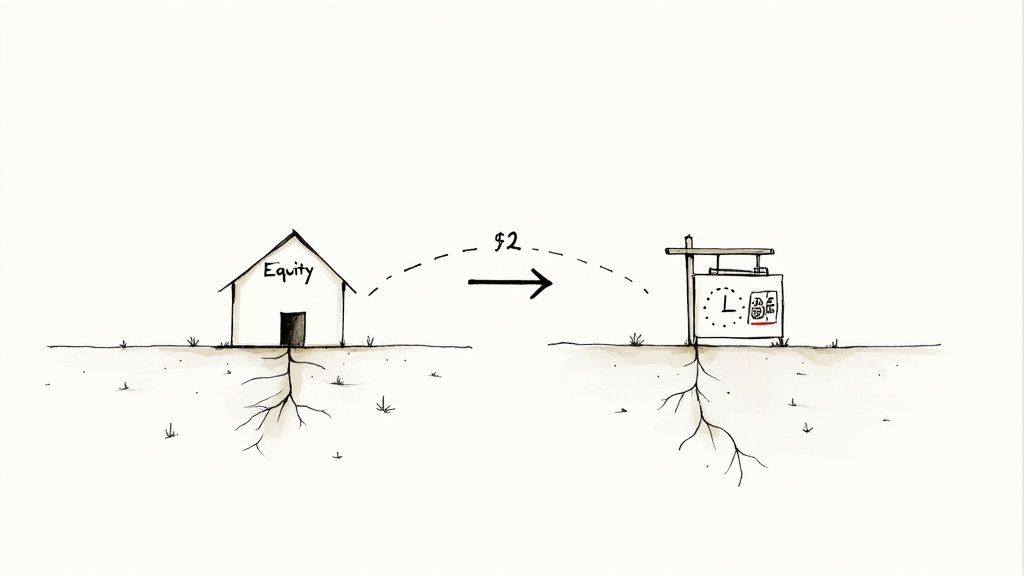
The difference between organic and paid marketing is simple: do you want to earn your audience or buy it?
Neither is better. They just serve different goals on different timelines. Nailing this distinction is the first step toward building a marketing engine that actually works.
Think of it like real estate. Organic marketing is buying a house. It takes a huge upfront investment of time and effort. But every blog post you write, every backlink you earn, and every email subscriber you gain builds equity. These assets grow in value, paying you back long after the work is done.
Paid marketing is renting an apartment. The second you start paying, you get immediate visibility. It’s perfect for short-term goals, like a product launch or a flash sale. The catch? The moment you stop paying rent, you’re out. Your ads vanish and the traffic dries up instantly.
Speed vs. Cost
Need results yesterday? Paid marketing is your go-to. Spin up a campaign and see traffic hit your site within hours. But that speed comes at a steep price. You pay for every click, impression, and lead.
Organic marketing is the long game. It can take months—sometimes over a year—to see real traction from SEO or content. The cost is measured in sweat equity, not ad spend. But once an organic channel hits its stride, it delivers a steady stream of customers at a fraction of the cost.
Key Insight: Paid marketing buys speed. Organic marketing buys sustainability. One is a sugar rush; the other is a permanent asset.
The All-Important Trust Factor
Here’s where the two strategies really diverge. People know an ad when they see one. And while ads work, they’re always viewed with skepticism. Studies show organic search results get over 70% of all clicks because users trust them more than sponsored links.
Organic marketing builds trust first. You provide value before asking for the sale. A genuinely helpful blog post that solves a problem establishes you as an authority. This creates a real connection, turning random visitors into die-hard fans.
That trust pays off with higher engagement and better conversion rates down the line.
Longevity and Compounding Returns
The most powerful aspect of organic marketing is its staying power. A single, killer article can rank on Google's first page for years, bringing in new customers daily with zero ongoing ad spend. Each piece of content builds on the last, creating a compounding effect that grows your reach and authority.
Paid campaigns have the shelf life of your budget. Turn off the spend, and your visibility flatlines. It’s purely transactional: you pay for traffic, you get traffic. No residual value. No lasting asset.
Head-to-Head Comparison: Organic vs Paid Marketing
Let's make it crystal clear. This table breaks down the core trade-offs.
Factor | Organic Marketing | Paid Marketing |
|---|---|---|
Speed | Slow to build momentum. | Immediate results. |
Cost | High initial time investment, low long-term cost. | Direct financial cost, continuous spending required. |
Longevity | Builds permanent assets with compounding returns. | Temporary visibility that stops when payment does. |
Trust | High, builds credibility through value. | Lower, often viewed with skepticism. |
Smart founders don't choose one or the other—they use both. Use paid ads to boost your best organic content or to test messages before investing months in an SEO strategy. Master both tools to get the best of both worlds.
The Four Pillars of Organic Growth
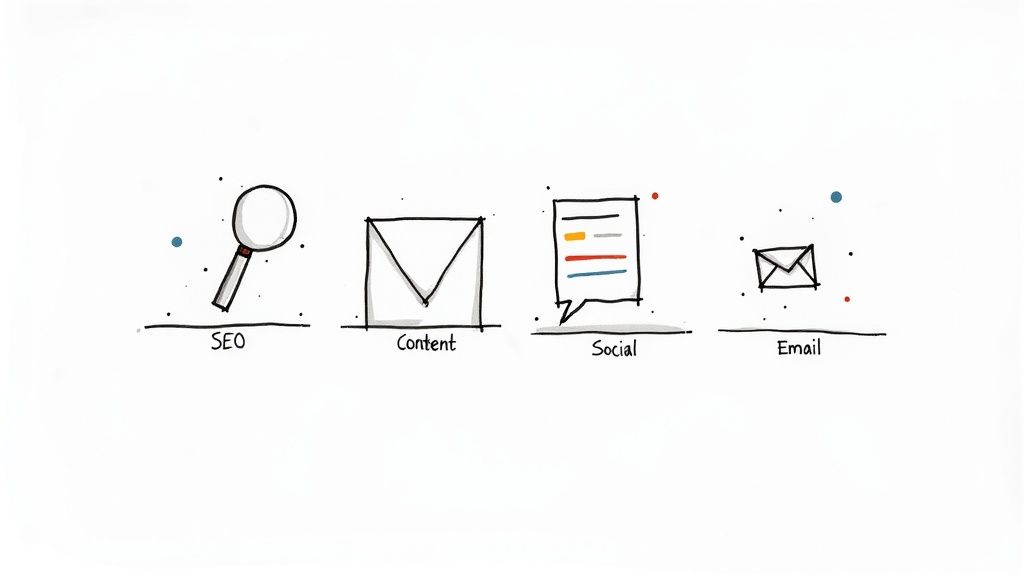
Organic marketing isn't one tactic. It’s an engine built on four core pillars. Kick one out, and the whole thing wobbles.
To build a brand that pulls customers in naturally, you need to master how these channels work together. Each one feeds the others, creating a self-sustaining growth loop.
SEO gets you found. Great content gives you something to share. Social media builds your community. Your email list turns that community into customers. Let’s break it down.
Pillar 1: Search Engine Optimization (SEO)
SEO is how you show up on Google when people search for what you offer. This isn't about gaming the system. It’s about making your site the most helpful answer to a user's question.
Think of Google as a library and your site as a book. SEO is how you label the spine, write a killer summary, and get other respected authors to quote you. It makes it a no-brainer for the librarian (Google) to hand your book to the right reader.
The Punchline: Real organic growth starts with SEO. A huge part of that is understanding your backlink profile—it’s how you prove to search engines that you’re a credible source.
Data doesn't lie: SEMrush found that 61% of B2B marketers say SEO and organic traffic bring in more leads than any other channel. Even better, 49% report that organic search delivers the best ROI.
Pillar 2: Content Marketing
Content is the fuel for your organic engine. It’s creating valuable stuff—blog posts, videos, guides—that your ideal customers actually want. Solve their problems, don't just shove your product in their face.
Instead of a digital billboard screaming "Buy now!", your content should be a helpful conversation that says, "We get your problem. Here's how to fix it." This is how you build trust and become the expert.
Actionable Tip: Brainstorm 10 questions your customer is Googling right before they need you. Answer each one in a detailed blog post. Boom—you just built a content strategy that attracts ready-to-buy customers.
A company selling project management software could write "5 Signs You've Outgrown Spreadsheets." It hits a specific pain point and naturally points to their software as the solution—without a hard sell. For more ideas, check our breakdown of powerful content marketing examples.
Pillar 3: Social Media Marketing
Forget vanity metrics like follower counts. Organic social media is about building a real community. It’s the digital version of the neighborhood coffee shop where the barista knows your name—it creates connection.
Use social platforms to show your human side, jump into conversations, and share value in a way that feels native to the channel. Speak the language of the platform.
LinkedIn: Your hub for industry insights, deep-dive case studies, and professional wins.
Instagram: Use killer visuals to tell your brand's story and show your products in action.
X (Twitter): The spot for quick conversations, hot takes, and bite-sized tips.
Be a member of the community, not a walking ad. Participate, listen, and help. People will get curious about what you do on their own.
Pillar 4: Email Marketing
Your email list is the only channel you truly own. No algorithm change can take it away. This is where you nurture relationships and turn casual followers into die-hard fans.
The inbox is personal space. Treat it with respect. Deliver consistent value, not constant promotions.
Here’s a simple framework for a newsletter people actually open:
Lead with value: Start with a helpful tip, a quick insight, or a link to a killer resource.
Tell a story: Share a behind-the-scenes look, a customer win, or a lesson learned.
Make a soft ask: Subtly mention a product, a new feature, or an upcoming webinar. No pressure.
Nail these four pillars, and you'll have a robust organic marketing machine. SEO brings people in, content gives them a reason to stay, social builds the community, and email deepens the connection. Together, they create unstoppable momentum.
Your First Organic Marketing Action Plan
Alright, enough theory. Time to stop reading about organic marketing and start doing it.
This is a no-fluff, step-by-step playbook for startups with more ambition than budget. Forget complex strategies that need a full team. We're focused on low-effort, high-impact moves to get your organic engine humming and land quick wins.
Let's get to work.
Step 1: Find Your Low-Hanging Fruit Keywords
Stop guessing what people are searching for. It's time to find "low-hanging fruit" keywords—super-specific, long-tail phrases your ideal customers are typing into Google right now.
Think problems, not products. Instead of the massive term "project management software," go for "best tool for managing freelance projects." It’s less competitive and laser-focused on a user with an urgent need.
You don't need expensive tools. Use these free resources:
Google's Autocomplete: Start typing a broad keyword and see what Google suggests. These are real queries people are making.
"People Also Ask" Section: A goldmine. Search for a topic and scroll down. Google hands you a list of related questions people need answered.
AnswerThePublic: This free tool visualizes all the questions people ask around a keyword, giving you hundreds of content ideas in seconds.
Your goal: build a list of 5-10 specific, problem-focused keywords. This list is your foundation.
Step 2: Create Your First Piece of Pillar Content
Now, pick the best keyword from your list. Your mission: create one killer piece of content that answers the question behind that keyword so completely that the reader is blown away. This isn't just another blog post. It's a "pillar" asset—the go-to resource on that topic.
Don't overthink the format. A simple "how-to" guide or a detailed listicle works perfectly. The key is to be relentlessly helpful.
Your content’s job is to solve a problem so thoroughly that the reader doesn’t need to hit the back button. Nail that, and search engines will reward you with better rankings.
If your keyword is "how to build an online presence for a new business," create a guide titled "A 5-Step Checklist to Build Your Online Presence from Scratch." It's actionable, clear, and matches searcher intent. For a deeper look, learn how to build an online presence in our detailed guide.
Step 3: Use a Simple Content Template
To move fast, lean on a proven template. This removes the guesswork and ensures you're hitting the right notes to keep readers hooked and search engines happy.
Here’s a powerful structure for your pillar post:
Punchy Intro: Hook the reader. State their problem and promise a clear solution. Keep it short.
Break It Down: Use subheadings (H2s and H3s) to chop your content into scannable sections. No one reads a wall of text.
Actionable Steps: Use numbered or bulleted lists for advice. This makes your content easy to follow and act on.
Add Visuals: Drop in at least one relevant image or screenshot. It breaks up the text and illustrates your points.
Clear Conclusion: Wrap it up with a quick summary and a clear call-to-action (CTA). Tell them what to do next—whether it's "Sign up for our newsletter" or "Check out our product."
This structure is a repeatable framework that speeds up content creation while keeping quality high.
Step 4: Outline Your First Simple Campaign
Your pillar content is the star. Now, build a dead-simple promotional campaign around it. The goal is to get this asset in front of relevant eyeballs without spending a dollar.
Your first campaign has just three parts:
On-Page SEO: Go back to your content. Make sure your main keyword is in the title, first paragraph, and a few subheadings. Write a meta description that makes people want to click.
Social Media Snippets: Don't just post the link. Pull out 3-5 of the most valuable tips or quotes from your article. Turn each one into its own social post, always linking back to the full guide.
Email Signature Link: Sneaky but effective. Add a line to your email signature: "P.S. I just wrote a guide on [Your Topic]. Read it here." This turns every email you send into a promotional tool.
That's it. This simple loop—find a problem, solve it with content, share it strategically—is the heart of organic marketing. You've just launched your first campaign and laid the foundation for sustainable growth.
How to Measure Organic Marketing ROI
You've heard it: "If you can't measure it, you can't improve it." This is gospel for organic marketing. It’s a serious investment of time, so you have to prove it's paying off.
First step? Ditch the vanity metrics.
Likes and shares are ego boosts, but they don't keep the lights on. Real success is measured by Key Performance Indicators (KPIs) that signal business growth. We're talking about metrics that show how your work is pulling in the right people and turning them into customers.
Ditching Vanity for Value
The goal is to draw a straight line from your organic efforts to business outcomes. More traffic is a great start, but it's just a start. The magic is showing how that traffic converts into leads, sales, and cold, hard revenue.
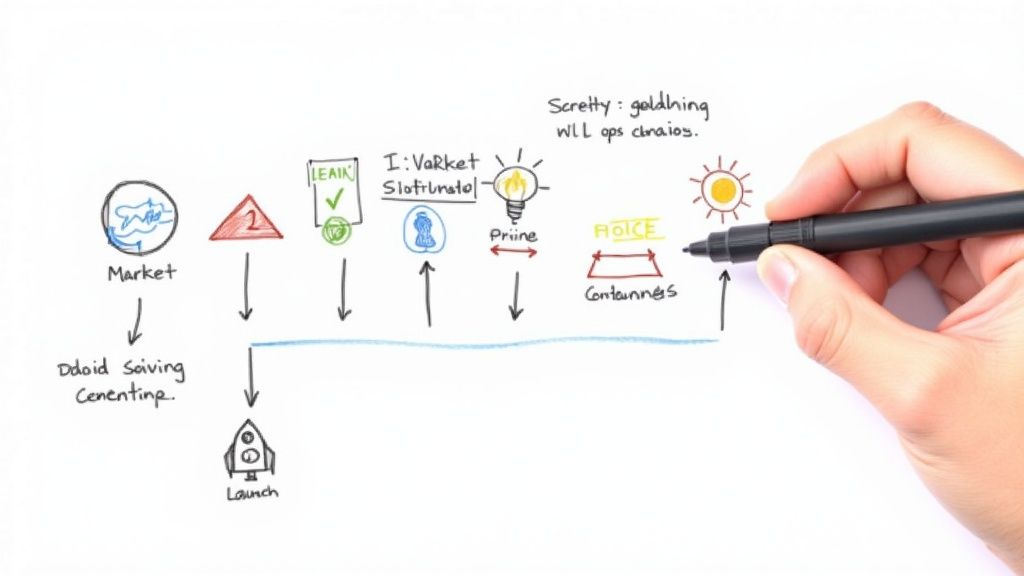
This workflow breaks down the process. It all flows from keyword research to content creation and, crucially, to performance tracking.
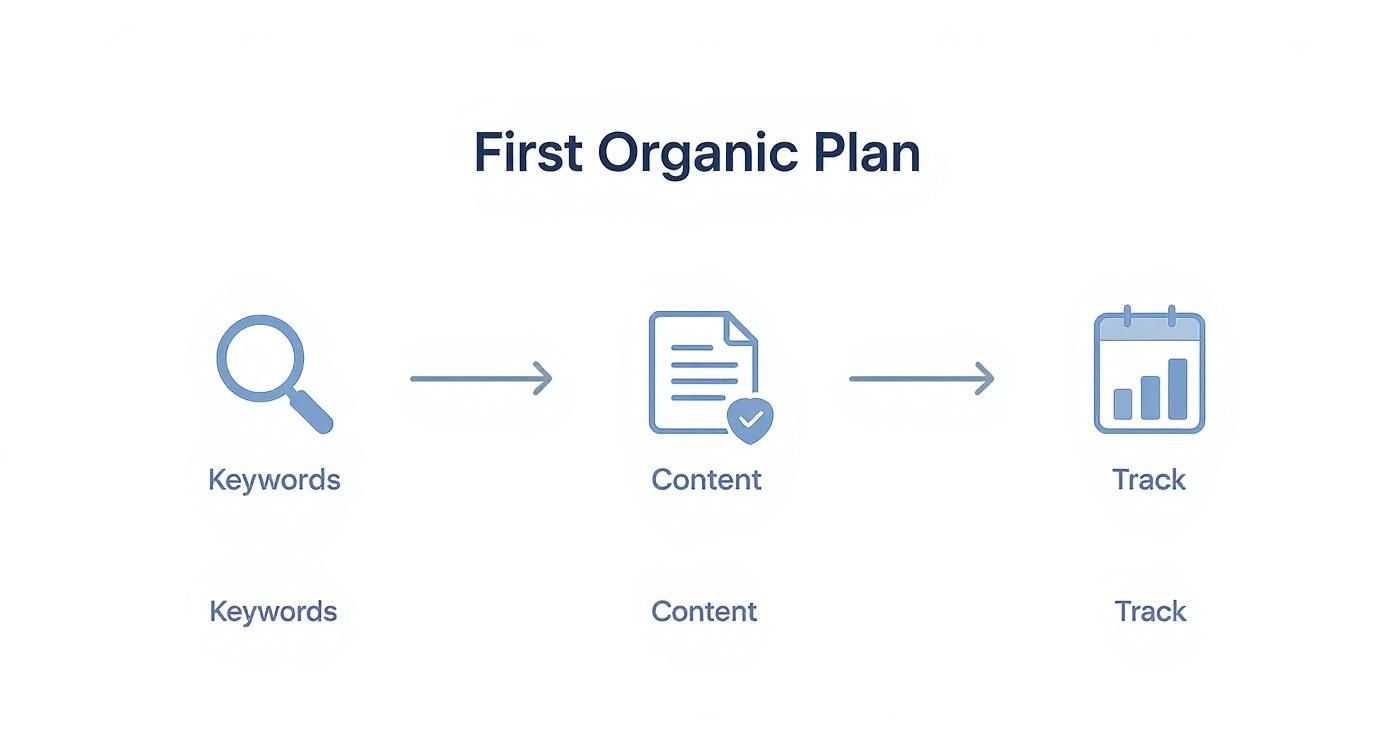
The key takeaway: measurement isn't an afterthought. It's baked in from day one. Every piece of content needs a clear purpose and a way to be tracked.
Core KPIs That Actually Matter
To prove the worth of organic marketing, zero in on a handful of powerful metrics. These KPIs tell the true story of your performance.
Track these starting today:
Organic Traffic: The baseline—visitors landing on your site from search engines. A steady climb shows your SEO is working.
Keyword Rankings: Are you becoming an authority on topics that matter? Tracking your rank for target keywords will tell you. Jumping from page two to one is an explosion in traffic.
Conversion Rate (Organic): The big one. What percentage of organic visitors take a desired action, like signing up for a newsletter or making a purchase?
Customer Acquisition Cost (CAC) from Organic: Calculate your investment (time, tools, content costs) and divide it by the number of new customers you acquire. Over time, this almost always crushes the CAC from paid channels.
Focusing on these numbers gives you a clear picture of what's working. For a full walkthrough, our team created a guide on how to measure marketing ROI that goes deeper.
Tying Organic Efforts to Revenue
Ultimately, connect the dots between that blog post and the money in your bank. A recent survey found that while over 63% of marketers say revenue is their top metric, only about 31.8% actually tie organic growth to revenue in reports. That’s a huge gap.
How do you bridge it? Proper tracking.
Pro Tip: Set up "Goals" in Google Analytics. Create a goal for any key action—a form submission, a demo watch, a purchase. Then, filter your reports to see exactly how many goal completions came from organic traffic.
This simple setup lets you say, "Our blog post on X brought in 50 new leads this month, resulting in $5,000 in new sales." That's a statement that gets everyone's attention and justifies your effort.
For a deeper dive, check out this detailed guidance on calculating marketing ROI for B2B. With the right data, organic marketing stops being a cost center and becomes a predictable revenue driver.
The Future of Organic Marketing
The core of organic marketing—building trust by being helpful—isn't going anywhere. But how we deliver that value is changing fast. To stay ahead, you can't run the same old playbook. You need a strategy for what's next.
The game is shifting from creating content to creating experiences. The brands that win tomorrow will master two massive shifts happening right now.
The Rise of AI and the New Search Landscape
AI is rewiring how we find information. AI-powered search, like Google's SGE, is shifting from a list of links to a direct answer. This means the bar for getting seen has been raised dramatically.
Your content can no longer just answer a question. It must be the definitive, most insightful resource. Stop thinking about basic keywords and start thinking about proving true topical authority.
The Actionable Insight: Don't just write a blog post. Build a comprehensive resource hub around your core topics—interconnected articles, videos, and tools that scream "we are the undisputed experts." This is what makes you the source an AI model wants to cite.
The Big Shift to Niche Communities
The days of chasing massive audiences on huge social platforms are numbered. The future of organic engagement is in small, focused, niche communities. People are tired of noisy feeds and want real connections.
This is a huge opportunity. Instead of shouting into the void, become a valued member of a tight-knit community on Discord, Slack, or specialized forums.
Here’s your pivot plan:
Listen first, talk later. Spend time in these communities to learn their culture, inside jokes, and biggest headaches before you post.
Give, don't pitch. Answer questions, share resources, and offer expertise with zero expectation of return.
Build real relationships. Connect with key members and become that go-to, trusted voice.
This approach builds loyalty that a viral post could never touch. It’s depth over reach.
Still Have Questions About Organic Marketing?
Got questions rattling around in your head? Perfect. Here are the straight-up answers I give founders every day.
So, How Long Does This Actually Take?
Look, organic marketing is a marathon, not a sprint. For instant traffic, use paid ads. For a lasting asset, be patient.
Generally, you’ll see the needle move on SEO and content in about 6 to 12 months. That’s when the compounding effect kicks in.
But smaller wins happen faster. A sharp social post or a helpful answer on Quora can send a burst of traffic overnight. The key is consistency. Keep showing up.
Is Organic Marketing Actually Free?
Nope. But it’s far more cost-effective long-term. You're not paying for clicks, but you are investing something more valuable: your time.
The real "cost" of organic marketing is paid in creativity, consistency, and sweat equity. You’re trading an ad budget for your own effort, building assets that pay you back for years.
You might not buy ads, but you may invest in SEO tools, content software, or a freelancer. The ROI isn't just saving cash; it's building a permanent foundation instead of renting attention.
I Have Almost No Budget. Where Do I Even Start?
When you’re bootstrapped, focus is your superpower. Don't try to be everywhere at once. Pick one thing and dominate it.
Here’s your game plan:
Solve One Problem, Brilliantly: Find your customer's single biggest headache. Create one massive, definitive piece of content that solves it better than anything else online.
Master One Channel: Where do your customers live? A specific subreddit? LinkedIn? Google? Pick one place and go all in. Become the go-to resource there.
Build Your Email List from Day One: Seriously, do this now. Your email list is the only audience you truly own. Slap a simple signup form on your site today. You’ll thank yourself later.
Ready to stop guessing and start building an organic growth engine that works? Viral Marketing Lab gives you the playbooks, templates, and no-fluff guides to nail your marketing on a bootstrapped budget. Check out our resources and get started.