how to create a go to market strategy that wins
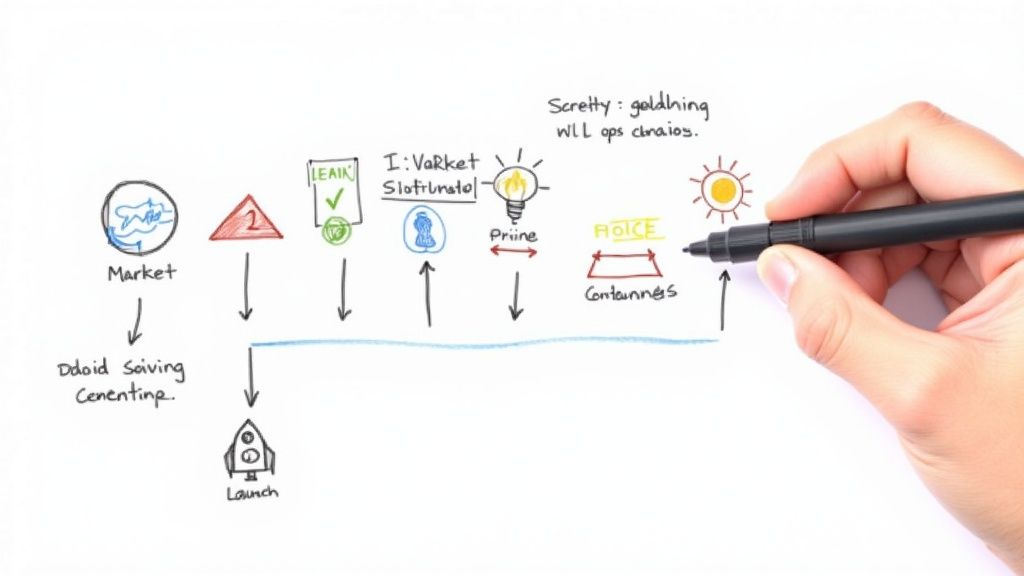
Forget dense corporate manuals. For bootstrapped founders, figuring out how to create a go to market strategy is about one thing: building a lean roadmap to find and win your first customers without burning cash.
It’s about making smart, deliberate choices before you write a single line of code to make sure you’re building something people will actually buy.
Your GTM Strategy: A Bootstrapper's Foundation
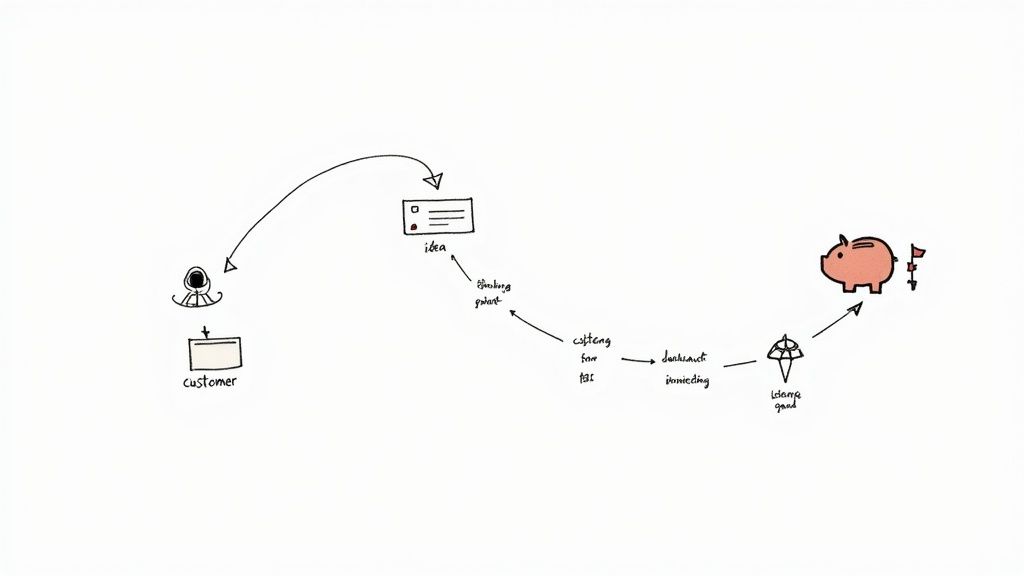
A go-to-market (GTM) strategy isn’t business jargon for VC-backed giants. For a bootstrapper, it's your survival guide. It's the critical link between your brilliant product idea and the people who will actually pay for it.
Think of it as the tactical action plan that forces you to answer the tough questions upfront.
Without a solid GTM plan, you fall into the classic "build it and they will come" trap. You spend months—or years—perfecting features, only to launch to the sound of crickets. A sharp strategy stops this costly mistake by grounding your business in market reality from day one.
The Core Questions Your GTM Must Answer
At its heart, a GTM strategy forces brutal honesty. This isn't about complex charts or 50-page documents. It's about getting crystal clear on the fundamentals that drive revenue.
Let’s break down what a lean GTM strategy looks like. The table below covers the essential questions you must answer.
The Core Components of a Lean GTM Strategy
Component | Key Question to Answer |
|---|---|
Market Segmentation | Who, specifically, are we selling to? Get granular. |
Value Proposition | What painful problem are we solving, and why are we better? |
Positioning | How do we want to be perceived versus the alternatives? |
Pricing Model | How will we charge in a way that aligns with the value we provide? |
Channel Selection | Where do our ideal customers hang out, and how do we reach them cheaply? |
Launch Plan | What are the exact steps to get our first 10 paying customers? |
Metrics & OKRs | How will we measure success? What numbers actually matter right now? |
Nailing these components gives you a clear path, turning your vision into a focused, executable plan.
This prep work directly impacts your survival odds. Research from Harvard Business Review found that 65% of businesses that meticulously plan their market entry achieve higher success rates.
A GTM strategy for a bootstrapper is an exercise in focus. It's about saying "no" to a hundred good ideas to say "yes" to the one great path that leads to paying customers with minimal waste.
This strategic foundation lets you move with speed and confidence. Instead of guessing, you operate from a playbook built on customer insight. It informs your product roadmap, your marketing copy, and your sales process.
For a more in-depth exploration of GTM fundamentals, check out this comprehensive guide to Go-To-Market strategies.
Finding Your Niche and Ideal Customer Profile

Trying to be everything to everyone is the fastest way to be nothing to anyone. Seriously. The first domino you must knock over is getting ridiculously specific about who you serve. You're hunting for an underserved niche you can own.
Forget boiling the ocean. Your mission is to become the only solution that makes sense for a small, specific group with a painful, expensive problem. When you're bootstrapped, this focus is how your limited resources punch above their weight.
From Broad Market to Actionable Niche
Market segmentation isn't just slicing a demographic pie chart. It's about finding a tribe—a group with shared pains, goals, and frustrations that big players ignore. The best niches hide in plain sight, sitting at the intersection of a specific industry, a particular role, and a nagging problem.
Think smaller. Not just "project management software," but "project management software for boutique architecture firms struggling with client approvals." Not "e-commerce tools," but "inventory tracking for Etsy sellers who dropship handmade jewelry." That specificity isn't a limitation; it's your unfair advantage.
How do you find these goldmines?
Drill Down on Industry: Get specific. Target a vertical like legal tech, construction, or D2C pet food brands.
Focus on Company Size: Zero in on a segment you understand. This could be solo creators, small businesses (10-50 employees), or mid-market companies too small for enterprise tools.
Use Their Tech Stack: Build for users of a specific platform they already live in, like Shopify, HubSpot, or Salesforce.
This granular approach makes every other part of your GTM strategy click into place. It’s the difference between shouting into a hurricane and having a quiet, productive conversation.
Key Takeaway: A niche isn't just a small market; it's a focused market. The goal is to make a group of customers feel like you built your product just for them... because you did.
Uncovering Real Pain Points with Scrappy Research
Got a potential niche? Great. Now prove it's real. This doesn't require a six-figure research budget. As a bootstrapper, your best tools are relentless curiosity and hustle. Your job is to become an expert on your target user's headaches.
Become a fly on the wall where your future customers hang out. Lurk in subreddits, LinkedIn groups, and niche forums. You’re digging for unfiltered conversations about their daily challenges, clunky workflows, and what they wish their current tools could do.
Here's an example of the kind of raw feedback you can find just by browsing industry forums like the r/SaaS subreddit.
Threads like this are pure gold. They reveal recurring problems and, more importantly, the exact language people use to describe them. Lift that directly for your landing page copy.
Defining Your Ideal Customer Profile
All this digging and listening culminates in your Ideal Customer Profile (ICP). This isn’t a fluffy marketing exercise; it’s a tactical document defining the perfect-fit customer. An ICP describes the company that will get the most value from your product and provide the most value back to you.
Your ICP should be so sharp that anyone on your team knows instantly if a lead is worth chasing. It goes beyond demographics into the firmographics and behaviors that scream "perfect match."
A solid ICP must nail down:
Industry/Vertical: What specific sector do they live in?
Company Size: How many employees? What's their annual revenue?
Geography: Where are they?
Pain Points: What are the top 1-3 problems that keep them up at night (which you solve)?
Buying Triggers: What event pushes them to look for a solution? (e.g., hiring their 10th employee, hitting a revenue milestone).
Once you have the ICP, then you can create detailed buyer personas. While the ICP defines the target company, buyer personas are the real people inside that company you must convince. To go deeper, check this guide on how to create buyer personas that feel like actual humans.
This clarity is the ultimate filter for your entire GTM strategy. It stops you from wasting precious time and money on customers who will churn in three months.
Nail Your Value Proposition and Market Position
Alright, you've pinpointed your niche and ideal customer. Now for the tough part: creating a message so sharp it slices through market noise and makes you the only logical choice.
This is the moment your "cool product" becomes an "irresistible solution."
Your value proposition isn't a fluffy slogan. It’s a crystal-clear statement that spells out what problem you solve, who you solve it for, and why you’re better than any other option. Think of it as the DNA of your go-to-market strategy; it dictates everything from your website copy to your sales emails.
Without a killer value prop, your product is just a commodity. You'll be forced into a price war, which is a death sentence for a bootstrapped startup. You have to sell outcomes, not features.
Stop Selling Features, Start Selling Outcomes
So many founders get trapped talking about what their product does. "Our software has a drag-and-drop dashboard and AI-powered analytics." Your customers don't care.
They care about what those features do for them. They're buying a transformation, a better version of their reality. Your job is to translate every feature into a tangible benefit and, ultimately, the outcome they desperately want.
Let's break it down:
Feature: "Drag-and-drop dashboard." (The what)
Benefit: "Easily customize your reports." (The how)
Outcome: "Build and share a client-ready performance report in under 5 minutes, freeing up hours of your week." (The why it matters)
See the difference? The outcome connects your product directly to their goals—saving time, making more money, or just eliminating a massive headache.
The Value Proposition Canvas: Your Shortcut to Clarity
A practical tool for this is the Value Proposition Canvas. It's a simple framework that forces you to align your product with your customer's needs. It’s split into two sides: the Customer Profile and the Value Map.
On the Customer Profile side, map out:
Customer Jobs: What are they trying to get done?
Pains: What frustrates them or holds them back?
Gains: What outcomes are they dreaming of?
All that scrappy research you did earlier? This is where it pays off.
Pro Tip: Don't just guess your customers' pains. Lift the exact words and phrases you found in forums, reviews, and interviews. Using their language is the fastest way to make your messaging resonate.
Once the customer side is done, map your product against it. Your features become "Pain Relievers" and "Gain Creators," directly addressing the needs you just uncovered. This exercise is a gut check to ensure you’re building a solution for a real-world problem, not just a product looking for one.
Carve Out Your Spot in the Market
With a solid value prop, define your market position. This is the specific real estate you want to own in your customer’s mind, especially compared to your competitors. If your value prop is what you do, your positioning is how you’re different and better.
Start by digging into your competitors, but not to copy them. You're looking for the gaps they’ve left open. Ask yourself:
Who are they really serving? (And who are they ignoring?)
What’s their core message? (And what are they silent about?)
What’s their pricing like? (Is there a chance to be simpler?)
This analysis helps you find your unique angle. Maybe every competitor targets enterprise clients, leaving a huge opening for a tool built for freelancers. Or maybe they're locked in a feature war, giving you the chance to win by being the simplest option. Understanding what is product positioning is the first step to claiming your territory.
This process boils down to a positioning statement, a short, internal memo that keeps your team on the same page. It looks something like this:
For [target customer], who [has this problem], [product name] is a [product category] that [delivers this key benefit]. Unlike [the main competitor], our product [is different in this crucial way].
This clarity makes you the obvious choice for your ideal customer and lays the foundation for every marketing move you make.
Nailing Your Pricing and Finding Customers
Let's talk about two make-or-break decisions: how much to charge and where to find your first customers. Mess these up, and you'll either bleed cash or scream into the void. Get them right, and you've built the foundation for a sustainable business.
For bootstrappers, the margin for error is paper-thin. This isn’t about throwing darts at a board; it's about making smart choices that connect your value to the places your ideal customers hang out.
Don't Just Pick a Price—Build a Pricing Strategy
Pricing isn't just a number; it's a powerful signal. It tells people who you're for and what value to expect. The biggest trap is trying to be the cheapest. That's a race to the bottom, and you don't have the runway to win it.
Instead, your price should be a direct reflection of the value you deliver.
Here are a few models that work wonders for bootstrapped founders:
Value-Based Pricing: The holy grail. Forget your costs or what competitors charge. Your price is based on the tangible value your product brings a customer. If your software saves a business $2,000 a month, a $200/month subscription feels like a steal.
Tiered Pricing: A classic for a reason. You create packages at different price points, split by features, usage, or seats. This lets you serve everyone from tiny startups to growing teams and gives them an obvious upgrade path.
Freemium: A powerful, but dangerous, acquisition tool. The free plan must be good enough to hook people but limited enough that your best customers have a burning reason to pay. This only works if your product has low variable costs and can target a massive audience.
Key Insight: Your initial pricing won't be perfect. The goal isn't to get it right on day one, but to be less wrong over time. Start with a price that feels slightly scary but justifiable, then listen and be ready to tweak it.
How To Test Prices Without Pissing Off Your First Fans
Changing your pricing is risky but necessary. The secret is to communicate clearly and always grandfather your early adopters. Your first 100 customers are gold. Reward their loyalty by locking them into their original price forever. It’s a small gesture that builds incredible goodwill.
For new visitors, run simple tests. Use A/B testing to show different prices, or just change the price on your site for a couple of weeks and see what happens to your conversion rate. Pay attention to both the number of sign-ups and the quality of customers you attract at each price.
This whole process loops back to understanding your market. Once you know your ideal customer inside and out, it becomes much clearer where you fit, what to charge, and where to find them.
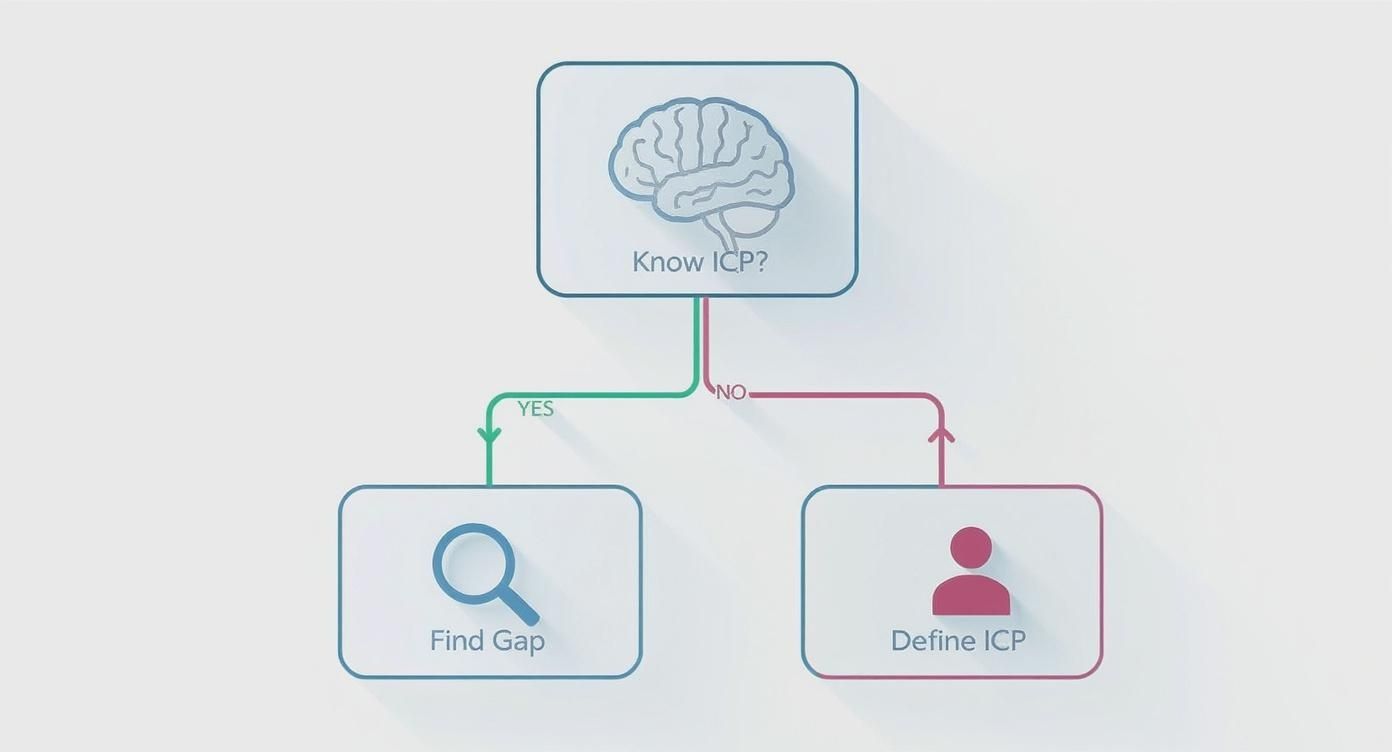
As you can see, a deep understanding of your ICP isn't optional—it's the starting block. It helps you find that unique gap in the market, which then informs both your pricing and your channel strategy.
Finding Customers When Your Marketing Budget is $0
With a price tag you feel good about, it’s time to find people to pay it. As a bootstrapper, you trade cash for creativity and sweat. You’re not buying Super Bowl ads; you’re looking for sustainable, high-leverage channels where your target audience already lives.
The key is focus. Don't try to be on TikTok, LinkedIn, Reddit, and a podcast all at once. You'll burn out. Pick one, maybe two, channels and master them. Once one is working, you can expand. A great way to amplify your reach without a big budget is through partnerships. Learning What is partnership marketing can open up new avenues for growth by tapping into other companies' audiences.
To help you decide where to focus, here’s a breakdown of the most effective, low-cost channels for bootstrappers.
Low-Cost Growth Channel Prioritization Matrix
Channel | Potential Reach | Cost Level | Effort to Implement |
|---|---|---|---|
SEO & Content Marketing | Very High | Low to Medium | High (Long-term) |
Community-Led Growth | Medium | Low | High (Consistent) |
Strategic Partnerships | High | Low | Medium |
Cold Outreach (Email) | Medium | Low | High (Manual) |
Niche Social Media | Medium | Low | Medium (Consistent) |
The perfect channel is at the intersection of your skills and your customers' attention. If you’re a great writer, SEO and content are a no-brainer. If you’re a natural connector, dive into community building or partnerships.
Start small, track everything, and when something starts to work, pour more fuel on that fire. That’s how you build a real acquisition engine without a venture-sized bank account.
Building Your Launch Plan and Success Metrics
A go-to-market strategy is just a document until you add an action plan and a scoreboard. This is where theory hits the pavement.
For a bootstrapper, a launch isn't a one-day firework show. It’s a phased rollout designed to build momentum without torching your tiny budget. You need a concrete roadmap to get from pre-launch buzz to post-launch tweaking. Even more critical? You need to define what success actually looks like before you start. Flying blind is a recipe for failure.
Architecting Your Phased Launch
A smart launch is a story told in three parts: before, during, and after. Each phase has a distinct goal. So many founders rush this, but building anticipation is just as important as the big day.
Think of it like a movie premiere. The studio doesn't just drop a blockbuster. They spend weeks releasing teasers, trailers, and cast interviews to build hype. Your launch needs that same kind of script.
Here’s what that looks like in practice.
Pre-Launch (The Build-Up): This is all about warming up your audience. Start dropping hints on social media, share behind-the-scenes progress, and chat with early followers. Spin up a waitlist and offer an exclusive early-bird deal for sign-ups.
Launch Day (The Main Event): Time to go live. Announce it to your waitlist first—give them a head start as a thank you. Then, push the news out across your main channels. That might be a Product Hunt launch, a newsletter blast, or a post in a niche community forum.
Post-Launch (The Grind): This is the most important part. The goal shifts from making a splash to building a sustainable growth engine. You’ll be gathering feedback, squashing bugs, and doubling down on what worked during the launch.
For a more granular breakdown, our guide on creating a product launch strategy template gives you a repeatable checklist so nothing falls through the cracks. It's an essential framework for turning a GTM doc into something that actually works.
Defining Metrics That Actually Matter
Forget vanity metrics. Social media impressions and website visits feel good, but they don't pay the bills. As a bootstrapper, you need to track the numbers that connect directly to your bank account and tell you if your business is sinking or swimming.
Your focus should be on a tiny handful of key performance indicators (KPIs) that track the entire customer journey, from first click to happy, paying customer.
Your dashboard shouldn't be a vanity board; it should be a diagnostic tool. If a metric doesn't help you make a decision about your product, marketing, or sales, stop tracking it.
These are the non-negotiable metrics for any early-stage, bootstrapped business.
Your Bootstrapper’s Metric Dashboard
Metric | What It Measures | Why It's Critical |
|---|---|---|
Activation Rate | The percentage of signups who complete a key action (e.g., creating their first project). | Shows if users "get" your product's core value. A low rate is a massive red flag for your onboarding. |
Customer Acquisition Cost (CAC) | The total sales and marketing cost to get one new customer. | Tells you if your growth is profitable. If CAC is higher than what a customer pays, you're lighting money on fire. |
Churn Rate | The percentage of customers who cancel their subscription in a given period. | Measures stickiness. High churn means your product isn't delivering ongoing value or you're attracting the wrong crowd. |
Monthly Recurring Revenue (MRR) | Your predictable revenue from all active subscriptions. | The heartbeat of a subscription business. Your single biggest job is to make this number go up, consistently, every month. |
Tracking these numbers religiously gives you an honest, unfiltered look at your business's health. It shows you where the leaks are so you can patch them before the ship sinks. For example, a high activation rate but high churn means your initial promise is great, but the long-term value isn't there. A low CAC but low MRR might mean you're great at attracting bargain-hunters who only ever buy your cheapest plan.
This data-first approach turns your GTM strategy from a static plan into a living system you can constantly test, learn from, and improve.
Go-To-Market Strategy FAQs
Even with a killer playbook, you'll have questions. Here are straight, no-fluff answers to the things founders get stuck on most.
What’s The Difference Between a GTM Strategy and a Business Plan?
Think of it this way: your business plan is the world map. It shows all the continents, countries, and oceans—your company structure, five-year financial projections, the grand vision.
A GTM strategy is the detailed, turn-by-turn GPS route for one critical trip: getting your product from the garage into the hands of your first paying customers. It’s hyper-focused on the tactical "how" of winning that initial beachhead.
How Often Should I Revisit My GTM Strategy?
Your GTM plan is not a "set it and forget it" PDF. For any bootstrapped startup, look at it quarterly, minimum. Markets shift, customers surprise you, and your initial assumptions will get punched in the face the second you launch.
Treat it like a living document.
Launch Phase (First 3-6 months): Review it monthly. You're in rapid learning mode, figuring out what messages land and which channels are a waste of time. You have to be nimble enough to pivot based on real data, not your day-one guesses.
Growth Phase (Post-6 months): A quarterly check-in is perfect. This is your chance to ask bigger questions. Are your channels still efficient? Has your ICP changed? Did a new competitor just change the game?
The goal isn't a constant, chaotic rewrite. It's about making small, intelligent course corrections. If a core metric like your Customer Acquisition Cost (CAC) suddenly doubles, that’s your fire alarm—dive back in immediately.
What Is a Product-Led vs. Sales-Led GTM?
This comes down to one core question: how do people find, try, and buy your product? It's a fundamental choice that shapes your entire company.
Product-Led Growth (PLG): The product itself is the main engine for acquiring and converting users. Think Slack or Calendly. You sign up (usually for free), see the value for yourself, and then decide to pay. The product does the selling.
Sales-Led Growth (SLG): A human sales team drives the revenue. This is the classic model for complex, big-ticket software sold to enterprises, like Salesforce. The process is built around demos, negotiations, and building relationships.
Key Takeaway: Most bootstrappers gravitate toward a PLG model. It’s more scalable and doesn't demand a pricey sales team before product-market fit. The catch? Your product experience has to be incredibly smooth and deliver that "aha!" moment fast.
Can a Go-To-Market Strategy Be Used for an Existing Product?
Absolutely. A GTM strategy isn't just for day-one launches. It's the playbook you pull out anytime you make a major strategic move.
Spin up a fresh GTM plan when you're:
Entering a New Market: Taking your product into a new country or targeting a completely different industry.
Launching a Major New Feature: Introducing a premium feature set designed for a new buyer persona.
Pivoting Your Business Model: Shifting from a consulting service to a SaaS product.
Each of these scenarios forces you to answer the same core questions you did at the beginning: Who is the customer now? What’s the right message for them? And what are the best channels to reach them? Rerunning the GTM playbook ensures you don't just wing it.
Ready to build a marketing engine that actually works for your bootstrapped startup? At Viral Marketing Lab, we provide the cheat sheets, templates, and actionable playbooks you need to grow without a VC-sized budget. Get access to proven growth strategies now at https://viralmarketinglab.com.