What Is Programmatic SEO And How It Works

Forget a massive army of writers. Sites like Zillow and TripAdvisor churn out millions of pages with a smarter strategy: programmatic SEO.
It's simple: you use one killer page template and a unique dataset to automatically generate thousands—or even millions—of hyper-targeted, optimized pages. This is your content engine.
The Content Engine Scaling Your Favorite Websites
Stop thinking one blog post at a time. Start building a system. Programmatic SEO is about building a content engine that does the heavy lifting for you.
Think of it like a mail merge, but for your website. You create a master template (the letter) and feed it a database of unique information (the names and addresses). The system combines them to create thousands of personalized "letters"—valuable, unique web pages.
This flips traditional SEO on its head. Traditional SEO is a slow grind for high-volume keywords with long-form articles. Programmatic SEO targets thousands of low-volume, high-intent "long-tail" keywords—the hyper-specific phrases people use when they're ready to act.
Here's the no-fluff breakdown.
Programmatic SEO vs Traditional SEO
Aspect | Programmatic SEO | Traditional SEO |
|---|---|---|
Scale | Creates thousands of pages at once from a template and data. | Creates one page or article at a time, manually. |
Keyword Focus | Targets thousands of low-volume, high-intent long-tail keywords. | Targets a few high-volume, broad "head" keywords. |
Content Creation | Automated generation using a structured dataset. | Manual writing, research, and editing by humans. |
Speed & Cost | Extremely fast and cost-effective once the system is built. | Slow, labor-intensive, and expensive to scale. |
Best For | Sites with large, structured datasets (listings, directories, tools). | Content-heavy sites (blogs, news, educational resources). |
Examples | Zillow, TripAdvisor, Zapier | Hubspot, Backlinko, NerdWallet |
One isn't better—they solve different problems. But for lean teams, the scale of programmatic SEO is a game-changer.
From Manual Labor To Automated Scale
The core difference is raw efficiency. Creating 1,000 pages by hand could take your team years and a small fortune. With a programmatic approach, you can launch the same number of pages in days. This is how bootstrapped startups punch above their weight.
The secret is finding a repeatable keyword pattern. Steal these winning formulas:
Zillow:
{address}, {city}, {state}(e.g., "123 Main St, Anytown, USA")TripAdvisor:
best things to do in {city}(e.g., "best things to do in Paris")Zapier:
connect {app a} to {app b}(e.g., "connect Slack to Google Drive")
Each pattern unlocks thousands of unique page ideas.
How The System Works
At its heart, a programmatic SEO setup has two main parts: a structured dataset and a flexible page template.
The dataset is your unique collection of information—property listings, city attractions, software integrations. The page template is the shell that pulls that data and displays it in a clean, user-friendly way.
This shows how one well-designed template can grab specific data points to create countless unique and valuable pages for users. Each page serves a different search query, yet they all come from the same scalable system. This is how you achieve massive growth without a massive team.
Key Takeaway: Programmatic SEO isn't spam. It’s about presenting unique, structured data in a helpful format to answer specific user questions at scale. Each page must be a valuable, standalone resource.
Since the early 2010s, this method has changed how businesses approach content. Companies now automatically generate anywhere from 5,000 to 50,000 pages, capturing huge chunks of organic traffic impossible to get manually. You can dive deeper into these trends in this detailed guide on programmatic SEO strategies.
Understanding The Three Core Components
To win at programmatic SEO, master its three core components. Think of your pSEO strategy as a car: nail these, and you'll build a traffic-driving machine.
The Dataset: Your Unique Fuel
Your dataset is the fuel. It's a structured collection of unique information that populates your pages. Without quality data, you're dead in the water.
Your data can be anything, as long as it’s organized and useful. Examples:
Product specifications: For comparing camera lenses.
Local business listings: For a directory of plumbers.
User-generated reviews: For a platform rating coffee shops.
Software integration details: For a SaaS company showing tool connections.
The data must be unique and structured. A messy spreadsheet won't work. You need clean rows and columns where every piece of information has a specific home. This rigid structure is what lets you automatically spin up thousands of distinct pages. Web scraping tools are a great way to build an initial dataset; you can learn more about specific tools in guides for products like Apify.
The diagram below shows where programmatic SEO fits: it’s an automated, systems-based approach versus old-school manual SEO.
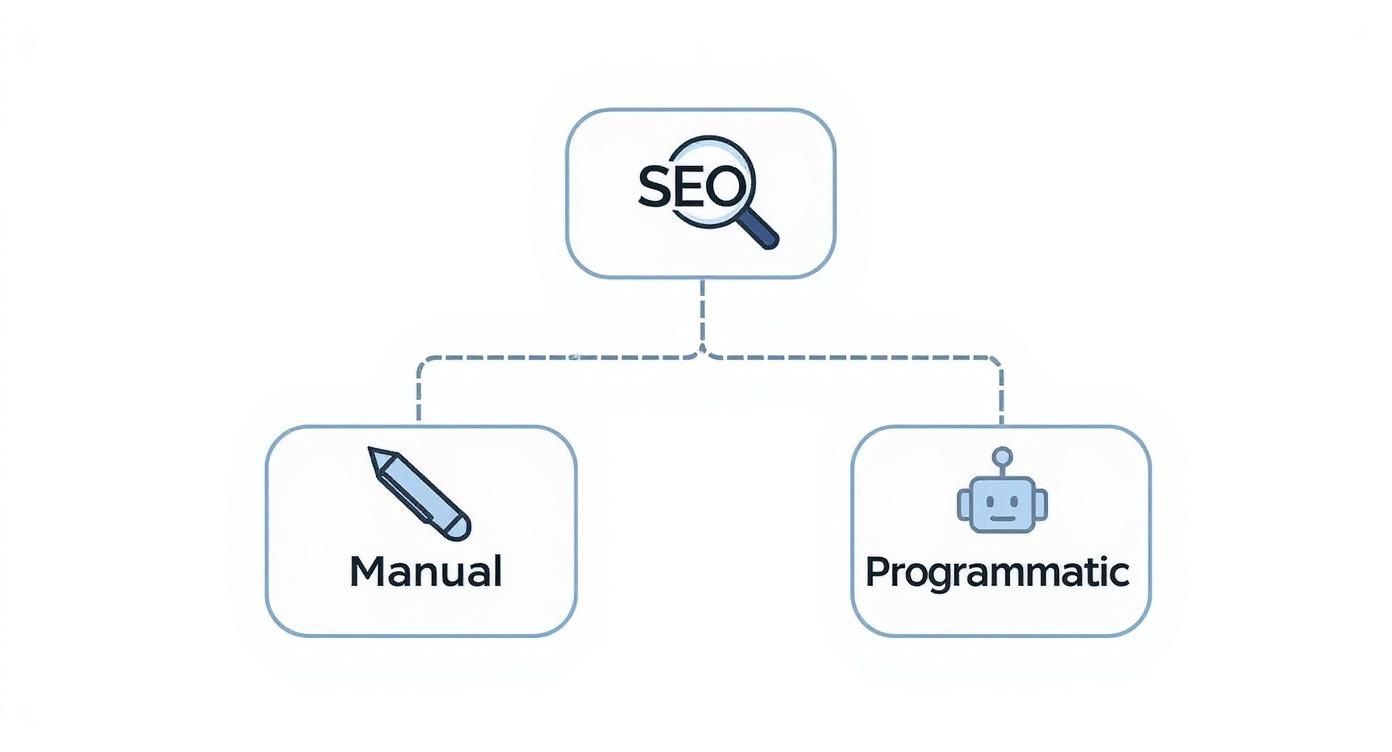
This visual draws a clear line: programmatic SEO is a technology-driven discipline built for massive scale.
The Page Template: The Engine
If data is the fuel, your page template is the engine. The template is a single, reusable design that defines the layout and structure for all your generated pages.
It’s built with placeholders. When a new page is created, the system grabs information from your dataset and slots it into the right spots.
A great template doesn't just display data; it makes it instantly useful. Design for user experience first. Focus on readability, navigation, and answering the user's query fast.
Look at Zapier's integration pages. The template is always the same: [App A] + [App B] Integrations. The engine pulls names, logos, and specific triggers from their dataset to create a unique page for every combo. That's efficiency. Understanding how certain platforms offer dedicated programmatic SEO features can clarify how this works in practice.
Internal Linking: The Chassis
Finally, build a strong internal linking structure. This is the chassis—it connects everything and provides structural integrity. Without it, your pages are isolated islands, invisible to Google and users.
A smart internal linking strategy does two things:
Helps search engines discover and crawl all your pages. By linking related pages, you create a web for Google’s bots to follow, ensuring every page gets indexed.
Improves user experience. It guides visitors to other relevant pages, keeping them on-site longer and helping them find what they need.
This can be done programmatically. A page about "restaurants in Boston" can automatically link to pages for "Italian restaurants in Boston" and "restaurants in Cambridge," building a logical and scalable content network that signals authority to Google.
Real-World Examples Winning With Programmatic SEO
Theory is fine, but action is better. Let's dissect the playbooks of companies that mastered this approach. This strategy isn’t just for giants. The cleverest examples come from scrappy startups that found a repeatable pattern and built a traffic machine.
https://www.youtube.com/embed/4DgWUgtZGqQ
Let's break down the formulas for Zapier and Wise to find actionable lessons you can steal.
Zapier: The Master of Integration Keywords
Zapier is the textbook example of pSEO done right. Their business is connecting software, so they turned every possible integration into a high-intent landing page.
Their keyword formula is brilliantly simple: Connect [App A] + to + [App B]
This structure creates thousands of unique pages that target hyper-specific problems. Someone searching “connect Slack to Google Drive” isn't window shopping. They have a problem and are hunting for a solution. Zapier’s page is built to be that exact solution.
The Actionable Insight: Your most powerful keyword pattern hides in your product's core value. Ask: What specific, repeatable problem do we solve? Turn that into your formula.
By 2025, winning pSEO strategies will blend human oversight with automated systems. Companies like Zapier and Wise have used this to generate 5.8 million and over 60 million monthly visits, respectively, by systematically targeting long-tail keywords. This approach uses data-driven templates to create thousands of unique, indexable pages, each optimized for specific search intent. You can dig deeper into how top companies pull this off in this complete guide to programmatic SEO.
The screenshot below shows a typical Zapier integration page, generated from a single template.
Notice how the template dynamically pulls in app logos, names, and specific "triggers" and "actions." This makes each page feel custom and valuable, not like a cheap, auto-generated placeholder.
Wise: Dominating Currency Exchange Queries
Wise (formerly TransferWise) uses programmatic SEO to capture a massive audience looking to exchange money—a search query with thousands of combinations.
Their keyword formula is just as direct: [Amount] [Currency A] + to + [Currency B]
This pattern spins up pages for every currency pair imaginable, like "1000 USD to EUR." Each page isn't a generic converter. It serves up real-time exchange rates, fee breakdowns, and a clear CTA.
Their page structure is a masterclass in serving user intent fast:
Answer First: The live exchange rate is the first thing you see. No digging.
Trust Signals: They show fees transparently and compare their rates against competitors.
Contextual Info: Historical data charts and FAQs add real depth and value.
This mix of live data, utility, and user-focused design is what makes their strategy so killer. They don't just rank for keywords; they provide an interactive tool that directly answers the user's question. That's what Google rewards.
You don’t need a massive team to get these kinds of results.
Ready to build your own traffic engine? This is your hands-on, five-step playbook designed for lean teams.
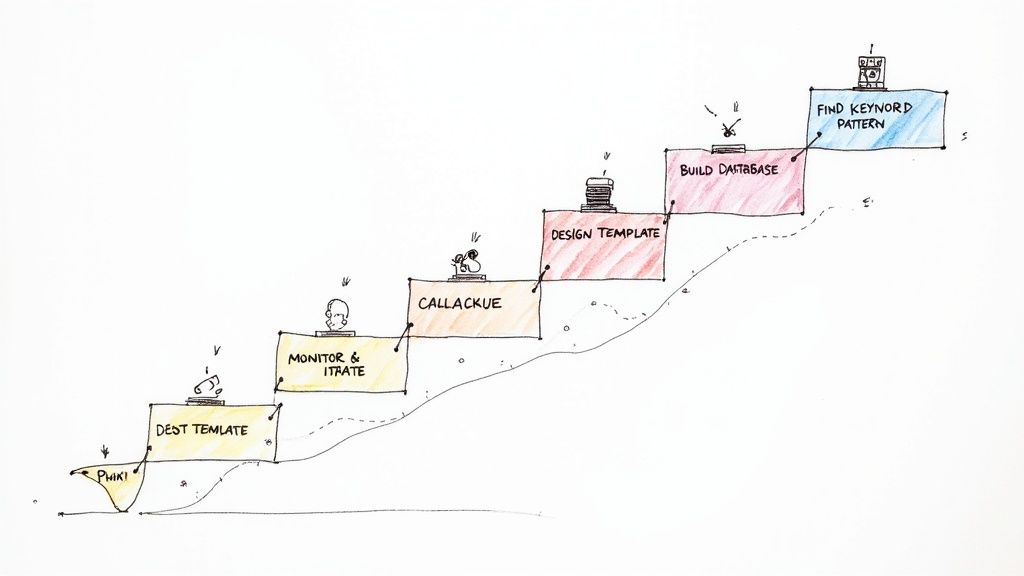
Follow this roadmap step-by-step. Let's go.
1. Find Your Keyword Pattern
Everything hinges on this. Your keyword pattern is the repeatable formula that unlocks thousands of pages. Get inside your customer's head and find the specific, repeatable problems they're trying to solve.
Your goal is to find a "head term" (the main topic) and a "modifier" (the variable).
Zapier's Pattern:
connect {app a}(head term)to {app b}(modifier).TripAdvisor's Pattern:
best things to do in(head term){city}(modifier).
Action Step: Brainstorm a list of 20 potential pages based on your pattern. Use an SEO tool to check their keyword difficulty and search volume. Look for low competition with some search volume—even 10-20 monthly searches per keyword is a great start when multiplied by a thousand pages.
2. Build Your Database
With a validated pattern, gather your fuel: the data. This is a structured collection of your modifiers and other unique info for your pages. A clean spreadsheet or a tool like Airtable is perfect.
Structure your database with clear columns. For a "best restaurants in {city}" project, your columns might be:
City Name
Restaurant Name
Cuisine Type
Average Rating
Unique Description
Action Step: Start small. A high-quality dataset of 100 items beats a sloppy list of 10,000. Focus on accuracy and uniqueness first—this gives your pages real value.
3. Design The Page Template
Next, design the engine: your page template. This is the reusable layout that will display the data from your database. Design for the user, not just Google.
A great template answers the user’s query instantly. It should feel like a custom-built resource, not an automated placeholder. Focus on clarity, speed, and immediate value.
Action Step: Build your template in a system that supports a CMS, like Webflow or WordPress. Use placeholders for every dynamic element—page title, images, descriptions—that will be pulled from your database.
4. Develop and Launch
Time to connect the dots. This step links your database to your page template so the system can automatically create a unique URL for every row in your dataset.
No-code tools shine here. You can sync an Airtable base directly to a Webflow CMS, creating thousands of pages without writing a line of code.
Action Step: Launch an initial batch of 50-100 pages. This "minimum viable launch" lets you test your setup, catch errors, and see how Google responds before going all-in. The right SEO tools for small business can make this process much smoother.
5. Monitor and Iterate
Your pages are live. The job isn't over. Now, watch performance and make improvements. Live in Google Search Console to track your most important metrics.
Pay attention to these three success signals:
Indexation Rate: How many of your new pages is Google actually indexing?
Keyword Rankings: Are your pages starting to show up for their target long-tail keywords?
Click-Through Rate (CTR): Are people clicking your pages from the search results?
Industry data shows programmatic SEO can slash manual content oversight by up to 75%. Most projects see a positive ROI in just 3–4 months, and it's not uncommon for traffic to jump over 200% in the first year. Stick with it—monitoring and tweaking turns your project into a massive growth channel.
Common Mistakes and How To Avoid Them
Programmatic SEO is a growth engine, but it's not a magic wand. Many projects fail due to a few common, avoidable mistakes. Get ahead of these pitfalls to build a traffic machine, not a digital graveyard.
The biggest trap? Creating "thin content." This is when your generated pages offer zero real value—a headline and a few data points. It's a database entry, not a useful resource.
Another killer mistake is building your project on a dataset that isn’t unique. If you just scrape public info everyone else has and spit it back out, you're not adding anything new. Why would Google rank you over the original source?
Creating Thin Or Duplicate Content
Flooding the internet with thousands of low-value pages is the fastest way to get slapped by Google. It's the cardinal sin of automation.
What Not To Do: You launch 10,000 pages for "Best {Restaurant Type} in {City}," but each page is just the restaurant's name and address. No unique description, no reviews, no photos. It’s useless.
What To Do Instead: Make every single page a genuinely useful destination.
Add unique descriptions: Use AI to spin up a short, unique paragraph for each entry.
Pull in user-generated content: If you have reviews, ratings, or photos, this is gold.
Include related data points: For a restaurant, add the average price, popular dishes, or a map embed.
The goal is simple: when a user lands on your page, they should find exactly what they need. If you do that, you win.
Choosing A Poor-Quality Dataset
Your entire project is built on your dataset. A garbage dataset leads directly to garbage pages.
What Not To Do: You build a directory of local marketing agencies by scraping names and websites. You don't verify the info. The result is a mess of outdated links, missing information, and duplicates.
What To Do Instead: Treat your dataset like a product. It's your most valuable asset.
Start Small and High-Quality: Begin with a curated list of just 100 verified entries. Manually check every single one.
Add Unique Value: Don't just list what's already out there. Add your own data points, like a "Best For" category (e.g., "Best for B2B SaaS") or an expert rating.
Clean and Structure It: Make sure every entry is complete and formatted consistently. A clean dataset is non-negotiable.
Key Takeaway: A unique, high-quality dataset is your competitive advantage. It's the "secret sauce" that makes your pages more valuable than anyone else's. Invest your time here.
Ignoring Technical SEO Basics
You can have the best content, but if your site's technical foundation is a wreck, it won't matter. With thousands of pages, small technical issues become massive problems.
What Not To Do: You launch your pages on a slow server, forget mobile optimization, and never generate a sitemap. Your pages take forever to load, look terrible on phones, and Google can't even find them. Game over.
What To Do Instead: Nail the technical basics before you launch.
Optimize for Speed: Ensure your page template is lightweight and your hosting can handle the load. Page speed is a huge ranking factor.
Build a Dynamic Sitemap: Automatically generate and submit an XML sitemap. This tells Google where to find all your new pages.
Create a Smart Internal Linking Structure: Don't let your pages become isolated islands. Automate links between related pages to pass authority and help users and search crawlers navigate your site.
Measuring Success And Scaling Your Project
You've launched. Pop the champagne, but don't get comfortable. This is the starting line, not the finish.
Now the real work begins: figuring out what’s working, what isn’t, and how to pour gasoline on the fire. You're shifting from building the engine to steering the ship.
Forget vanity metrics. Your first job is making sure Google sees your pages. Live inside Google Search Console and obsess over the right data.
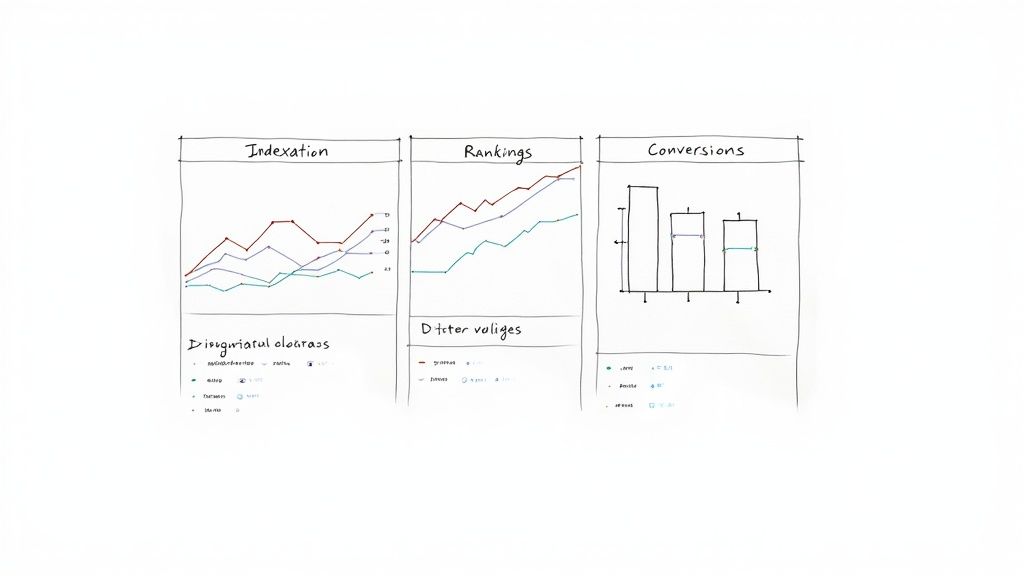
This shift in focus—from broad traffic to laser-specific performance signals—is everything. It’s how you spot problems before they kill your momentum.
Tracking The Metrics That Matter
Track these core metrics. They tell the true story of your project’s health.
Indexation Rate: This is ground zero. Go to the "Pages" report in Google Search Console. What percentage of your URLs are indexed? If it's low, Google is either struggling to crawl your site or doesn't see enough value in your pages.
Impressions and Clicks: Are your pages showing up in search? A steady climb in impressions is the first pulse of life. Clicks follow as rankings improve.
Average Keyword Position: Track a sample of your target long-tail keywords. Look for a gradual climb from page ten to page one over a few weeks.
Tracking thousands of keywords by hand is a nightmare. This is where tools come in. For a deeper dive, you can find breakdowns of different rank trackers and research tools, including reviews on products like SEMrush, which can put this on autopilot.
Identifying Your Winners
After a few weeks, patterns will emerge. Some pages will take off while others collect dust. Play detective and figure out why.
Look for your top-performing pages in Google Search Console. Is there a common thread? Maybe they're all related to a specific category. For a project on "best restaurants in {city}," you might discover pages for coastal cities with seafood restaurants are crushing it.
This is your signal. The market is telling you exactly what it wants. Double down on what’s working, don't waste time fixing what isn’t.
This data-first approach takes the guesswork out of the equation. You're no longer publishing pages into the void; you're actively responding to clear signals from Google and your users.
Scaling With A Simple Framework
Once you’ve found your winning page templates and data clusters, scale—intelligently. Scaling isn't just dumping more pages onto your site. It’s about making your next batch even better than the last.
Use this simple, actionable framework:
Expand Your Winning Dataset: If seafood restaurant pages are your golden ticket, find another 200 seafood restaurants to add to your database. Prioritize expanding data categories that are already winning.
Target New Keyword Modifiers: Think adjacent. If "best seafood restaurants in {city}" works, try "best family-friendly seafood restaurants in {city}" or "seafood restaurants with outdoor seating in {city}."
Improve Your Page Template: Look at your top-performing pages. How can you make them more valuable? Add user reviews, embed a map, or use structured data to snag rich snippets. A tiny improvement to your template rolls out across thousands of pages instantly.
This loop—measure, identify winners, scale intelligently—is the secret sauce. It turns a one-time launch into a sustainable, self-improving traffic machine.
Got Questions About Programmatic SEO?
Still have questions? You're not alone. Let's tackle the most common ones we hear from founders and marketers.
Is Programmatic SEO Just a Game For Big Companies?
Not at all. While giants like Zillow crush it, the core ideas work just as well on a smaller scale. You can kick things off with a unique, focused dataset of just 50-100 items and still build a powerful set of targeted pages.
The magic is in the uniqueness of your data and the quality of your page template—not raw numbers. A killer project with 100 pages will always beat a sloppy one with 10,000. For a deeper look at this, one resource explains in great detail what programmatic SEO entails.
Wait, Isn't This Just a Fancy Name For Doorway Pages?
Important distinction. Doorway pages are spammy, low-value pages built to rank for a keyword and immediately shove users somewhere else. They offer zero value on their own.
Real programmatic SEO is the opposite. It’s about creating genuinely useful, unique pages at scale. Each page is a destination, giving a user the specific information they searched for. The value is baked into your unique data and presented in a helpful way. That’s what Google wants to reward.
What Kind of Tech Skills Do I Need to Pull This Off?
The tech can range from simple to complex, but you don't need to be a senior engineer. Thanks to new tools, the barrier to entry is lower than ever.
Start small with tools you already know. Once the project shows results, you can scale up your tech stack. Don't let perfection stop you from getting started.
Here’s a quick look at what you might need:
For a Basic Setup: Go no-code. Use Webflow and its powerful CMS, or connect an Airtable base to a site builder like Softr.
For More Complex Projects: For thousands of pages with custom logic, you'll probably need a developer comfortable with databases, backend code, and a modern web framework.
At Viral Marketing Lab, we give bootstrapped founders the tools, templates, and actionable playbooks to scale growth without a huge budget. Find what you need to build your own traffic engine at https://viralmarketinglab.com.