What Is Cost Per Acquisition A Complete Guide

Let's cut to the chase. Cost Per Acquisition (CPA) is the real-world price you pay to win a new customer from a specific marketing campaign.
Forget vanity metrics. CPA is the all-in, final price tag for getting a paying customer—not just a click, a like, or a lead, but someone who actually pulls out their wallet.
Why CPA Is Your Most Important Metric
Simply put, your Cost Per Acquisition tells you if your marketing is actually making you money.
Metrics like impressions and click-through rates are nice, but they don’t pay the bills. CPA cuts through the noise and connects your ad spend directly to new customers. It's the ultimate report card for your marketing efficiency.
For bootstrapped startups, knowing your CPA isn't just a good idea—it's a survival tactic. It forces you to be ruthless with your budget and double down on what actually works.
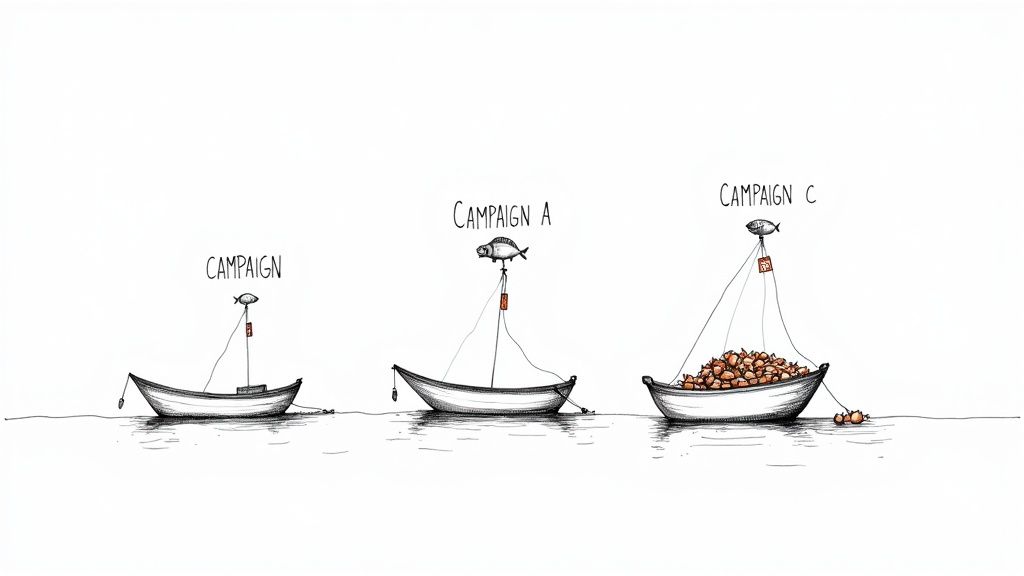
The Fishing Trip Analogy
Imagine you’re running three different fishing trips (your marketing campaigns) to catch customers.
Trip A (Google Ads): You spend $500 and catch 10 fish. Your CPA is $50 per fish.
Trip B (Facebook Ads): You spend $300 and catch just 3 fish. Your CPA is $100 per fish.
Trip C (Content Marketing): You spend $1,000 and catch 50 fish. Your CPA is only $20 per fish.
Trip B was the cheapest trip, but Trip C was the most efficient way to fill your boat.
That’s the power of CPA. It reveals the true cost-effectiveness of each channel, showing you exactly where to put your money for the biggest returns. It shifts the conversation from "How much did we spend?" to "How much did we pay for each win?"
To help you get a firm grasp on this, here's a quick breakdown of what CPA is all about.
CPA at a Glance
This table sums up the Cost Per Acquisition formula and why it's such a game-changer for your business.
Component | What It Means | Why It's Critical |
|---|---|---|
Total Cost of Campaign | Every single dollar you spent—ad spend, tools, creative, etc. | Gives you the complete, honest picture of your investment. |
Number of Acquisitions | The total number of new customers you gained from that campaign. | Focuses on the end result: actual business, not just clicks. |
Cost Per Acquisition | The final price tag for each new customer you acquired. | Tells you if your marketing is profitable and sustainable. |
Keeping a close eye on these components will give you the clarity needed to make smarter, more profitable marketing decisions.
By focusing on CPA, you shift from spending money on marketing activities to investing in profitable customer growth. It’s the clearest indicator of a sustainable business model.
This single number is the bedrock of any solid user acquisition strategy. It sets the financial guardrails for growth and tells you, point-blank, whether you can actually afford to scale.
How to Calculate Your CPA Accurately
Alright, let's get down to brass tacks. The calculation is simple, but getting it right means knowing exactly what to include. Calculating your Cost Per Acquisition demands a brutally honest look at both your spending and your results.
The basic formula is your North Star:
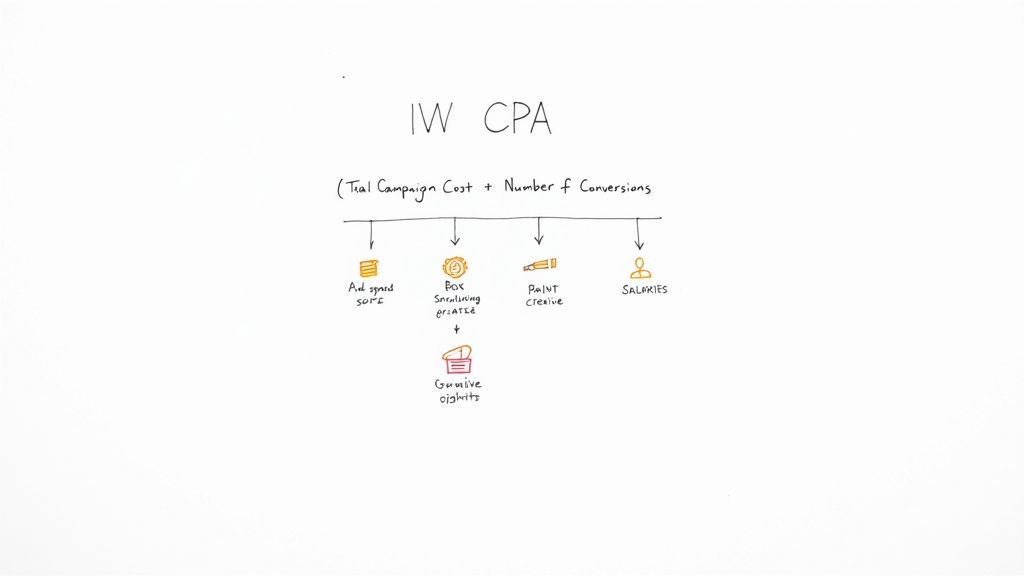
CPA = Total Campaign Cost ÷ Number of Conversions
Simple, right? But the devil is in the details. The accuracy of your CPA hinges entirely on how you define your costs and your conversions.
Defining Your Total Campaign Cost
"Total Campaign Cost" is more than just ad spend. If you stop there, you’re flying blind. To get a true CPA, you must account for every dollar that went into making a campaign happen.
Think about all the direct and indirect costs:
Direct Ad Spend: The obvious one—money paid directly to Google, Facebook, or LinkedIn.
Creative Production: The cost to create the ad—design, copywriting, video, and other assets.
Software and Tools: A slice of your subscription costs for marketing automation, analytics, or design tools.
Team Salaries: A portion of the salaries for the marketing team who worked on the campaign. Don't forget this.
Ignoring these "hidden" costs gives you a misleadingly low CPA and a false sense of profitability. If you really want to nail down every figure that contributes to your acquisition costs, we recommend diving into a comprehensive guide on how to calculate Customer Acquisition Cost (CAC).
Defining Your Conversion
Just as important is defining what a "conversion" or "acquisition" means for your business. Hint: it’s not always a final sale. Your conversion goal must align with your campaign's objective.
A conversion could be any of these key actions:
A Completed Sale: The go-to metric for e-commerce.
A Free Trial Sign-Up: A critical first step for SaaS.
A Qualified Lead Submission: The main goal for B2B services.
An App Installation: The primary objective for mobile-first businesses.
The key is consistency. Once you define a conversion, stick with it. This ensures your calculations are comparable over time, so you can track your progress.
CPA Calculation Examples in Action
Let's see this play out with a few real-world examples.
1. E-commerce Brand An online store spends $5,000 on a Google Shopping campaign. That spend generates 100 direct sales.
Calculation: $5,000 ÷ 100 sales = $50 CPA
2. SaaS Company A SaaS startup spends $10,000 on LinkedIn ads to promote its new software. The campaign brings in 200 free trial sign-ups.
Calculation: $10,000 ÷ 200 sign-ups = $50 CPA
3. B2B Service Provider A marketing agency invests $3,000 in a content marketing campaign (including writer fees and promotion). This effort produces 15 qualified leads who booked a consultation call.
Calculation: $3,000 ÷ 15 leads = $200 CPA
When you calculate CPA with this level of detail, you get a clear, actionable understanding of what it truly costs to win. This is the foundation for smarter budgets and profitable growth.
CPA vs. CAC vs. CPL: Untangling Key Metrics
In marketing, acronyms get thrown around like confetti. CPA is your campaign-level report card, but it's often confused with two other heavy-hitters: Cost Per Lead (CPL) and Customer Acquisition Cost (CAC).
Getting these straight isn't about sounding smart in meetings—it’s about knowing which lever to pull to grow your business without burning cash.
Think of your customer journey as a funnel. Each metric measures performance at a different stage, giving you a complete health check on your entire marketing engine.
CPL: The Top of Your Funnel
Cost Per Lead (CPL) is your first checkpoint. It tells you how much it costs to get a potential customer to raise their hand. This could be downloading an ebook, signing up for a newsletter, or filling out a contact form.
CPL asks: "How much did we just pay for this person's email address?"
CPL is all about generating that initial spark of interest. A low CPL means you’re great at grabbing attention, but it’s no guarantee of a sale.
CPA: Your Campaign-Specific Action
Cost Per Acquisition (CPA) is the next step down. It measures the cost of a specific action that’s more valuable than just an email. Think free trial sign-ups, demo requests, or a first-time purchase.
CPA asks: "How much did it cost to get a prospect to take this specific, valuable action?"
CPA is tactical. It tells you if a particular ad campaign or landing page is convincing people to take a meaningful step toward becoming a customer.
CAC: The Bottom-Line Metric
Finally, Customer Acquisition Cost (CAC) is the big one. It zooms out to measure the total cost to get one new paying customer, across all your sales and marketing expenses over a period. This includes everything—salaries, software, ad spend, you name it.
CAC asks: "When we factor in everything, how much did it truly cost us to win this new paying customer?"
While CPA keeps you focused on individual campaigns, CAC tells you if your entire business model is financially sustainable. If you want to dive deeper into this, check out our complete guide on customer acquisition cost calculation.
A low CPL is good, a solid CPA is better, but a sustainable CAC is everything. Your business lives or dies by its ability to acquire customers for less than they are worth over their lifetime.
To make this crystal clear, let's put these metrics head-to-head.
CPA vs CAC vs CPL Showdown
Here’s a quick table to distinguish between these three critical metrics and know exactly when to use each one.
Metric | What It Measures | When to Use It | Core Business Question |
|---|---|---|---|
CPL | The cost to generate one new lead (e.g., an email sign-up). | To evaluate top-of-funnel ad campaigns and lead magnets. | "Is my marketing effective at generating initial interest?" |
CPA | The cost for a specific conversion action (e.g., a free trial). | To optimize the performance of a single marketing campaign. | "Is this specific campaign efficiently driving valuable actions?" |
CAC | The total cost to acquire a new paying customer. | To assess the overall health and scalability of your business model. | "Is my business model profitable and sustainable for growth?" |
Each metric tells a different part of your growth story. CPL tracks your ability to attract attention, CPA measures your power to create engagement, and CAC reveals the final, bottom-line truth about your profitability. Master all three, and you'll have a powerful dashboard for steering your startup's growth.
Benchmarking Your CPA by Industry and Channel
Knowing your Cost Per Acquisition is a great first step, but that number doesn't live in a vacuum. A $50 CPA—is that a massive win or a sign you’re burning cash? The answer: it depends entirely on your industry and the marketing channels you're using.
Without context, your CPA is just a data point. Benchmarking it against industry and channel averages turns that number into a powerful strategic tool. It helps you spot overspending, find efficiencies, and set realistic campaign goals.
A B2B SaaS company with a long sales cycle and high customer lifetime value can afford a much higher CPA than a DTC e-commerce brand selling low-margin items. Benchmarking shows you where you stand in your specific competitive arena.
Industry Averages Tell Part of the Story
CPA varies wildly across industries because each sector has unique challenges and competitive pressures. For example, in 2025, e-commerce has a relatively modest average CPA of around $274, making it one of the more accessible markets to enter. But this is a world away from other sectors. Insurance companies, for instance, are staring down brutally high acquisition costs averaging $1,280 per customer. You can explore more about these CPA differences and what drives them.
What causes these huge gaps? A few key factors:
Product Price Point: Higher-priced items can justify a higher CPA. Simple as that.
Customer Lifetime Value (LTV): Industries with recurring revenue (like SaaS or insurance) can afford to spend more upfront.
Sales Cycle Length: Complex B2B sales require more marketing touchpoints, driving up acquisition costs.
Market Competition: The more saturated a market is, the more you’ll pay for ads. This pushes your CPA up.
This side-by-side comparison shows how CPL, CPA, and CAC represent different stages of your marketing funnel.
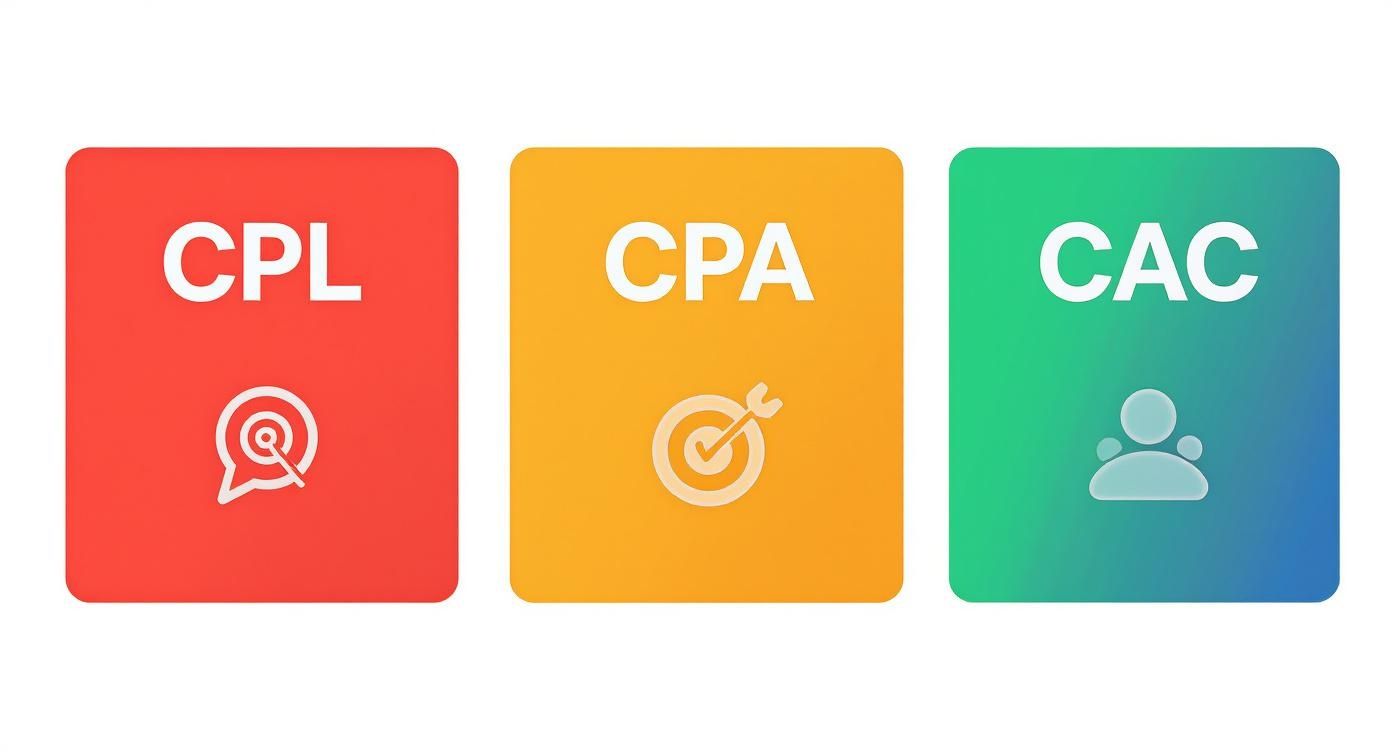
This visual breaks down the customer journey perfectly—from simply generating a lead (CPL), to getting them to take a specific action (CPA), and finally to winning a paying customer (CAC).
How Marketing Channels Impact CPA
Just as industries differ, so do marketing channels. Where you spend your budget has a massive impact on your acquisition costs. A campaign on Google Search will perform completely differently than one on TikTok or through an affiliate program.
Here’s a quick look at why the channel matters so much:
Search Ads (Google/Bing): Often have a higher CPA because they target users with high purchase intent. You're paying a premium to reach people actively looking for a solution.
Social Media Ads (Facebook/Instagram/LinkedIn): The CPA can be lower, but it’s a mixed bag. You're targeting users based on interests, not intent, so it can take more work to convert them.
Content Marketing/SEO: The initial investment can be high. But the long-term CPA can become incredibly low as a single blog post acquires customers for years to come.
The goal isn't just to find the channel with the lowest CPA. It's to find the channels that deliver customers with the highest lifetime value at a profitable CPA.
At the end of the day, a "good" CPA is one that works for your business model. By comparing your numbers to industry and channel benchmarks, you get the perspective you need to make smarter budget decisions and build a sustainable growth engine.
Actionable Tactics to Lower Your CPA
Knowing your Cost Per Acquisition is one thing. Driving it down is how you win.
Lowering your CPA isn't about slashing your budget—it’s about making every dollar work harder. This is your playbook for immediate results. We're skipping the generic advice and diving straight into proven strategies you can use today to stop burning cash.
Master Your Ad Targeting
Want to burn your budget fast? Show your ads to the wrong people. Precision targeting isn't a "nice-to-have"; it's non-negotiable for a healthy CPA. Stop casting a wide net. Start using a spear.
Here are three ways to sharpen your targeting right now:
Build Hyper-Targeted Lookalike Audiences: Take a list of your best customers—the ones with the highest lifetime value—and upload it to your ad platform. Create a lookalike audience from this elite group. This tells the platform to find new prospects who share the same profitable traits.
Master Negative Keywords: For search campaigns, negative keywords are your best defense against wasted ad spend. Actively block irrelevant search terms that trigger your ads but have zero chance of converting. Think terms like "free," "jobs," or "reviews" if you're selling a premium SaaS product.
Layer Your Audience Targeting: Don't just target by a single interest. Get granular. Combine demographics, behaviors, and interests to build a super-specific profile of your ideal customer. Instead of just targeting "small business owners," try targeting those who also follow specific industry influencers and use certain software tools.
Optimize Your Landing Pages for Conversion
You could have the greatest ad in the world, but if it clicks through to a confusing, slow landing page, you're just paying for bounces. Your landing page has one job: convert visitors. Every element must drive toward that goal.
Your ad makes a promise. Your landing page must deliver on it instantly. A disconnect between the two is the quickest way to kill your conversion rate and inflate your CPA.
Start with the basics: make sure your landing page headline mirrors the ad creative. This reassures visitors they're in the right place. Then, remove all friction. Simplify your forms, crush your page load times, and make your call-to-action button impossible to miss.
A/B Test Your Ad Creative Relentlessly
Never assume you know what will resonate. Data beats intuition every time. Consistent A/B testing is the engine of CPA reduction, allowing you to iterate your way to high-performing ads.
Focus your tests on high-impact variables first:
Headlines: Test different angles. Does a question-based headline outperform one stating a direct benefit?
Visuals: Pit a clean product shot against a lifestyle image or a short video. See what grabs attention.
Call-to-Action (CTA): Experiment with button text. Does "Get Started" work better than "Claim Your Free Trial"?
Track your results like a hawk. Even a small lift in conversion rate from a winning test can lead to a significant drop in your CPA. As you explore these tactics, performing sensitivity analysis can also help you understand how small changes to these key variables might impact your overall acquisition costs.
These strategies are a powerful starting point. For a more exhaustive list of tactics, check out our guide on how to reduce customer acquisition costs. By continually refining your targeting, landing pages, and creative, you turn CPA management from a guessing game into a predictable system for profitable growth.
Why Your Acquisition Costs Keep Rising
If your Cost Per Acquisition feels like it's in a constant upward spiral, you're not imagining it. It’s a market-wide reality.
Getting new customers is getting more expensive for everyone, turning efficiency from a nice-to-have into a core survival strategy. The digital marketing space is more crowded and competitive than ever.
The Primary Drivers of High CPAs
So, what's really pushing these costs up? A few powerful forces are at play.
Intense Competition: More businesses are fighting for the same eyeballs on Google and Facebook. This spike in demand for limited ad space creates a bidding war, which directly drives up your ad spend.
Ad Platform Saturation: Let's be honest, your potential customers are tired. They're experiencing ad fatigue, making them numb to most advertising. It now takes more creativity, sharper targeting, and a bigger budget to cut through the noise.
The core reason for rising CPAs isn’t just one thing; it's a perfect storm of more competition, smarter consumers, and saturated channels. This new reality forces a shift from just acquiring customers to acquiring them profitably.
The data backs this up. The cost to acquire one new customer has surged, with businesses seeing a staggering 222% increase in spend between 2017 and 2025. This signals a permanent shift in the market.
If you want to dig deeper, you can discover more customer acquisition statistics that highlight this trend.
Common Questions About Cost Per Acquisition
Even when you've got the basics down, a few practical questions always pop up when it's time to track your Cost Per Acquisition. Let's tackle the most common ones so you can use this metric with total confidence.
What Is a Good CPA?
This is the million-dollar question, and the answer is simple: it depends. A "good" CPA is always relative to your Customer Lifetime Value (LTV).
If your LTV is $500 and your CPA is $50, you’ve built a fantastic acquisition machine. But if your LTV is $40 and your CPA is $50, you’re paying to lose money on every new customer.
The goal isn't just a low number; it's a CPA that leaves plenty of room for profit after you’ve covered all your other business costs. A healthy LTV-to-CAC ratio is often seen as 3:1 or higher.
How Often Should I Calculate My CPA?
The right rhythm for calculating CPA depends on what you're measuring.
For specific ad campaigns, check your CPA weekly, if not daily. This lets you make quick, smart decisions, like shutting down an underperforming ad before it eats your budget.
For a bigger-picture, business-level view that includes broader costs like salaries and software, calculating it monthly or quarterly gives you a more stable, strategic look at your overall acquisition health.
Can I Measure CPA for Organic Channels?
Absolutely, but you have to think about it differently. For channels like SEO or content marketing, there's no "ad spend." Instead, you tally up the costs of creating and promoting that content.
To calculate an organic CPA, just add up these expenses over a specific period:
Salaries for your content and SEO team.
Costs for freelance writers, designers, or editors.
Subscription fees for your SEO and content tools.
Divide that total cost by the number of new customers you brought in through organic channels during that same timeframe. Simple as that.
What Is the Biggest Mistake in CPA Tracking?
The single biggest pitfall is ignoring indirect costs. Too many marketers only count direct ad spend, which paints a dangerously misleading—and artificially low—picture of their CPA.
Forgetting to include costs like creative production, software subscriptions, and team salaries gives you a false sense of profitability. A true CPA must reflect the total investment required to win a customer.
This oversight is a classic startup mistake. It can trick you into scaling campaigns that are actually unprofitable, all while you think you've struck gold. Always aim for a "fully loaded" CPA to get the most honest view of your marketing performance.
At Viral Marketing Lab, we provide the blueprints and tools bootstrapped founders need to build profitable, sustainable growth engines. Get access to our curated resources and start acquiring customers more efficiently today. Find out more at https://viralmarketinglab.com.