How to Write a Marketing Plan That Actually Works
Most marketing "plans" are just wish lists. They're built on hope, disconnected from business goals, and forgotten a week after they’re made. Forget that.
This guide is different. We're cutting the fluff to give you a punchy, practical framework. This isn't about theory; it's a roadmap to revenue. Your goal is to move from random acts of marketing—a post here, an ad there—to a strategic, goal-driven assault.
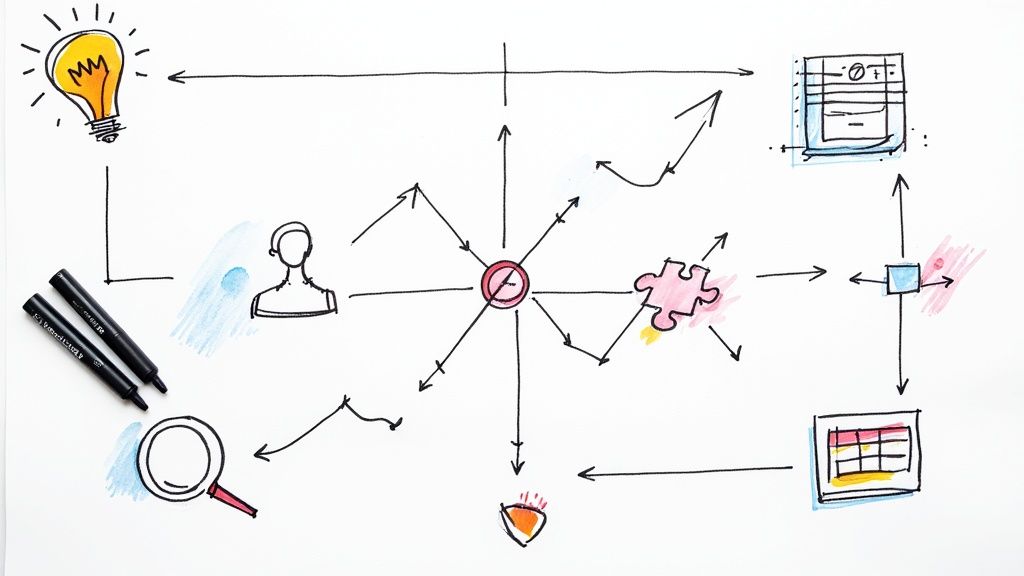
A real plan ensures every dollar and hour you invest pushes your business forward. It’s the difference between being busy and being effective. It all breaks down into three core phases: discovery, strategy, and execution.
This flow proves great marketing isn't about tactics. It's about sharp research and crystal-clear goals.
The Pillars of a Modern Marketing Plan
Before you write a word, understand the core components. These are the non-negotiable pillars of your plan. Without them, your strategy is built on sand.
Here’s a quick look at the core components of a modern marketing plan that wins.
Core Components of a Modern Marketing Plan
Component | What It Is | Why It Matters |
|---|---|---|
Market & Customer Research | The intel-gathering phase. Analyze competitors and get inside your customer's head. | Stops you from guessing. Ensures your message hits people who will actually buy. |
Goals & Objectives | Concrete definitions of success, tied directly to your financial targets. | Vague goals get vague results. Specific targets tell you exactly where to aim. |
Strategies & Tactics | The high-level "how" (e.g., content marketing) and the specific actions (e.g., writing blog posts). | This is where you connect vision to work. It turns your goals into a to-do list. |
Budget & Resources | A realistic look at what you can do with the time and money you have. | A plan without a budget is a daydream. This forces you to make smart, high-impact choices. |
Measurement & KPIs | The specific metrics (Key Performance Indicators) you'll use to track progress. | If you can't measure it, you can't improve it. KPIs tell you what's working so you can adapt. |
These elements create a powerful document that guides every decision.
A great marketing plan is a compass, not a script. It provides direction but allows for adjustments. The goal is clarity and focus, not a 50-page document nobody reads.
Map Your Market and Customer DNA
Winning means knowing the battlefield. Before you spend a dime, get inside the heads of your customers and competitors. This isn't about expensive reports; it's about scrappy, real-world intelligence.
A plan built on assumptions is a fantasy. Your mission is to swap guesswork for a rock-solid, evidence-based picture of your market. This ensures every move you make is strategic, targeted, and effective.
Uncover Competitor Playbooks
Your competitors are already spending money to figure out what works. Your job is to spy on them—ethically—and learn from their wins and losses. This isn't about copying. It's about finding their weak spots and the market gaps you can drive a truck through.
First, identify 3-5 direct competitors—companies selling a nearly identical product. Then, find 2-3 indirect or aspirational competitors—brands your customers already love.
Got your list? Start digging.
Deconstruct their messaging: What's their main promise? What pain points do they hammer on their homepage? This reveals their positioning.
Audit their content: Check their blog and social feeds. What gets the most comments, likes, and shares? That’s a massive clue about what your audience craves.
Examine their traffic sources: Use free tools to see where their visitors come from. Are they winning with SEO, or pouring cash into ads? This exposes their customer acquisition channels.
By reverse-engineering competitors, you spot proven tactics. More importantly, you find the unmet needs in the market. That's where you win.
Go Beyond Generic Target Audiences
"Target audience" is too vague. "A 35-year-old marketing manager" is a demographic, not a person. To create marketing that connects, you need detailed, actionable customer personas. This isn't about inventing a character; it's about creating a data-backed sketch of your ideal buyer.
A powerful persona digs into the motivations and frustrations of your customer. It helps you speak their language. Get this right, and your marketing will feel like it was made just for them.
Build Your Customer DNA Profile
You don't need a huge budget to build a killer persona. You just need empathy and detective work. Find where your ideal customers hang out online and listen.
Here are scrappy ways to gather real-world insights:
Scour Online Communities: Dive into Reddit subreddits, Facebook Groups, and niche forums. Note the exact language people use, the questions they ask, and the problems they complain about.
Read Customer Reviews: Analyze 1-star and 5-star reviews for your competitors. Negative reviews are a goldmine of pain points. Positive reviews tell you what people truly value.
Conduct Simple Surveys: Use a free tool like Google Forms to create a short survey. Ask 5-7 sharp questions about their biggest challenges and ultimate goals.
Pull this intel into a one-page doc for each customer type. To see this in action, check our guide on how to create buyer personas that drive results. This turns an abstract "audience" into a real person you can connect with.
Define Your Goals and Fuel Your Engine

A plan without clear goals is just a dream. Be brutally honest about what you want to achieve and what you're willing to commit to make it happen. Vague ambitions like "get more customers" are useless. You need specific, measurable targets tied to your bottom line.
Setting SMART Marketing Objectives
The SMART framework forces clarity. It moves you from fuzzy ideas to concrete commitments. Every marketing objective must be:
Specific: Nail down exactly what you want. Not "improve website," but "increase website lead conversion rate."
Measurable: Slap a number on it. "Increase conversion rate by 15%."
Achievable: Be ambitious but realistic. A 15% lift is a stretch; 500% is a fantasy.
Relevant: Ensure the goal pushes the business forward. Does it tie to revenue?
Time-bound: Give yourself a hard deadline. "Increase the conversion rate by 15% in the next quarter."
Suddenly, "increase brand awareness" becomes "Increase organic search traffic to key service pages by 25% over the next six months." Now that's a target you can build a plan around.
Your marketing goals are a filter. If a tactic doesn't help you hit a SMART objective, don't do it. Simple.
Tackling the Budget Head-On
A plan with no resources is as useless as a plan with no goals. You have to be ruthlessly efficient with every dollar. Stop thinking of your budget as an expense. It's fuel for your growth engine. Every dollar needs a job. First, understand how to create a marketing budget that aligns with your goals.
Don't spread a small budget thin. Focus is your superpower. Prioritize spending for maximum impact, now.
Prioritizing Your Marketing Spend
The question isn't "what can we do?" but "what must we do?" Your budget must reflect this urgency.
Here’s a practical way to think about it:
Foundational (Must-Haves): The non-negotiables. Website hosting, email platform, analytics. This is the plumbing. It has to work.
Growth Experiments (High-Impact Bets): Where you put real money behind the 1-2 channels you believe will drive the biggest results. This could be targeted ads, content creation, or SEO.
Future-Proofing (Nice-to-Haves): The smallest slice of the pie. Attending an event or trying a new tool.
The global digital ad market hit $733 billion in 2023, with search ads owning the biggest piece at $202.4 billion. This shows paid search is often a high-impact bet, but your research will determine if it’s right for you.
Deciding where to put limited funds is tough. Our guide on creating a marketing budget for startups offers frameworks for these hard choices. Remember, your budget isn't set in stone. It's a living document you adjust based on data.
Choose Your High-Impact Marketing Plays
You have goals and a clear picture of your customer. Now for the main event: picking your marketing strategies. This is where you decide how to grab attention and drive action. This isn't about doing everything. It's about being brutally selective.
Your most precious resources are time and focus. Spreading yourself thin across ten channels is a guaranteed path to burnout. Pick 2-3 high-impact marketing plays and execute them with precision.
Build Your Foundation with Content and SEO
Content Marketing and SEO are two sides of the same coin. Content is the value you create; SEO is how people find it. This combo is the ultimate long-term growth engine.
Content marketing isn't just blogging. It’s about becoming the go-to resource in your niche by answering your customers' most burning questions. SEO makes that content visible on Google. It's about understanding what your audience is searching for and creating the best answer. A solid SEO foundation delivers a steady stream of "free," high-intent traffic.
Don't overcomplicate SEO. It’s about understanding user intent and creating the best answer online. Your customer research is your secret weapon here.
Let's say you sell project management software. Your research shows customers Google "how to run effective team meetings." Instead of just talking about features, you create:
A killer blog post: "The Ultimate Guide to Cutting Meeting Time in Half"
A downloadable template: "Free Agenda Template for Productive Weekly Syncs"
A short video tutorial: "3 Common Meeting Mistakes and How to Fix Them"
This content attracts the right audience, solves a real problem, and tees up your software as the perfect solution.
Select Your Primary Distribution Channels
Great content is useless if no one sees it. Your channel strategy gets it in front of people. Your persona research already told you where your audience hangs out. Now, pick your spots.
Choose one or two channels where you can genuinely connect.
For B2B Startups: LinkedIn is a powerhouse. It’s perfect for sharing in-depth articles and networking. You build authority by sharing value, not sales pitches.
For B2C or Visually-Driven Products: Instagram or TikTok might be your best bet. Short-form video is incredible for showing a product in action and building a brand personality.
For Niche Communities: Don't sleep on Reddit or industry forums. These are goldmines for authentic conversation, as long as you add value instead of spamming links.
Don't Forget the Power of Email Marketing
Email marketing still delivers an average return of $36 for every $1 spent. It’s the only channel you truly own. You aren't at the mercy of an algorithm change. Your email list is a direct line to your most engaged audience.
Here’s how it all fits together:
Capture Leads: Use your content (guides, templates) as "lead magnets" to get email sign-ups.
Nurture Relationships: Set up a simple, automated email sequence to welcome new subscribers and build trust.
Drive Conversions: Use email to announce products, share case studies, or offer exclusive deals to drive sales.
Your plan needs specifics. Instead of "do content marketing," it should say, "Publish two SEO-focused blog posts per month and promote them on LinkedIn to drive email sign-ups." That clarity turns ideas into action.
Build Your Action and Measurement System
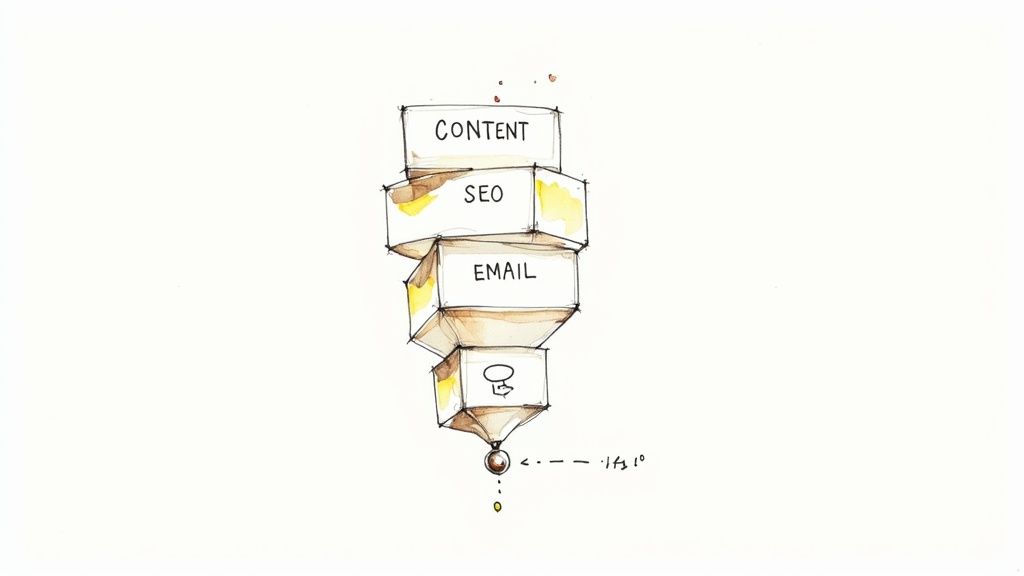
Strategy without execution is just talk. It’s time to turn your big ideas into a concrete plan of attack—and figure out if any of it is actually working. A great marketing plan is a living roadmap, guided by data, not gut feelings.
From Goals to a Practical Marketing Calendar
A goal like "Increase organic traffic by 25%" doesn't tell you what to do on Tuesday morning. Break these ambitions down into smaller initiatives and plot them on a marketing calendar.
Your calendar becomes the single source of truth. A simple spreadsheet works. The point is to map your strategic moves into quarterly and monthly chunks.
For a goal of generating 500 new leads from content:
Q1 Initiative: Launch a foundational "Pillar Page" and create three supporting blog posts.
February Goal: Publish two blog posts and create a downloadable checklist to capture emails.
Week 2, February: Draft the first blog post, design social graphics, and schedule LinkedIn promotion.
A massive goal just became a series of achievable tasks. This creates momentum. To streamline things, explore marketing automation strategies for small businesses.
Locking in Your Key Performance Indicators
If you can't measure it, you can't improve it. Key Performance Indicators (KPIs) are the specific metrics you track to know if you're on the right path. They help you cut through vanity metrics (like "likes") and focus on what drives growth. Your KPIs must tie directly to your SMART goals.
Don't drown in data. Pick 3-5 primary KPIs for your overall marketing and 1-2 specific KPIs for each campaign. This keeps you focused on what moves the needle.
It's easy to get lost. Over 80% of marketers use AI, meaning they're processing 230% more data than a few years ago. Choosing the right metrics has never been more critical.
Choosing Metrics That Matter
The KPIs you track depend on your goals. A brand awareness plan looks at different numbers than a sales-driven one. Match the metric to the mission.
Here’s a quick look at how to tie your goals to meaningful KPIs.
Essential KPIs by Marketing Goal
Match the right metrics to your marketing objectives to track what truly matters for business growth.
Marketing Goal | Primary KPIs | Secondary KPIs |
|---|---|---|
Increase Brand Awareness | • Website Traffic | • Social Media Engagement Rate |
Generate New Leads | • Number of New Leads (MQLs) | • Website-to-Lead Rate |
Drive Sales & Revenue | • Customer Acquisition Cost (CAC) | • Customer Lifetime Value (LTV) |
Improve Customer Retention | • Customer Churn Rate | • Net Promoter Score (NPS) |
Choosing the right metrics is fundamental. To go deeper, our guide on how to measure marketing ROI provides a detailed framework for connecting spend to revenue. This system gives your plan its power. It provides the structure for consistent work and the feedback loop for smart adjustments.
Common Marketing Plan Questions Answered

Even with a solid framework, questions pop up. Let's tackle the most common hurdles founders face. Getting these right is the difference between a plan that drives growth and one that gathers dust.
How Often Should I Update My Marketing Plan?
Think of your plan as a living document, not a stone tablet. For a startup, a quarterly review is non-negotiable. This is your chance to look at the data and see what’s working. It’s when you decide to double down or pivot.
A major overhaul should happen annually, aligning your marketing with bigger business goals. But the tactical side needs to be more fluid.
Monthly Check-ins: Are you hitting your KPIs? If not, reallocate resources.
Weekly Huddles: A quick sync-up to review tasks and clear roadblocks is crucial.
The key is agility. Your high-level strategy is your North Star, but your execution must be flexible.
What Is the Biggest Marketing Plan Mistake?
The single biggest mistake? Creating a plan in a vacuum. Too many founders build a strategy on assumptions instead of research. This leads to targeting the wrong people with the wrong message on the wrong channels. It's the fastest way to burn your cash.
The second-biggest mistake is making it too complex. A beautiful, 50-page document nobody reads is useless.
A concise, focused 5-10 page plan that is brutally clear and actionable is infinitely more powerful than a novel-length strategy. Action over aesthetics, always.
Your plan’s only job is to provide clarity and direction. Keep it lean and focused.
Can I Create a Plan with a Tiny Budget?
Absolutely. A plan is even more critical when your budget is tight. With limited funds, every dollar and hour must count. A plan forces you to make strategic choices instead of wasting resources on random acts of marketing.
A low-budget plan means shifting focus from paid ads to high-impact, low-cost strategies:
SEO: Creating valuable content that ranks in search is a long-term investment that pays dividends for years.
Content Marketing: You build immense trust by simply answering your audience's most pressing questions.
Community Building: Engaging in niche forums where your ideal customers hang out costs nothing but time and builds incredible loyalty.
Your plan helps you prioritize these organic channels and execute them with discipline.
Does My Marketing Plan Really Need a SWOT Analysis?
Yes. It's not just a business school exercise. A SWOT (Strengths, Weaknesses, Opportunities, Threats) analysis is your reality check. It forces you to be brutally honest about where you stand. It grounds your strategy by making you look at internal factors (strengths and weaknesses) and external realities (market opportunities and threats).
This process ensures your plan leverages your unique advantages while protecting you from risks. Without it, you’re just flying blind.
Ready to turn your ideas into a repeatable growth engine? At Viral Marketing Lab, we provide bootstrapped founders with the tools, templates, and actionable blueprints needed to build and execute a winning marketing plan. Get access to our curated resource hub and start growing smarter today.