10 Drip Marketing Examples to Steal for 2025
Stop guessing. Start converting. Drip marketing isn’t a nice-to-have; it’s your automated growth engine. It delivers the right message at the right moment, turning cold leads into loyal fans while you sleep. For lean startups, mastering this isn't just an advantage—it's a survival tactic. It’s your 24/7 sales team, your tireless customer onboarder, and your secret weapon for scalable growth.
Forget generic theory. We're diving deep into ten battle-tested drip marketing examples you can implement today. This is a tactical playbook, not a high-level overview. It’s designed to help you build your own automated revenue machine from the ground up.
Inside, you'll get actionable blueprints for:
Welcoming and onboarding new users to drive instant activation.
Nurturing leads with high-value content that builds unshakable trust.
Flipping trial users into paying customers.
Winning back inactive subscribers before they're gone for good.
Recovering abandoned carts to reclaim lost revenue.
Each example is a mini-playbook: strategy, timing, sample copy, and the KPIs that matter. We’ll show you exactly why they work and how to replicate their success. Let's build your growth engine.
1. Welcome Series Email Drip Campaign
Your welcome series is your digital handshake. It’s an automated sequence that fires the moment a user subscribes, registers, or buys. This is your single best shot to make a killer first impression, set expectations, and pull new leads deeper into your world—all while their engagement is at its peak.
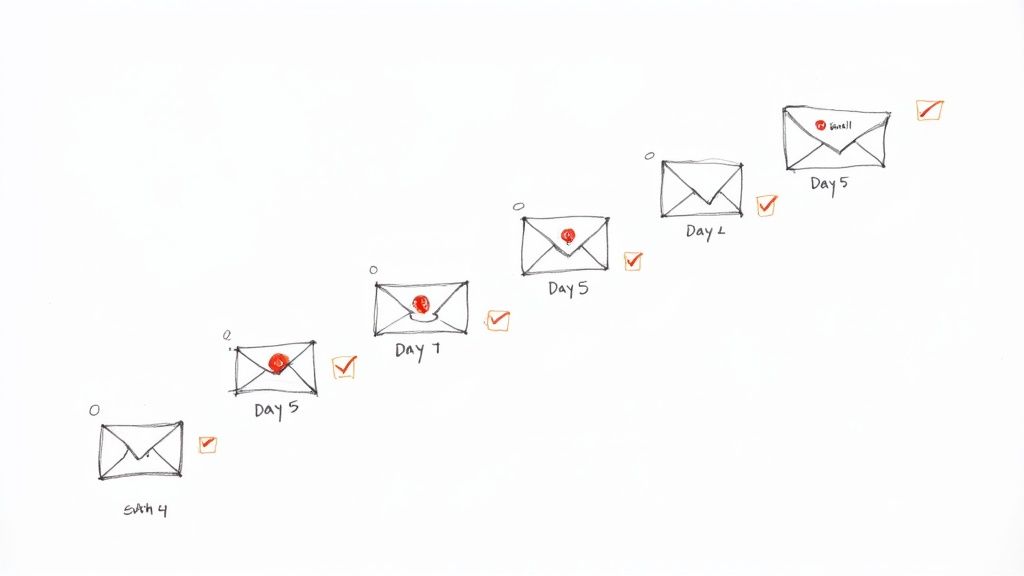
A single welcome email is a missed opportunity. A drip series lets you pace your intro, preventing user overwhelm while systematically building a relationship. It's a cornerstone of effective drip marketing examples, consistently delivering massive open rates and laying the groundwork for long-term loyalty.
Strategic Breakdown
A killer welcome series is more than "thanks for subscribing." It's an onboarding machine. It tells your story, hammers home your value, and segments users based on their first moves. Slack crushes this by using welcome emails to drive immediate product use, with each message highlighting a key feature to get users to their "aha!" moment faster. ConvertKit uses its sequence to teach creators how to win on the platform, engineering user success from day one.
Actionable Takeaways & Implementation
Build a welcome series that converts with this value-driven flow:
Email 1 (Immediate): Deliver the goods. Send the promised lead magnet, confirm the subscription, and give a warm welcome. Keep it short, sharp, and focused.
Email 2 (Day 2): Tell your story. Share your brand mission or a founder's note. Humanize your business. Build a connection.
Email 3 (Day 4): Deliver pure value. Offer a killer tip, a link to your best content, or a useful checklist. Build trust before you ask for anything.
Email 4 (Day 6): Drop a soft CTA. Invite them to follow you on social or explore a product category. For optimizing your initial subscriber journey, explore these 7 welcome email example strategies that can be integrated into your welcome series email drip campaign.
Email 5 (Day 7): Make the pitch. Now that you've built trust, you've earned the right to sell. Present your core offer with a clear, direct CTA.
2. Educational Content Drip Campaign
The educational drip campaign makes you the authority. It delivers a structured mini-course straight to a subscriber's inbox, proving your expertise before you ever ask for the sale. This automated sequence teaches them about a key topic, methodically building their knowledge and your credibility.
This is one of the most potent drip marketing examples for B2B, SaaS, and info-products. Stop telling leads you're an expert—show them. By educating your audience, you nurture them from curious to purchase-ready, arming them with the knowledge to see your solution's true value.
Strategic Breakdown
An effective educational drip is a curriculum, not a content dump. It guides a user from a specific pain point to your solution. This transforms your marketing from an interruption into a welcome lesson. HubSpot Academy masters this with free certification courses that teach marketing concepts while naturally showcasing the power of their software. Copyblogger has long used email courses on copywriting to build deep trust before ever mentioning a paid product.
Actionable Takeaways & Implementation
Build an educational series that nurtures with a clear learning path:
Email 1 (Immediate): Welcome to the course. Set expectations: what they'll learn and when. Deliver lesson one instantly.
Email 2 (Day 3): Teach the core concept. Introduce a foundational principle and provide a "quick win"—a simple tip they can apply now.
Email 3 (Day 6): Go deeper. Introduce a more advanced topic or a common pitfall. Include a checklist or worksheet to boost engagement.
Email 4 (Day 9): Bridge to your solution. Connect the lesson directly to how your product solves the problem faster or better. This is the soft pivot from educator to advisor.
Email 5 (Day 12): Stick the landing. Summarize the key lessons and present your offer as the logical next step, maybe with a "graduation" discount.
3. Product Launch Drip Campaign
A product launch drip campaign turns an announcement into an event. It's an orchestrated sequence that builds massive anticipation and drives a flood of day-one sales. This campaign uses teasers, behind-the-scenes content, and early-bird offers to maximize momentum right out of the gate.

A single launch-day email gets lost. This drip campaign systematically builds excitement, turning passive subscribers into enthusiastic first-day buyers. It's one of the most powerful drip marketing examples for ensuring your new offering makes the biggest possible splash.
Strategic Breakdown
A great launch campaign tells a story. It builds a narrative around the problem your product solves, creating demand before the solution even exists. Apple are the undisputed masters, turning every release into a global spectacle. SaaS companies like Notion use pre-launch emails to reveal new features piece-by-piece, building a waitlist of users primed to adopt the new functionality on day one.
Actionable Takeaways & Implementation
Engineer a launch that generates buzz and drives sales with this phased rollout:
Email 1 (3 Weeks Out - The Teaser): Announce something big is coming. Use curiosity-driven subject lines but keep the details under wraps.
Email 2 (2 Weeks Out - The Problem): Agitate the pain point your product solves. Make the problem feel urgent and relatable.
Email 3 (1 Week Out - The Reveal): Unveil the product. Showcase its core features with a video or GIF. Announce the official launch date and time.
Email 4 (Launch Day): The main event. Send a clear, direct email with a powerful CTA and a countdown timer to drive immediate action.
Email 5 (Post-Launch): Deploy social proof. Hit the fence-sitters with testimonials, case studies, or user-generated content to seal the deal. For a deeper dive, review this comprehensive product launch strategy template to structure your sequence.
4. Re-engagement/Win-Back Campaign
A win-back campaign is your automated system for reactivating dormant subscribers. This sequence targets users who have gone cold—no opens, no logins, no purchases—and aims to either bring them back or cleanly remove them to protect your sender reputation.
This is a high-leverage play. It's cheaper to reactivate an old customer than to find a new one. These drip marketing examples remind users of your value, reignite their interest, and can recover significant lost revenue.
Strategic Breakdown
A smart win-back campaign is more than a discount. It’s a strategic attempt to understand why they left. Netflix and Spotify master this by blending nostalgia ("We miss you!") with a showcase of new content the user has missed. They remind people what they loved and make it easy to come back. E-commerce platforms empower stores to personalize offers based on past purchases, dangling the perfect bait to lure customers back.
Actionable Takeaways & Implementation
Revive dormant accounts with this escalating sequence:
Email 1 (60+ Days of Inactivity): Start with a gentle nudge. Use a subject line like "Is everything okay?" or "We miss you." Remind them what's new. No hard sell.
Email 2 (Day 65): Provide pure value. Send your best new resource or case study. Re-establish your brand as a valuable signal in the noise.
Email 3 (Day 70): Make a compelling offer. Now's the time for a strong, time-sensitive incentive like a 15% discount or a free month.
Email 4 (Day 75): Send the "break-up" email. Politely inform them they're being removed from your active list. Give them one last chance to stay. This is critical for list hygiene.
5. Abandoned Cart Recovery Campaign
The abandoned cart campaign is an e-commerce money-printing machine. This automated sequence triggers when a user adds items to their cart but bounces without buying. It’s a high-intent, high-return sequence designed to nudge potential customers across the finish line.
This is one of the most profitable drip marketing examples any online store can run. You're not messaging a cold lead; you're talking to someone who was seconds away from giving you money. The goal is to remind them, address their concerns, and close the deal.
Strategic Breakdown
An effective abandoned cart sequence is more than a simple reminder. It overcomes common hurdles like price shock, distractions, or shipping costs. Shopify offers robust built-in tools for this, while platforms like Klaviyo allow deep customization. Retailers like Target excel by blending product reminders with social proof like star ratings or "popular item" tags to create urgency and build confidence. The key is making it frictionless to complete the purchase.
Actionable Takeaways & Implementation
Turn window shoppers into buyers with this multi-touch approach:
Email 1 (1 Hour Later): Send a simple, helpful reminder. Use a subject line like "Did you forget something?" Include clear images of the cart items and a massive button that links directly back to their pre-filled cart.
Email 2 (24 Hours Later): Re-engage with benefits or social proof. Include customer reviews or highlight your return policy to build trust and overcome objections.
Email 3 (48-72 Hours Later): Create urgency. Introduce a small, time-sensitive incentive like a 10% discount or free shipping. Frame it as their final chance.
6. Behavioral Trigger-Based Drip Campaign
Behavioral trigger-based drips obliterate time-based schedules. They send hyper-relevant messages based on what a user does—visiting a pricing page, downloading a specific resource, or clicking a link. This allows for extraordinarily contextual communication, meeting users exactly where they are.
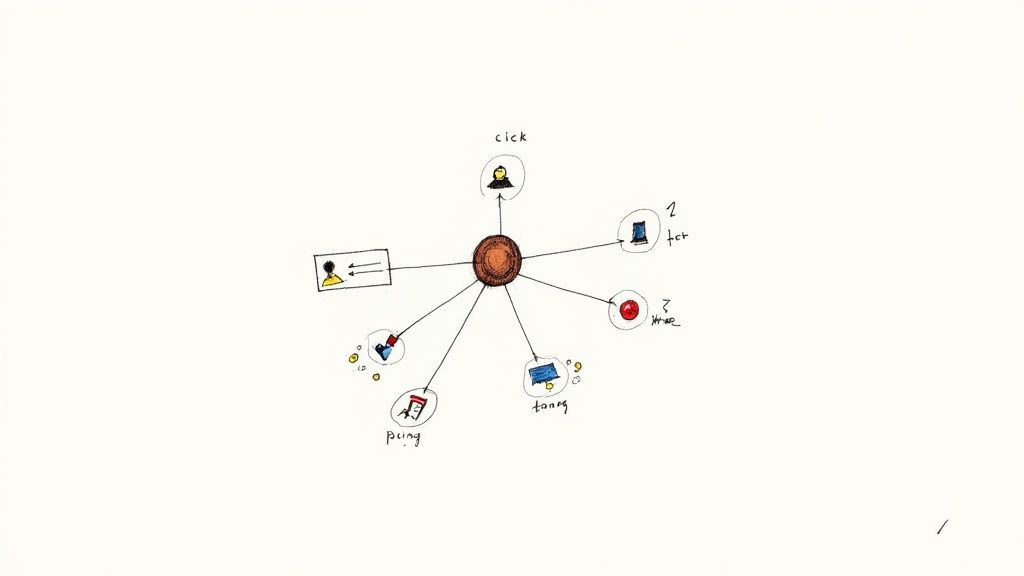
Unlike static sequences, this dynamic strategy ensures your message always hits the mark. It's one of the most sophisticated drip marketing examples, turning your email marketing from a monologue into a responsive dialogue. This real-time relevance skyrockets engagement and conversion rates by delivering the perfect message at the perfect moment.
Strategic Breakdown
An effective behavioral campaign identifies high-intent actions that signal a specific need. It's about connecting an action to an outcome. HubSpot and Intercom are masters of this. If a user repeatedly visits the "integrations" page, a triggered email showcasing a relevant case study will crush a generic newsletter. Airbnb sends post-booking sequences with local travel tips, triggered by a confirmed reservation, enhancing the experience and building loyalty.
Actionable Takeaways & Implementation
Implement a powerful behavioral drip by mapping key conversion points:
Trigger 1 (High-Intent Action): A user visits your pricing page three times in a week. Trigger an email offering a 15-minute demo or a pricing FAQ.
Trigger 2 (Content Engagement): A user downloads an ebook on "Advanced SEO." Enroll them in a 3-part drip series that offers more advanced SEO content.
Trigger 3 (Product Usage): A SaaS user activates a key feature for the first time. Send a congratulatory email with tips to get the most out of it. Drive deeper adoption.
Trigger 4 (Inactivity): A user hasn't opened your last five emails. Trigger a win-back email with a pattern-interrupt subject line like "Did we do something wrong?"
Trigger 5 (Link Click): A user clicks on a specific product category in your newsletter. Follow up 24 hours later with an email showcasing best-sellers from that exact category.
7. Nurture Campaign for High-Touch Sales
When the sales cycle is long and the deal size is huge, a generic drip won't work. The high-touch sales nurture campaign is a strategic, long-term sequence designed to build deep relationships with high-value prospects. It orchestrates emails, personalized content, and sales touchpoints over months, keeping your solution top-of-mind without being annoying.
This approach is a critical part of a sophisticated sales engine. It focuses on educating key decision-makers, establishing your brand as a trusted partner. As one of the most strategic drip marketing examples, it’s essential for businesses where trust and expertise are the real currency.
Strategic Breakdown
An effective high-touch nurture campaign is less a sales pitch and more a guided consultation. It systematically addresses complex pain points, delivering insights tailored to the prospect's industry and role. B2B giants like Salesforce master this by creating thought leadership funnels. They deliver industry reports and executive briefings that speak directly to a CIO's challenges, building credibility long before a demo is requested. The goal is to make the sales call feel like the natural next step.
Actionable Takeaways & Implementation
Construct a high-touch nurture sequence focused on personalization, value, and timing:
Months 1-2 (Awareness & Education): Start with high-level value. Think industry trend reports, webinars, and third-party validation like Gartner reports.
Months 2-4 (Consideration & Validation): Segment and personalize. Send targeted case studies that mirror the prospect's industry. Introduce content showcasing ROI. Have sales send a personalized LinkedIn connection request.
Months 4-6 (Decision & Handoff): High engagement (like downloading a whitepaper) should trigger a sales alert. The final emails can offer an executive briefing or a one-on-one strategy session, creating a warm handoff.
8. Trial/Freemium Conversion Drip Campaign
The trial conversion campaign is the engine of product-led growth. It's a targeted sequence sent to users during their free trial with one goal: persuade them to become paying customers. It’s a delicate balance of education, value reinforcement, and strategic selling designed to get users to their "aha!" moment and make upgrading a no-brainer.
This campaign is laser-focused on overcoming purchase friction. It answers the user's question: "Is this worth paying for?" This is one of the most critical drip marketing examples for any SaaS business because it directly connects user acquisition to revenue.
Strategic Breakdown
A powerful trial conversion drip feels like a guided tour from a product expert, not a sales pitch. It proactively highlights high-value features and shares success stories. Figma and Slack are masters of this, often triggering tips about a feature right after a user tries it. Dropbox triggers upgrade prompts when a user nears their storage limit, making the value proposition of a paid plan impossible to ignore.
Actionable Takeaways & Implementation
Build a trial conversion sequence that drives upgrades by focusing on value realization:
Email 1 (Day 1): Welcome them and set a clear goal. Guide them to perform the one action that demonstrates the product's core value.
Email 2 (Day 3): Showcase a key "pro" feature. Use a GIF to show how a similar user achieved a specific outcome with it.
Email 3 (Day 7): Send a milestone email. Celebrate their progress ("You've created your 5th project!") and suggest a next step involving a paid feature.
Email 4 (3 Days Before Trial Ends): Create urgency. Remind them the trial is ending and list the premium features they're about to lose.
Email 5 (Final Day): Make the final offer. Provide a clear CTA to upgrade, perhaps with a small, time-sensitive discount to close the deal.
9. Referral/Advocacy Drip Campaign
A referral campaign transforms your happiest customers into a powerful, automated growth engine. It’s a sequence designed to systematically encourage and reward users for bringing new customers into your ecosystem. This drip automates word-of-mouth marketing to scale user acquisition in a highly cost-effective and trustworthy way.
Unlike one-off requests, a drip series keeps the opportunity top-of-mind and makes sharing frictionless. It turns customer satisfaction into tangible referrals. This is one of the most powerful drip marketing examples for startups because it taps into social proof and builds a viral loop directly into your product.
Strategic Breakdown
An effective referral drip is more than a link and a reward. It's about identifying advocates, simplifying sharing, and celebrating their success. Dropbox famously nailed this by offering extra storage to both the referrer and the new user—an incentive perfectly aligned with their product's value. Uber and Airbnb built their empires on referral programs that provided immediate credits, making the first ride or stay irresistible.
Actionable Takeaways & Implementation
Build a referral campaign that generates momentum by focusing on simplicity and mutual benefit:
Email 1 (Triggered by Positive Action): Trigger the campaign after a positive signal, like a high NPS score or a repeat purchase. Introduce the referral program and highlight the "what's in it for you" for both parties.
Email 2 (3-5 Days Later): Make sharing effortless. Provide a pre-written message and one-click sharing buttons for email and social.
Email 3 (10-14 Days Later): Showcase social proof. Share a short story from another customer who successfully referred a friend.
Email 4 (Ongoing): Send transactional updates. Notify the referrer when a friend signs up or a reward is earned to reinforce the behavior. You can find more advanced referral marketing strategies to integrate into your sequence by exploring these viral marketing program tactics.
Email 5 (Quarterly): Re-engage top referrers with a new tiered reward or a limited-time bonus.
10. Post-Purchase/Customer Onboarding Drip Campaign
The post-purchase drip is where a sale becomes a relationship. It's an automated sequence triggered after a purchase, designed to ensure customers successfully adopt and find value in your product. This campaign is critical for killing buyer's remorse, slashing churn, and maximizing customer lifetime value.
Unlike a simple "thank you," a post-purchase series proactively crushes the learning curve. By breaking down setup and features into digestible steps, you empower customers to win. This is one of the most powerful drip marketing examples for SaaS and tech companies because it directly impacts retention.
Strategic Breakdown
An effective onboarding sequence is about teaching, not selling. It builds momentum and confidence from day one. Notion excels at this, sending new users emails that highlight specific use cases and templates, encouraging immediate engagement. Stripe gives developers a clear implementation path with code snippets and API docs, ensuring a smooth technical onboarding.
Actionable Takeaways & Implementation
Create an onboarding campaign that sticks by delivering quick wins:
Email 1 (Within 1 Hour): Send an enthusiastic welcome. Confirm the purchase, provide login details, and give them one high-impact "first step."
Email 2 (Day 2): Introduce a core feature with a short video tutorial. Celebrate this small win to build momentum.
Email 3 (Day 4): Share a pro-tip. Show them how to get more out of the product, moving them from novice to pro.
Email 4 (Day 7): Connect them to the community. Invite them to a user forum or Slack group. To dive deeper into building a frictionless start for your users, explore these user onboarding best practices that can supercharge your campaign.
Email 5 (Day 14): Ask for feedback. Inquire about their experience and offer a direct link to support, showing you value their input.
10 Drip Marketing Campaigns Compared
Campaign | Implementation Complexity 🔄 | Resource & Tech Needs ⚡ | Expected Outcomes 📊⭐ | Ideal Use Cases 💡 | Key Advantages ⭐ |
|---|---|---|---|---|---|
Welcome Series Email Drip Campaign | Low–Medium 🔄: simple time-sequence, needs A/B testing | Minimal ⚡: basic ESP, templates, signup data | High engagement ⭐⭐⭐⭐; open rates ~40–50% 📊 | New subscribers, SaaS onboarding, creators 💡 | Immediate brand connection; cost‑effective; easy to personalize ⭐ |
Educational Content Drip Campaign | Medium 🔄: curriculum design and pacing | High ⚡: content production, downloads, assessment tools | Builds authority & long-term engagement ⭐⭐⭐; slower conversion 📊 | B2B, online courses, lead nurturing 💡 | Trust & qualification; better qualified leads at conversion ⭐ |
Product Launch Drip Campaign | Medium–High 🔄: timing coordination across phases | High ⚡: creative assets, PR, segmented lists | Generates buzz and traffic spikes ⭐⭐⭐; strong early sales impact 📊 | New product releases, DTC & tech launches 💡 | Creates urgency; maximizes launch impact and pre-orders ⭐ |
Re-engagement / Win‑Back Campaign | Low–Medium 🔄: inactivity triggers, short sequence | Low–Medium ⚡: segmentation, incentives, surveys | Moderate recovery ⭐⭐; re‑engagement ~12–20% 📊 | Lapsed customers, list hygiene, subscription services 💡 | Recovers revenue; improves deliverability; collects feedback ⭐ |
Abandoned Cart Recovery Campaign | Low 🔄: immediate cart triggers, few emails | Medium ⚡: e‑commerce integration, product images | Very high ROI ⭐⭐⭐⭐; recovers ~10–30% carts 📊 | E‑commerce retailers, shopping platforms 💡 | Targets ready‑to‑buy users; high ROI per dollar spent ⭐ |
Behavioral Trigger‑Based Drip Campaign | High 🔄: complex branching, real‑time rules | High ⚡: advanced automation, clean data, CRM integration | High relevance & conversions ⭐⭐⭐⭐; superior ROI 📊 | Product‑led SaaS, data‑driven marketing, personalization 💡 | Hyper‑personalization; efficient, contextual engagement ⭐ |
Nurture Campaign for High‑Touch Sales | High 🔄: long cycles, multi‑channel coordination | High ⚡: sales alignment, bespoke content, events | Higher deal values & close rates ⭐⭐⭐; long sales cycle 📊 | Enterprise B2B, ABM, high‑value prospects 💡 | Builds deep relationships; improves sales efficiency & qualification ⭐ |
Trial / Freemium Conversion Drip Campaign | Medium 🔄: milestone mapping, usage tracking | Medium–High ⚡: product analytics, segmentation | Good conversion potential ⭐⭐⭐; 2–5% avg (10–30% optimized) 📊 | SaaS with free trials/freemium models 💡 | Targets warm users; measurable lift in paid conversions ⭐ |
Referral / Advocacy Drip Campaign | Medium 🔄: program design, tracking & rewards | Medium ⚡: referral platform, incentives, fraud controls | High‑quality leads & LTV increase ⭐⭐⭐⭐; higher retention 📊 | Viral products, strong customer bases, community growth 💡 | Lowest CAC; high conversion and lifetime value from referrals ⭐ |
Post‑Purchase / Customer Onboarding Drip Campaign | Medium 🔄: time‑sensitive flows, CS coordination | Medium–High ⚡: how‑to content, videos, support links | Reduces early churn ⭐⭐⭐⭐; first 30 days critical for retention 📊 | New customers across SaaS & e‑commerce, product adoption 💡 | Accelerates time‑to‑value; improves satisfaction and retention ⭐ |
From Examples to Execution: Your Next Move
You've just dissected ten powerful drip marketing examples. You now have a playbook for building an automated growth engine. The common thread is simple but potent: deliver the right message to the right person at the right moment.
The power isn't in knowing these campaigns exist; it's in understanding why they work. Strategic timing, psychological triggers, and precise segmentation are what turn a simple email sequence into a revenue machine. This is the difference between sending emails and building relationships at scale.
Key Insights to Carry Forward
As you move to implementation, lock in these core principles:
Segmentation is Non-Negotiable: One-size-fits-all fails. Success hinges on segmenting your audience by behavior, lifecycle stage, or intent. A lead who downloaded an ebook needs a different conversation than a trial user about to expire.
Timing is Everything: The delay between emails isn't random. It's strategic. A cart abandonment sequence must be fast. A long-term nurture campaign must be patient. Match the user's decision-making pace.
Value Before a-sk: Deliver genuine value—an educational resource, a pro-tip, a success story—before you ask for the sale. Build trust first, then present your offer as the logical solution.
Your Actionable Blueprint for Implementation
Knowledge without action is worthless. Translate these drip marketing examples into results. Don't try to build all ten campaigns at once. Get focused.
Identify Your Biggest Bottleneck: Where are you leaking growth? Converting sign-ups? Retaining customers? Pick the one drip campaign that solves your most painful problem right now.
Launch a Minimum Viable Drip (MVD): You don't need a perfect 12-email sequence. Map out a simple 3-4 email flow. Write the copy, set the triggers, and go live. Perfection is the enemy of progress. Get data flowing.
Master the Open: Your automation is useless if no one reads it. The subject line is everything. To maximize impact, mastering compelling email subject lines is non-negotiable. Craft subject lines that demand to be opened.
Measure, Analyze, Iterate: Track your KPIs relentlessly. Open rates, click-throughs, conversions, unsubscribes. Use this data to find weak links, test new ideas, and continuously optimize your system.
The best marketers treat their drip campaigns as living systems, not static assets. They test, learn, and refine constantly. Adopt this mindset, and you'll transform email automation from a marketing tactic into a core driver of sustainable, predictable growth. Your engine is ready. Turn the key.
Ready to skip the learning curve and deploy proven campaigns immediately? Viral Marketing Lab provides a complete arsenal of ready-to-use drip marketing templates, copy-and-paste sequences, and strategic cheat sheets designed specifically for lean startups and entrepreneurs. Stop building from scratch and start growing faster by visiting Viral Marketing Lab to access our full library today.