Decoding Social Media Marketing Cost: What's the Real Price?
Trying to pin a single number on social media marketing cost is like asking, "How much for a bag of groceries?"
The real answer? It depends on what you put in the cart.
You could spend anywhere from $200 to over $50,000 a month. For most small businesses hiring an agency or freelancer, the starting line is between $900 and $2,500 per month. That's just for management—ad spend is a separate line item.
Your final price tag hinges on your business size, goals, and the exact services you need to win.
Your Quick Guide To Social Media Marketing Costs
So why the massive range? Because "social media marketing" isn't a product; it’s a custom strategy. What a local coffee shop needs is worlds away from what a national e-commerce brand requires.
Think of it like buying a car. You could get a reliable used sedan to get from A to B. Or, you could spring for a luxury SUV loaded with every bell and whistle. Both are cars, but the experience, features, and price are night and day. Your social media budget determines the horsepower of your campaign.
Breaking Down the General Numbers
To get a clearer picture, let's break down costs by business size and service depth. Startups need foundational work. Big companies need complex, multi-platform strategies to move the needle.
Here’s a quick breakdown of what businesses typically spend per month on management fees (again, this excludes your ad budget):
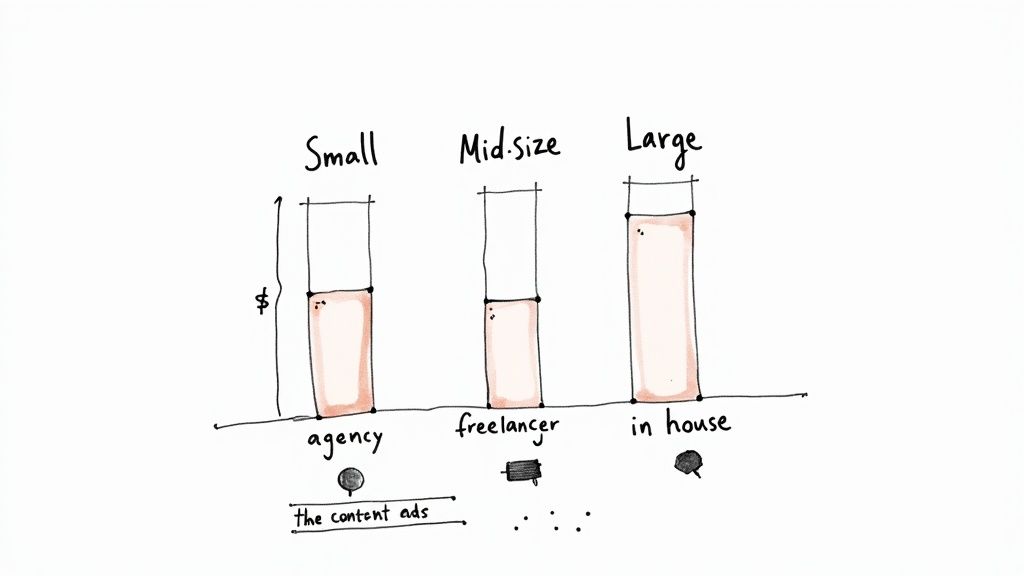
Small Businesses & Startups: $900 - $2,500 per month. This covers content for one or two key platforms, basic community management, and monthly reports.
Mid-Sized Businesses: $2,500 - $7,500 per month. This budget unlocks more platforms, advanced content like video, and proactive strategies to actually grow your audience.
Large Enterprises: $7,500+ per month, often hitting $20,000 or more. We're talking full-funnel strategies, influencer campaigns, and deep-dive analytics across every channel.
If you're just starting out, our guide to social media marketing for beginners will help you master the core principles before you spend a dime.
A Clearer Look at Service Levels
Let's get specific. To give you an actionable idea of where your money goes, we can break down costs by service scope. This helps you match your budget to real outcomes.
This table lays out the common service tiers you'll find when hiring an agency or freelancer.
Typical Monthly Social Media Marketing Costs By Service Level
Service Level | Typical Monthly Cost Range (Agency/Freelancer) | Key Services Included |
|---|---|---|
Basic Management | $900 - $2,000 | Content creation for 1-2 platforms, scheduling, basic community engagement, and monthly performance reports. |
Standard Growth | $2,000 - $5,000 | Everything in Basic, plus ad campaign management (ad spend is extra), video content, and proactive audience growth tactics. |
Comprehensive Strategy | $5,000 - $10,000+ | All-inclusive services: multi-platform strategy, advanced analytics, influencer marketing, and dedicated strategic guidance. |
Stop seeing this as an expense.
Key takeaway: Your budget isn't a cost; it's an investment in reaching your ideal customer. A higher budget doesn't just mean more posts—it means more strategy, better content, and smarter targeting.
So, what are you actually paying for? Your social media budget isn't one big, mysterious number. It’s a mix of four essential parts. Once you see how they fit together, the investment makes perfect sense.
Think of it like building a custom car. You wouldn't ask, "How much for a car?" You'd break it down. You need the chassis (strategy), the engine (ad spend), the slick paint job (content), and the high-tech diagnostic tools (software). Skimp on one part, and the whole machine suffers.
Content Creation: The Visuals That Stop the Scroll
Your content is the first thing people see. It’s your hook, your handshake, your first impression. This is where your brand’s personality shines. Cutting corners here is like showing up to an interview in sweatpants—it sends the wrong signal.
Good content isn't an accident, and it's not free. The cost comes down to quality and complexity. Simple branded graphics are affordable. A full-blown video shoot or custom animations are a real investment.
Here’s what drives this cost:
Graphic Design: Creating sharp static images, infographics, and carousels that nail your brand's look.
Video Production: From quick smartphone Reels to professionally shot and edited brand stories.
Copywriting: Writing captions and ad copy that grab attention and drive action is a real skill.
Photography: Professional product shots or lifestyle photos make your brand look leagues better than stock photos ever could.
Remember, platforms reward high-quality content. A recent study found that 58% of US shoppers bought something after seeing it on social media. That journey starts with content that makes them stop and look.
Ad Spend: The Fuel for Your Campaigns
If content is the car, ad spend is the gas. Without it, you’re not going far. Organic reach is dead. You have to pay to get your content in front of a new, targeted audience.
Actionable Insight: Ad spend isn't a fee you pay your agency. It's the budget you give directly to platforms like Meta or LinkedIn to show your ads to people. It's a direct investment in getting seen.
Your ad spend could be $15 a day for a small local test or over $50,000 a month for a national push. This is the most flexible part of your budget. Crank it up or dial it back based on what’s working.
Management and Strategy: The Brains of the Operation
This is the human element—the strategic thinking that makes everything work. It’s the most valuable part of your investment. You’re not paying someone to schedule posts; you're paying for expertise.
This piece covers all the critical thinking:
Strategy Development: Nailing down your goals, target audience, and best platforms.
Campaign Management: Setting up, monitoring, and tweaking ad campaigns to make every dollar work harder.
Community Engagement: Actually talking to people. Responding to comments builds real connections.
Analytics and Reporting: Digging into the data to see what’s working, what’s not, and how to get better results.
Hiring an expert here—an agency or a freelancer—stops you from throwing money away on a doomed strategy. Their job is to maximize the return on your content and ad spend.
Essential Tools: The Tech That Makes It All Happen
You can't run a modern social media machine without the right tech. These tools automate tasks, deliver deeper insights, and make the whole process smoother. While some have free versions, professional-grade software comes with a subscription.
These costs are often rolled into an agency's retainer, but if you're DIY-ing it, you’ll need to budget for them. Key tools include:
Scheduling Platforms: Think Hootsuite, Buffer, or Sprout Social.
Analytics Software: Tools that go deeper than the platforms' native analytics.
Design Tools: Canva Pro or the Adobe Creative Suite.
Listening Tools: Software that tracks brand mentions and industry conversations.
Each of these four pillars—Content, Ad Spend, Management, and Tools—is a vital part of your total social media marketing cost. Understand how they work together, and you'll build a smarter budget.
Comparing Ad Costs Across Major Platforms
Not every social platform fits every business. Their ad costs reflect that. Picking where to spend your ad budget is like choosing the right tool for a job. A sledgehammer is powerful, but it’s the wrong choice when you need a scalpel.
To invest smart, you have to understand the financial landscape. Social media ad costs boil down to two key metrics: Cost Per Click (CPC)—what you pay when someone clicks—and Cost Per 1,000 Impressions (CPM)—the price for a thousand people to see your ad.
These numbers swing wildly depending on who you're targeting and what you want them to do.
This infographic breaks down the four core components of your total social media marketing cost.
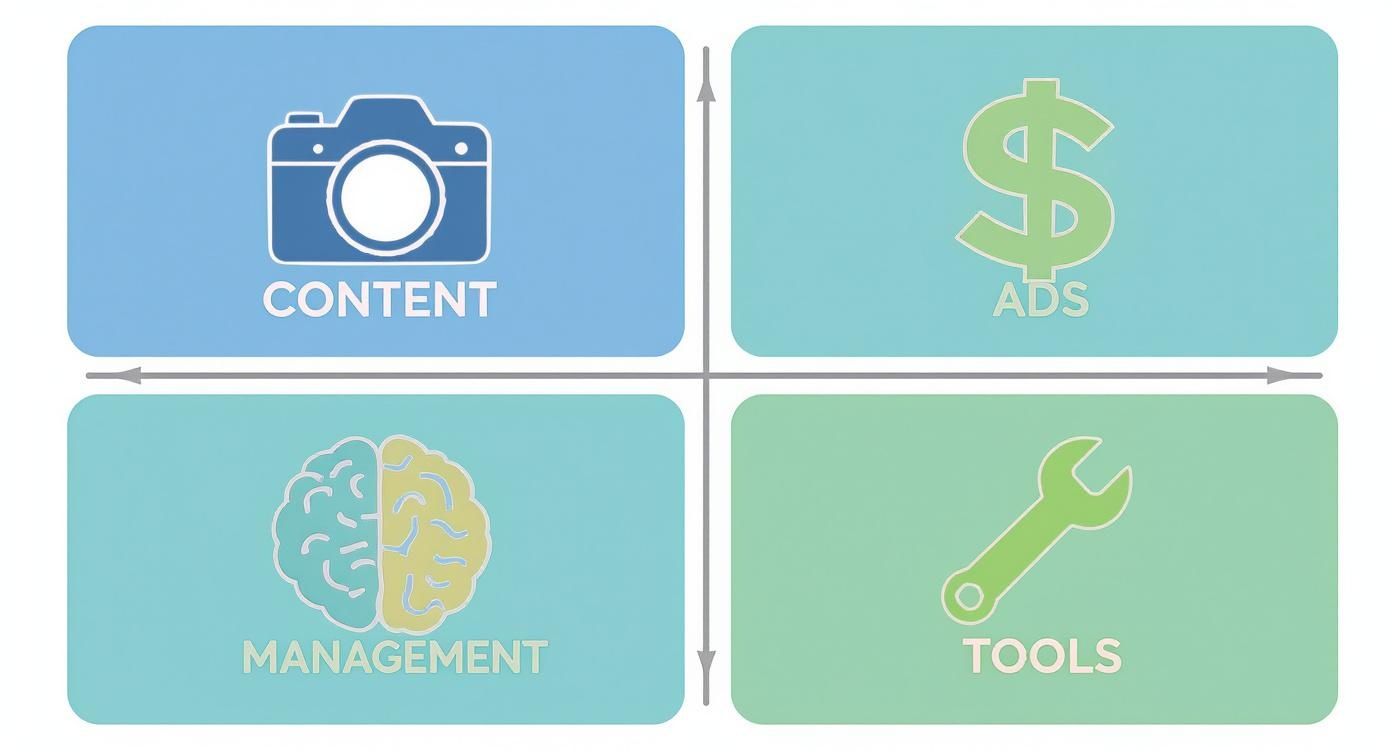
As you can see, your budget is split into Content, Ads, Management, and Tools. Ad spend is just one piece of the puzzle.
Let's look at how average costs stack up across the big players.
Average Ad Costs Across Major Social Media Platforms
This table compares the average CPC and CPM for leading social networks, helping you decide where to allocate your budget.
Platform | Average CPC (Cost Per Click) | Average CPM (Cost Per 1,000 Impressions) | Best For |
|---|---|---|---|
$1.10 | ~$7 | B2C, E-commerce, Local Businesses | |
$1.10 | ~$7 | Visual-heavy B2C, Influencer Marketing | |
$5 - $6 | $20+ | High-ticket B2B, Lead Generation | |
TikTok | ~$1 | ~$10 | Mass-market B2C, Brand Awareness |
YouTube | ~$3 | ~$7 | B2C/B2B Storytelling, Product Demos |
These are just averages. Your actual costs will depend on your industry, audience, and ad quality. But it's a solid starting point for understanding where your money goes furthest. You can dive deeper into these benchmarks and ROI strategies over at Quimby Digital.
Meta Ads: Facebook and Instagram
For most businesses, Meta (Facebook and Instagram) is the go-to starting point. Its massive user base and granular targeting make it a versatile and affordable choice, especially for B2C.
Whether you're selling custom t-shirts or promoting a local bakery, Meta lets you zero in on your ideal customer. That precision stops you from wasting money on people who were never going to buy anyway.
LinkedIn Ads: The B2B Investment
If you're in B2B, LinkedIn isn't just an option; it's often the best option. This is where you connect with decision-makers and industry leaders. That direct line to a high-value audience is why it’s the priciest platform.
Think of it this way: a single LinkedIn click could lead to a $50,000 software contract. The potential return on one B2B lead justifies the higher upfront cost.
While a $6 click can be jarring, it’s a strategic investment. You’re paying a premium to get your message directly in front of the people who sign purchase orders.
Here’s why that cost makes sense for B2B:
Hyper-Specific Targeting: Target users by job title, company size, industry, and seniority.
High-Intent Audience: Professionals on LinkedIn have a business mindset, making them receptive to B2B offers.
Premium Ad Formats: Features like Sponsored InMail land your message directly in a prospect's inbox.
TikTok Ads: For Mass-Market Reach
TikTok is the king of short-form video and a direct line to younger demographics. Its algorithm is brilliant at serving users content they'll love, creating a massive opportunity for advertisers to go viral.
The vibe on TikTok is authenticity and entertainment. The best ads don't feel like ads. This makes it a fantastic playground for brands with a strong personality looking to connect with a broad consumer audience.
Compared to LinkedIn, TikTok is incredibly cost-effective for reaching tons of people, fast. With a CPM around $10, you can get your brand in front of a huge audience without breaking the bank. It's the perfect choice for e-commerce, mobile apps, and entertainment companies chasing mass visibility.
YouTube Ads: For Capturing Attention
YouTube blends the visual power of TV with the targeting of digital marketing. As the world's second-largest search engine, it's where people go to learn and be entertained—a prime spot for your brand.
Ad costs on YouTube fall in the middle of the pack. Its real strength is its diverse ad formats, like pre-roll ads that grab attention right before a user’s chosen video. This format is perfect for storytelling and showing a product in action, making it a powerful tool for any brand that shines visually.
The Influencer Marketing Investment
Let's be honest: the best marketing doesn't feel like marketing. It feels like a genuine recommendation from someone you trust. That's the magic of influencer marketing.
Instead of interrupting someone's feed, you partner with creators they already follow. It’s a simple shift from interruption to endorsement, and the results speak for themselves.
Data shows that for every dollar a brand invests in an influencer campaign, they get an average of $5.78 back. Why? Trust. A staggering 61% of consumers trust influencer recommendations more than traditional brand ads.
Decoding Influencer Tiers And Costs
Ready to budget for an influencer campaign? The cost isn't just about follower count; it’s a mix of reach, engagement rate, and audience niche.
Bigger isn't always better. Here’s the breakdown:
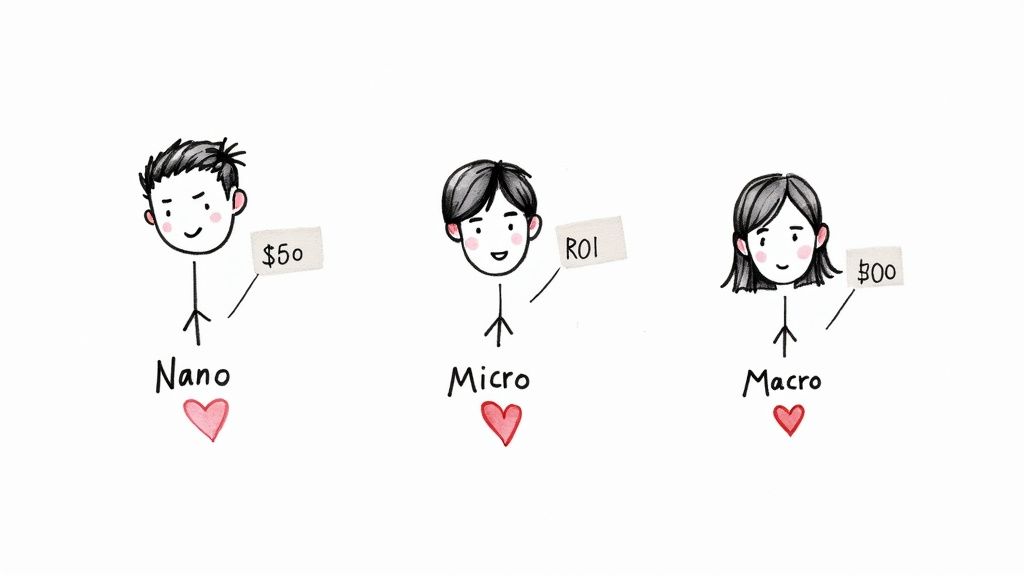
Nano-Influencers (1k - 10k followers): These are grassroots champions with small but mighty communities. They might work for free products or charge $10 - $100 per post.
Micro-Influencers (10k - 100k followers): This is the sweet spot. A fantastic blend of solid reach and authentic engagement. Expect to pay $100 - $1,000 per post.
Macro-Influencers (100k - 1M followers): Established social media personalities. A single post can run $1,000 - $10,000+.
Mega-Influencers (1M+ followers): These are the celebrities of social media. Costs start at $10,000 and can skyrocket past $1 million.
The key takeaway? Micro-influencers often deliver the most bang for your buck. They hit an average engagement rate of 3.86% on Instagram, blowing the 1.21% seen by macro-influencers out of the water. For a deep dive, check our guide on influencer marketing for small business.
Common Pricing Models For Influencers
Once you’ve picked your tier, you need to figure out how to pay them. There's no universal rate card.
The right model depends on your goals—are you chasing awareness, sales, or just great content?
Actionable Insight: Your negotiation should be about value, not just cost. A micro-influencer with a hyper-engaged, targeted audience is often a smarter financial move than a macro-influencer with millions of passive followers.
Here are the main pricing structures:
Pay-Per-Post/Video: The most straightforward approach. You pay a flat fee for specific content. It's clean, predictable, and great for budgeting.
Campaign Fee (Bundles): Package deals for a series of posts over time. Think two Instagram posts and five Stories for a single, often discounted, price.
Commission/Affiliate Model: A performance-based play perfect for driving sales. You give the influencer a unique code and pay them a cut of every sale they generate.
Gifting/Product Seeding: Especially useful for nano-influencers. Send free products in exchange for an honest review. A cost-effective way to get your foot in the door.
To dig deeper into how these fees are structured, review common influencer platform pricing models. Knowing these helps you build partnerships that work for your budget and goals.
Choosing Your Management Model
Deciding who runs your social media is one of the biggest levers you can pull on your total cost. It’s about choosing the right operational engine for your brand. Will you hire an agency, bring on a freelancer, or build your own team?
Each path comes with its own price tag, benefits, and hidden complexities. The right choice means looking beyond the monthly invoice to what truly works for your long-term goals.
Hiring A Social Media Agency
Think of an agency as a pre-built marketing department on demand. You get instant access to a team of specialists—strategists, copywriters, designers, and ad managers—for a single monthly retainer. This model is perfect for businesses that need comprehensive expertise and want to scale fast without the hiring headaches.
Agency retainers typically range from $2,000 to $10,000+ per month. While that might sound high, it's often cheaper than building an in-house team with the same diverse skillset.
Key advantages:
Instant Expertise: Tap into years of collective experience from day one.
Access to Premium Tools: Agencies already pay for expensive software, saving you that overhead.
Scalability: Easily scale services up or down as your needs change.
The trade-off? An agency won't be as deeply embedded in your company culture. But for pure, results-driven execution, they are tough to beat.
Contracting A Freelancer
Hiring a freelancer is like bringing in a specialist for a specific job. It's a flexible, affordable option, ideal for businesses that have a strategy but need an expert to execute a piece of it.
Freelancers usually charge in two ways:
Hourly Rates: $50 to over $200 per hour, based on experience.
Project-Based Fees: A flat rate for a defined project, like setting up an ad campaign.
This model is a lifesaver for startups managing costs tightly. You pay only for the work you need. The challenge is management. Juggling multiple freelancers can become a job in itself, and ensuring a consistent brand voice requires more oversight.
The choice between an agency and a freelancer boils down to this: Do you need a full orchestra or a brilliant solo musician? One provides a complete sound, while the other offers specialized mastery.
Building An In-House Team
Bringing social media in-house is the ultimate investment in brand control. This means hiring your own employees to live and breathe your brand every day.
While it offers unmatched brand alignment, it's also the most expensive route. It's not just salary. The true costs include:
Salaries: A social media manager's salary can range from $50,000 to $90,000+ per year.
Benefits: Health insurance and retirement plans add another 20-30% on top of the base salary.
Overhead: Don't forget costs for equipment, office space, and software subscriptions.
This approach makes sense for larger companies where social media is a core part of the business. The deep integration can lead to incredible authenticity, but the high fixed costs make it a serious commitment.
How To Build And Justify Your Budget
A budget is just a number on a spreadsheet until you prove its worth.
The trick isn't just spending money; it's investing it wisely. That means having a clear plan for every dollar and connecting your social media costs directly to business results. It’s about moving the conversation from “we spent X” to “we invested X and got Y back.”
The easiest way to start is by pegging your budget to your business's overall health. Two simple models give you a solid jumping-off point.
Simple Formulas To Start Budgeting
A go-to method is the percentage of revenue approach. Most companies set aside 5% to 15% of their total revenue for all marketing. If your company brings in $1 million a year, your total marketing budget is $50,000 to $150,000.
From that pot, you carve out a slice for social media. For a deeper dive, check out these marketing budget allocation best practices.
Another powerful method is working backward from your goals. If a new customer is worth $500, and you want 100 new customers from social media this year, that’s $50,000 in value. Suddenly, you have a clear ceiling on what you can spend to acquire them.
Proving The Value Of Your Investment
Putting the budget together is half the battle. Justifying it is the other, more important half. To do that, you have to track the right metrics.
Forget vanity metrics like follower counts and likes. To prove value, focus on Key Performance Indicators (KPIs) that speak the language of business growth: revenue, customers, and profit.
This is where knowing how to measure social media ROI becomes non-negotiable. It shifts the conversation from "How many likes did we get?" to "How much revenue did this campaign drive?"
Here are the KPIs that actually matter:
Conversion Rate: What percentage of people who clicked your ad bought something or filled out a form? This is the ultimate gut-check.
Cost Per Acquisition (CPA): How much did it cost to win one new customer? If your CPA is $50 and your average sale is $200, you’re printing money.
Customer Lifetime Value (CLV): The holy grail. CLV measures the total money a customer is expected to spend with your brand over their entire relationship.
Actionable Insight: Tracking CLV changes the game. It lets you justify a higher upfront acquisition cost. If you know a customer acquired for $100 will end up spending $2,000 over three years, that initial investment looks incredibly smart.
Justifying your budget means telling a story backed by data. It's about showing that social media spending isn't an expense—it's a direct driver of growth.
Got Questions? We've Got Answers.
When it comes to the dollars and cents of social media marketing, questions pop up. We've tackled the most common ones to help you finalize your budget with confidence.
How Much Should A Small Business Spend Per Month?
A smart starting point for most small businesses is $900 to $2,500 per month for management fees, plus your ad budget.
This range is the sweet spot. It's enough to get a pro team handling your content and running initial ad campaigns, but not so much that you break the bank. It's the perfect investment to build real momentum.
Are Social Media Ads Really Worth The Money?
Absolutely. With organic reach at an all-time low, paying for ads is the only way to guarantee your message gets in front of a fresh, targeted audience.
Think of it this way: Organic posts are like talking to customers already in your shop. Paid ads are like a massive billboard on the busiest highway, pulling new people straight through your doors. You need both to grow.
What Are The Most Common Hidden Costs?
Great question. Hidden costs usually sneak up in three places. Factor these into your budget.
Premium Tools: Monthly subscription fees for scheduling, analytics, and design software add up fast.
Content Production: Need a professional video shoot or product photographer? That’s often a separate line item from your management fee.
Ad Testing: A chunk of your initial ad spend is for testing. You have to experiment to find what works. It's a crucial investment that doesn't always bring in sales right away.
How Long Does It Take To Actually See An ROI?
You'll see surface-level metrics like clicks and impressions almost immediately. But for the numbers that really matter—leads and sales—expect it to take 3 to 6 months.
This gives your marketing partner enough time to collect data, find your best audience, and fine-tune your campaigns until they’re running like a well-oiled machine. Patience is key. Social media is a long game, not a lottery ticket.
Ready to stop guessing and start growing? Viral Marketing Lab provides the blueprints, tools, and templates you need to build a cost-effective marketing machine that gets real results. Explore our resources at https://viralmarketinglab.com and accelerate your startup's growth today.