Build a Marketing Automation Workflow That Actually Converts
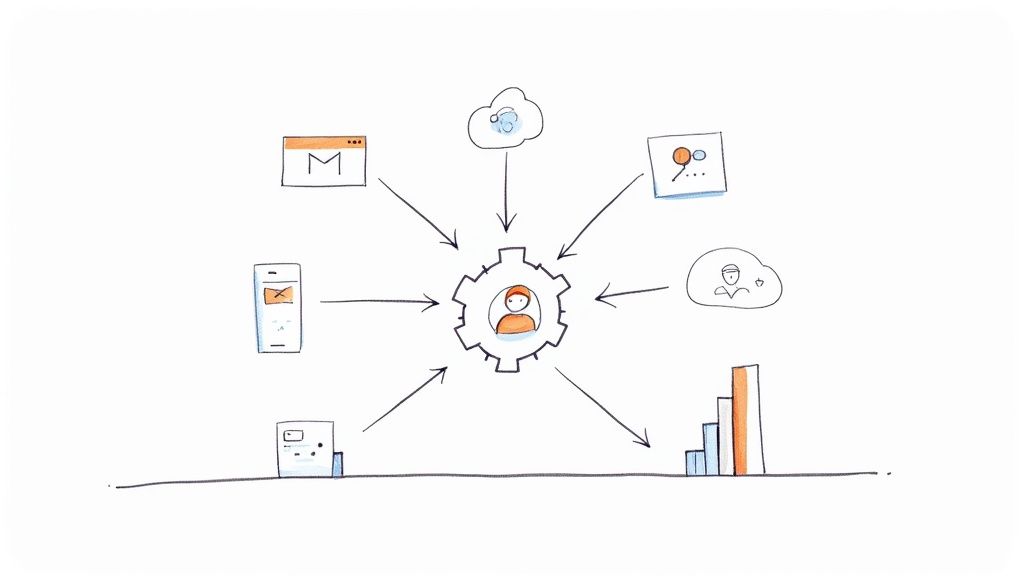
A marketing automation workflow is your secret weapon for growth. It’s a series of automated actions that hits the right person with the right message at the right time—all triggered by their behavior.
Think of it as your digital marketing engine, humming 24/7 to nurture leads and delight customers. All without you lifting a finger for every single interaction.
Ditch Manual Marketing For Good
Let’s be real: manual marketing is a time-sucking vortex. Juggling welcome emails, following up with webinar attendees, and chasing down abandoned carts is exhausting.
This is precisely where a sharp marketing automation workflow becomes a game-changer.
Instead of your team drowning in repetitive tasks, automation frees them for high-level strategy and creative wins. The impact is immediate. A simple welcome series, for instance, instantly engages new subscribers and proves the power of a system that runs itself. This isn't about losing the personal touch; it's about scaling it.
Let's break down the real-world difference.
Manual vs. Automated: A Quick Takedown
It’s one thing to talk theory, but seeing the contrast side-by-side makes the advantage of automation undeniable. This table shows just how much effort, time, and opportunity you reclaim when a workflow handles the grunt work.
Aspect | Manual Approach | Automated Workflow |
|---|---|---|
Effort | High; constant staff intervention for every task. | Low; set it once, and it runs on autopilot. |
Consistency | Prone to human error and brand inconsistencies. | Delivers a consistent, on-brand experience every time. |
Scalability | Impossible to scale without bloating your payroll. | Scales effortlessly as your audience explodes. |
Timing | Delayed responses based on team availability. | Instant, real-time engagement 24/7. |
Personalization | Generic, one-size-fits-all messaging. | Hyper-personalized based on user data and behavior. |
The takeaway is simple: manual tasks cap your growth. Automated workflows build the foundation for it.
The Unstoppable Power of Automated Engagement
The shift to automation isn't a trend; it's a fundamental change in how businesses connect with people. To master this, you must first understand the core of digital marketing automation. This approach delivers the personalized experiences customers now demand, all while making your team brutally efficient.
The market growth tells the story. Projections show the marketing automation industry rocketing from $5.65 billion in 2024 to an insane $14.55 billion by 2031.
With 75% of organizations already using some form of automation, this is no longer optional—it's table stakes.
Here's what a simple, yet lethal, welcome sequence looks like in the wild.
This workflow fires the moment a user subscribes, instantly sending a welcome email and then branching out based on their next move.
Why Smart Workflows Always Win
A smart workflow doesn't just send messages; it nurtures relationships. By reacting to user actions—like visiting a pricing page or downloading a PDF—it delivers relevant content that pushes them closer to a decision.
The magic of a marketing automation workflow is its ability to create a consistent, personal journey for every single lead, no matter how they find you. No one falls through the cracks. Ever.
Ultimately, this strategic shift builds a more robust and scalable marketing operation. To dive deeper, explore the concrete benefits of marketing automation for businesses ready to grow. It’s the key to working smarter, not harder.
Map Your Workflow Before You Build a Single Thing
Jumping into your automation tool without a plan is a recipe for disaster. I've seen it a hundred times. You end up with a tangled mess of a workflow that confuses your team and fails your audience.
Think of this step as drawing the blueprint before you pour the foundation.
First, define one crystal-clear goal. Vague objectives like "increase engagement" are useless. Get specific. "Convert webinar attendees into booked product demos." That's a goal. "Onboard new customers to slash churn by 15% in their first 30 days." That's a goal. A sharp, measurable objective guides every single decision you make next.
This infographic nails how automation transforms marketing from a chore into a growth engine.
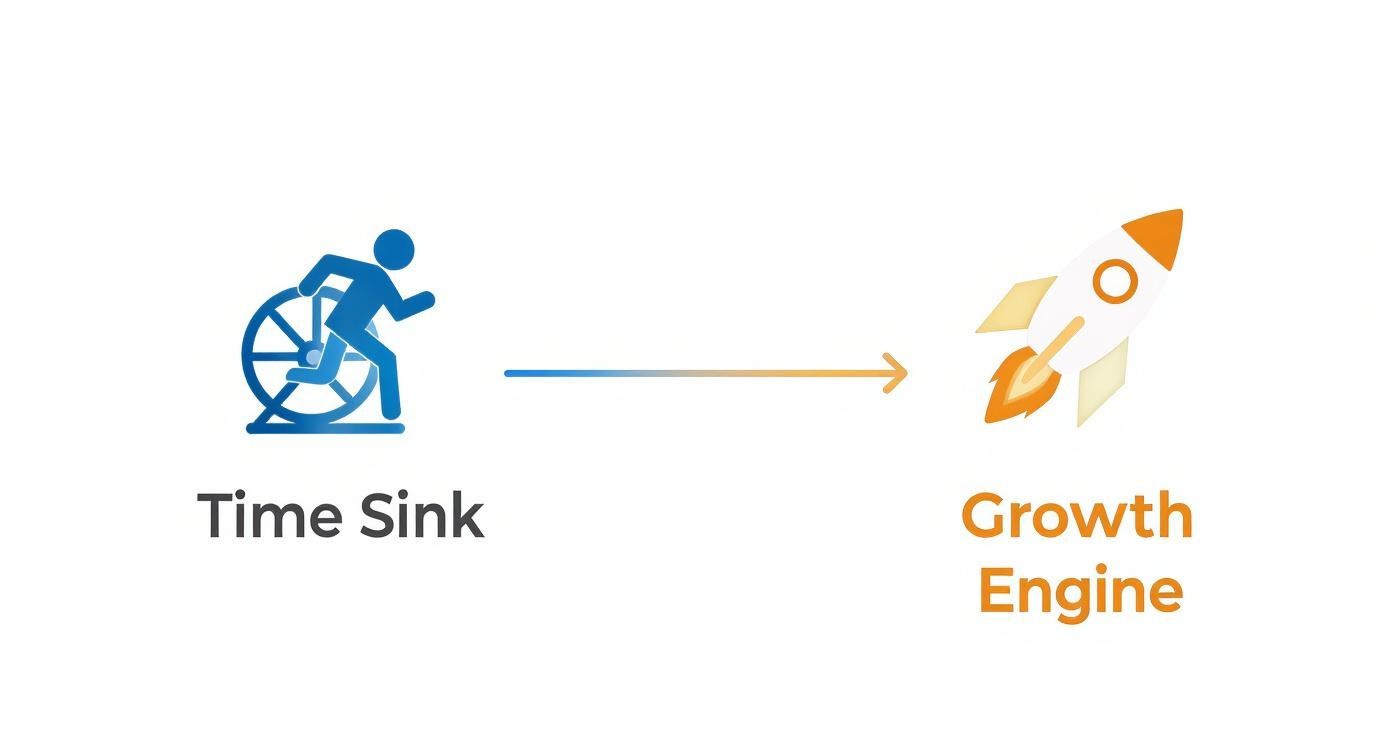
The contrast is stark. A well-planned marketing automation workflow turns that manual grind into scalable, repeatable success.
Define Your Audience and Triggers
With a goal locked in, zero in on who you're talking to. Blasting the same message to everyone is a rookie move. Smart automation is built on sharp segmentation. Group users based on their behavior, their stage in the customer journey, or how they found you.
Someone who just downloaded a top-of-funnel ebook is in a different universe than someone who requested a quote. Your messaging must reflect that. To nail this, our guide on powerful customer segmentation techniques is required reading.
Next, pinpoint the triggers—the specific actions that kick off your workflow. This "if this, then that" logic is the beating heart of automation.
Classic examples:
Behavioral Trigger: A user hits your pricing page three times in one week.
Action: Automatically send a personal email from a sales rep offering to answer questions.
Time-Based Trigger: It's been 30 days since a customer last purchased.
Action: Send a friendly "we miss you" email with a small incentive to return.
The secret to a killer marketing automation workflow: map out every "if/then" scenario before you log into your software. This strategic foresight prevents chaos and makes your automation feel personal, not robotic.
Blueprint a Webinar Follow-Up Sequence
Let's get practical with a real-world scenario: a webinar follow-up.
Our goal: convert attendees into qualified leads. The audience splits into two segments: people who showed up, and those who registered but bailed.
Trigger: The webinar ends.
Segment 1 (Attendees): Immediately get an email with the recording and a genuine "thank you." Two days later, a follow-up hits their inbox with a case study tied directly to the webinar's topic.
Segment 2 (No-Shows): Immediately get a "sorry we missed you" email, also with the recording. Three days later, send them an email highlighting the top three takeaways from the session to reignite their interest.
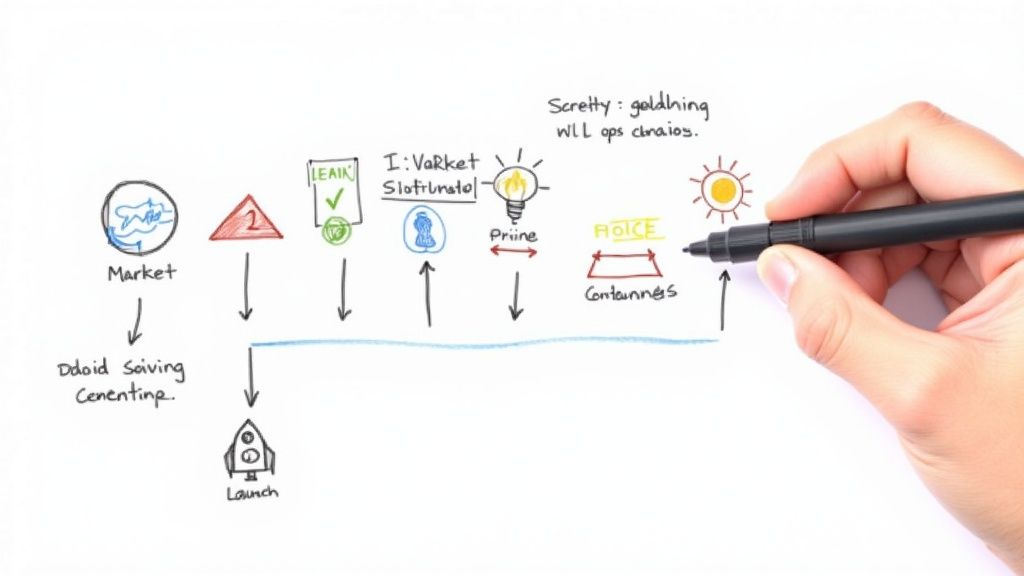
Sketching this on a whiteboard makes the sequence easy to visualize and critique. This is the planning that delivers insane ROI—some companies see up to a 451% increase in qualified leads from automated nurturing alone. It works.
Nail Your Triggers and Actions
You've got the blueprint. Now it's time to bring it to life in your automation tool. This is where the magic happens.
Every marketing automation workflow, no matter how complex, runs on one simple principle: if a user does this (the trigger), your system automatically does that (the action).
Think of triggers as digital tripwires your customers cross. A form submission is a classic trigger, but the real power comes from listening to subtle behavioral cues.
Instead of waiting for a hand-raise, set triggers for high-intent behaviors that reveal what they're really thinking.
A prospect checks your pricing page for the third time this week.
A shopper abandons a full cart at checkout.
A loyal customer hasn't logged in for 60 days.
These behavioral triggers are pure gold. They signal intent, hesitation, or disengagement, letting you swoop in with the perfect response.
Connect Triggers to Smart Actions
Once a trigger fires, the action must be just as strategic. An "action" isn't just "send an email." It's delivering the most relevant experience at that exact moment. An abandoned cart trigger, for instance, demands an automated email that can claw back a huge chunk of that lost revenue.
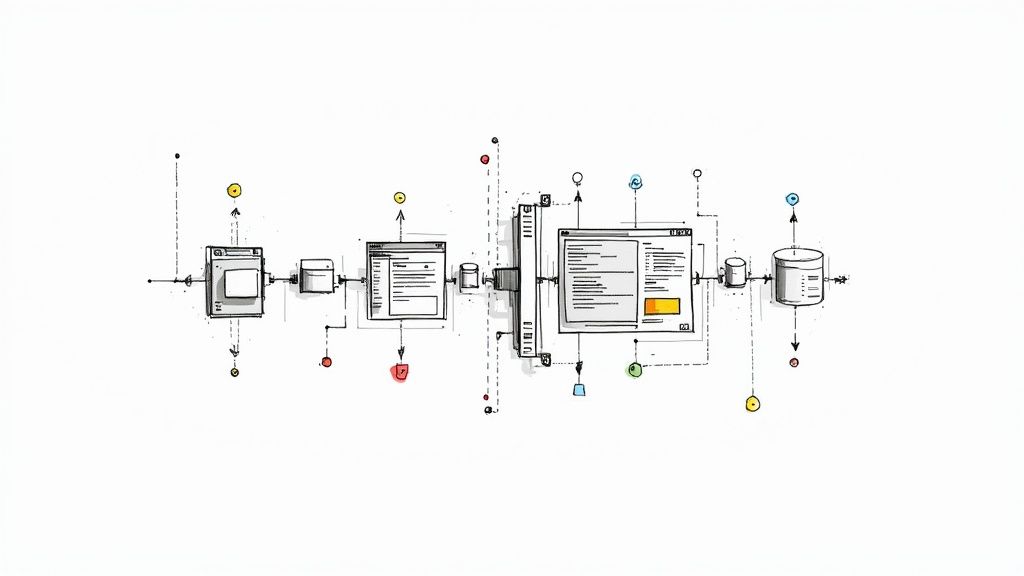
Here’s what this looks like in practice—a simple but potent sequence kicked off by a single trigger.
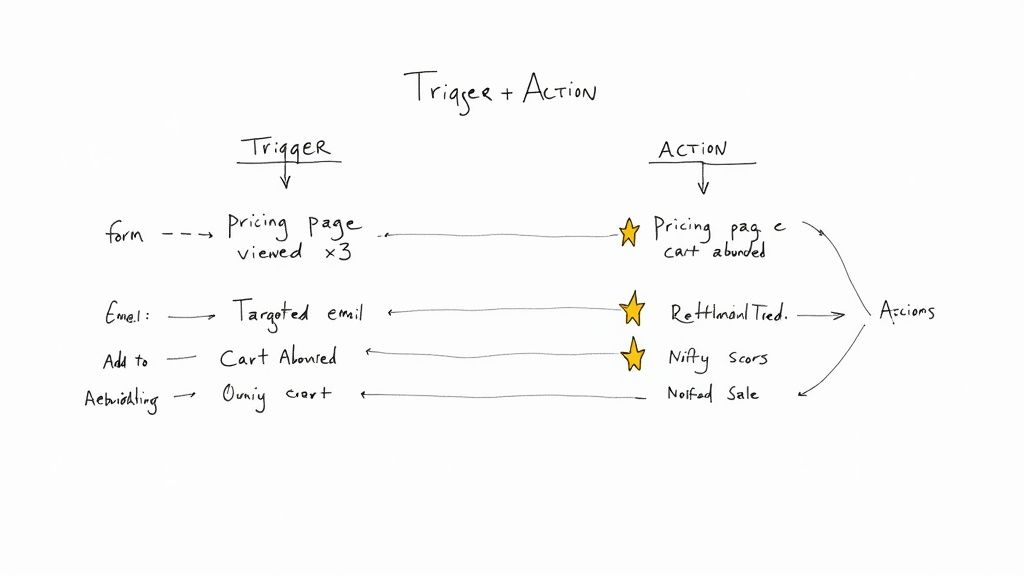
This map shows how one trigger (a form submission) can start a cascade of events: send an email, wait a few days, then check for a click before deciding the next move.
The goal is a chain of events that feels helpful, not pushy. Diversify your actions.
Send a Hyper-Targeted Email: Stop the generic blasts. If someone viewed your "enterprise" page, send them a case study from a similar company. Dive deeper into how email marketing automation works for more ideas.
Update a Lead Score: A user who downloads a whitepaper and attends a webinar is hotter than a new subscriber. Your system must automatically bump up their lead score in your CRM.
Alert a Sales Rep: When a lead score passes a certain threshold, fire an internal notification to sales. That's their cue to pick up the phone.
Add to a Retargeting Audience: If someone shows strong interest but doesn't convert, add them to a custom audience for a gentle ad campaign on Facebook or LinkedIn to stay top-of-mind.
The secret is matching the action's intensity to the trigger's intent. A casual blog reader doesn't need a sales call. Someone who just requested a demo does. This alignment separates smart automation from spam.
The Critical Role of Timing and Delays
Finally, timing. The dead air between your actions is just as important as the actions themselves. Hammering a new lead with five emails on day one is the fastest way to an unsubscribe.
Build strategic delays into your workflows. After the welcome email, wait two days before sending a helpful follow-up. For an abandoned cart, a reminder an hour later is great. A second one 24 hours later might be even better.
These pauses give your message room to breathe and let your audience act.
Align Content with Each Workflow Stage
An automated workflow without killer content is an empty shell. I've seen it a hundred times: a technically perfect sequence falls flat because the messages are generic, boring, or tone-deaf to the user's journey.
This is where content mapping becomes your secret weapon.
You must align specific content with each stage of the journey. A brand-new subscriber needs a completely different message than someone who visited your pricing page three times this week. Sending the wrong thing at the wrong time guarantees an unsubscribe.

Get this right, and every automated message delivers real value. Your workflow will feel personal and helpful, not robotic and intrusive.
Audit and Place Your Content Strategically
Before you slot content into your workflow, you need to know what you have. A quick content audit isn't a week-long project. It's a simple inventory of your assets.
List your best content and categorize it by its job and funnel stage.
Top-of-Funnel (Awareness): Educate, don't sell. Think blog posts, checklists, intro guides, or short videos.
Middle-of-Funnel (Consideration): Showcase expertise. This is where you deploy in-depth webinars, detailed case studies, expert interviews, and product comparisons.
Bottom-of-Funnel (Decision): Close the deal. Use free trial offers, demo invitations, customer testimonials, and clear pricing guides.
With your inventory ready, start slotting these assets into your workflow.
The goal is a seamless journey where each piece of content logically leads to the next. It's a conversation—you wouldn't ask for a sale before you've introduced yourself.
Map Content to a Welcome Workflow
Let's make this real. Here’s how you map content for a new subscriber's marketing automation workflow. The goal: build trust and guide them toward your solution.
Immediate Trigger (Subscribes): Send a welcome email with your most popular, high-value blog post. This is a low-commitment piece that delivers instant value.
Delay 3 Days (If opened Email #1): Follow up with a compelling case study. This shifts from "what" to "how," showing a real-world success story that builds credibility.
Delay 4 Days (If clicked case study): Offer deeper value. Send an invite to a relevant, on-demand webinar. This asks for more time but offers a bigger payoff.
Final Step (If watched webinar): They're warm. Time for the bottom-of-funnel offer. Send a direct invitation to book a demo or start a free trial.
This tiered approach respects the user's journey. Remember, welcome emails have a stunning 34.1% open rate. Wasting that first touchpoint with a hard sell is a massive missed opportunity. Educate first. The sale will follow.
Launch, Test, and Optimize Relentlessly
You built the workflow. It looks perfect. But hitting "activate" isn't the finish line—it's the starting gun. Now the real work begins.
Before a single real user enters your sequence, you have to break it. Intentionally. Run rigorous tests on every possible path.
Don't just hit the "send test" button. Create dummy contacts and push them through each branch. Did the personalization tag work? Did the case study link go to the right place? Do the time delays feel natural, or are they awkward?
Catching a broken link now is a five-minute fix. Finding it after it's been sent to 5,000 people is a brand-damaging fire drill you don't want.
Move Beyond Vanity Metrics
Once your workflow is live, the game shifts from functionality to performance. It's easy to obsess over open and click-through rates. They aren't worthless, but they don't tell the whole story.
The metrics that define a successful marketing automation workflow are tied directly to your original goal. Track what actually moves the needle.
Goal Conversion Rate: Forget clicks. What percentage of people who entered the workflow actually booked the demo or made the purchase? This is your North Star.
Stage-Specific Unsubscribe Rates: Is one email causing a mass exodus? A spike in unsubscribes at a specific point is a massive red flag that your message is off.
Time to Conversion: How long does it take for a new lead to convert? If you can shorten this cycle, you've found a major win.
The most powerful optimization insight comes from where people drop off. A workflow isn't just a path to success; it's a diagnostic tool showing you exactly where your message is breaking down.
Focusing on these deeper metrics helps you diagnose problems with surgical precision. A high open rate but a pathetic conversion rate on your final email doesn't mean your subject line is weak—it means your offer isn't compelling enough.
The A/B Testing Mindset
Continuous optimization is systematic testing. Guesswork has no place here. The goal is small, iterative improvements that compound over time, turning a good workflow into a marketing machine.
A/B testing is your best friend. Isolate one variable at a time to get clean, actionable data.
Not sure where to start? Test these:
Subject Lines: Pit a direct, benefit-driven line against a creative, curiosity-piquing option. See what grabs attention.
Calls to Action: Does a short, punchy email outperform a longer one? Does "Book a Demo" convert better than "See It in Action"? Test it.
Timing and Delays: The pause between messages is a powerful tool. Test waiting two days versus four. You might find more breathing room boosts conversions.
This isn't about finding a single "perfect" formula. It's about adopting a mindset of constant refinement. A disciplined approach to testing is what separates a static sequence from a dynamic, high-converting machine.
Got Questions? Let's Talk Workflow.
Even with a solid game plan, your first foray into marketing automation will throw you some curveballs. That's normal. Let's tackle the most common questions marketers ask when they're getting their hands dirty.
My goal: straight, no-fluff answers so you can get unstuck and build with confidence.
How Do I Pick the Right Software?
It’s easy to get distracted by shiny features. The best tool is the one that matches your goals. The biggest mistake is buying a powerful platform you don't know how to use. Don't do it.
Before you even look at pricing, grab a whiteboard. Sketch out your dream workflow. What are the non-negotiable triggers and actions you need? Then find the software that brings it to life without torching your budget.
For simple email sequences: Mailchimp or ConvertKit are brilliant places to start. They're intuitive and effective.
For complex logic & CRM integration: When you need more muscle, platforms like ActiveCampaign or HubSpot offer powerful, scalable solutions.
For enterprise-level needs: For massive, intricate campaigns, tools like Marketo or Pardot (now Marketing Cloud Account Engagement) are built for that scale.
Pro tip: always check integrations. Your automation software must play nice with your CRM, website, and e-commerce platform, or you’re signing up for a world of headaches.
What's the Biggest Mistake People Make?
Hands down: obsessing over the "automation" while forgetting the "marketing." I’ve seen teams build incredibly sophisticated workflows that are technical marvels... filled with generic, impersonal content.
That's how you create a robotic experience that repels the exact people you’re trying to connect with. The tech is just the delivery truck; the content is the package they actually care about.
The point isn't to automate tasks. It's to scale a personal, valuable journey. Always start with the customer experience and your content strategy, then find the tech to execute it.
Never let the tool dictate your strategy. A simple two-email workflow with hyper-relevant content will crush a complicated one with bland messaging every single time.
How Often Should I Tweak My Workflows?
A marketing workflow is a living part of your business, not a "set it and forget it" machine. You can't launch it and ghost it. Markets change, customer needs shift, and your business goals will look different in six months.
Your automations must evolve with them.
A quarterly check-in is a great rhythm. Spend an hour on your key metrics. Are conversion rates solid? Is one email causing a huge spike in unsubscribes? These quick reviews let you make data-backed tweaks before a small crack becomes a big problem.
Beyond that, do a deeper, strategic review at least once a year. Step back and ask the big question: "Does this workflow's core purpose still align with our main company objectives?" As your business grows, your automation must grow with it. This regular maintenance ensures your campaigns stay sharp and effective.
Ready to stop guessing and start growing? At Viral Marketing Lab, we give bootstrapped founders the exact tools, blueprints, and cheat sheets they need to build marketing systems that actually work. Get the actionable resources you need to accelerate your startup's growth at https://viralmarketinglab.com.