How to Write a Press Release That Actually Gets You Noticed
Want to write a killer press release? Nail these three things: find a truly newsworthy angle, write a headline a journalist can't ignore, and structure the story so they get the point in seconds. This isn't about making an "announcement"—it's about telling a compelling story that fits their beat.
Why Press Releases Still Matter for Startups
Let's be real: in a world of endless social media feeds, does a press release even matter anymore?
Yes. But not for the reasons you think. Ditch the idea of a dry corporate announcement blasted into the void. Today, a sharp press release is a lethal, low-cost tool for any startup. It’s your shot at controlling your brand's narrative and ensuring your key message lands perfectly. When a journalist covers your story, your release becomes their primary source—a massive win for message control.
Build Instant Credibility and Authority
For a new startup, credibility is currency. A press release isn't just news; it's a stamp of legitimacy.
Getting your story on established media sites—even niche industry blogs—builds immediate trust with customers, partners, and investors. It screams that you’re a serious player. When multiple outlets pick up your story, you build a digital footprint that reinforces your expertise long after the initial buzz fades.
Drive SEO and Online Visibility
Beyond the media hype, a press release is a powerful SEO weapon.
Every piece of coverage from a reputable site usually nets you a high-authority backlink. To Google, these are votes of confidence that directly boost your website's domain authority, helping you climb the search rankings for keywords that matter. The release itself is also searchable, giving your brand more chances to pop up in Google News and standard search results.
Stop treating a press release like a one-off event. It's a permanent asset. The backlinks and search visibility it creates deliver value for months, even years.
Generate Real Business Results
Forget "getting your name out there." A modern press release drives measurable impact.
The data doesn't lie. 68% of businesses report that press releases directly boosted their brand visibility. Better yet, the average release delivers a stunning ROI of 100–175% within 90 days. To see how these numbers apply to your strategy, dig into the effectiveness of data-driven PR.
Integrate press releases into your broader startup content marketing strategies. This turns a simple news item into a genuine business driver, ensuring every announcement supports your growth goals.
The Anatomy of a Modern Press Release
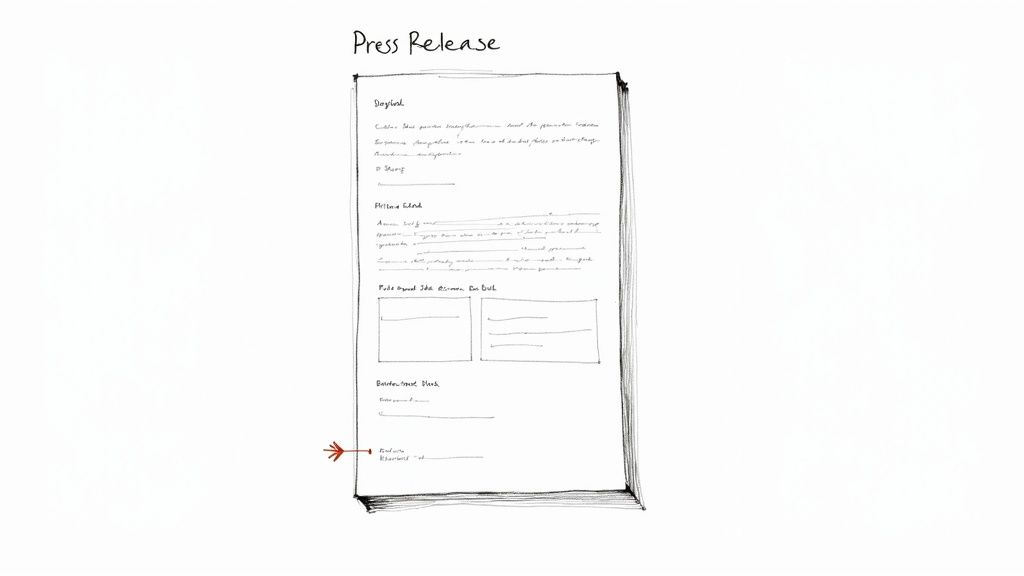
Think of your press release as a story blueprint. Every component has a job. Get it right, and you're speaking a journalist's language. Get it wrong, and you look like an amateur.
This isn't about arbitrary rules; it's the standard format busy editors expect. Following it makes their job easier, which massively increases the odds they’ll cover your news. Let's break down the essential building blocks.
Headline and Subheadline
Your headline is your first and only shot to grab attention. Make it punchy, clear, and scream the most newsworthy part of your story. Forget clever wordplay; go for direct impact.
The subheadline is your follow-up punch. It backs up the headline with a crucial piece of context or a juicy data point that makes a journalist have to read on.
Bad Headline: "InnovateTech Launches New Platform" (Vague, boring, and headed for the trash.)
Good Headline: "InnovateTech Launches AI Platform That Cuts Startup Marketing Costs by 40%" (Specific, benefit-driven, and newsworthy.)
Dateline and Introduction
The dateline is simple: CITY, State – (Month Day, Year) –. It grounds your story in a time and place.
Now for the most critical part: your opening paragraph. It must summarize the entire story—the classic "who, what, when, where, and why"—in 25-40 words. A journalist should get the whole story from this paragraph alone.
Assume your lead paragraph is the only thing an editor will read. It must work as a standalone summary. If it doesn't, you've already lost them.
Body Paragraphs and Quotes
The rest of the release proves your intro. Use body paragraphs to add details, data, and a human element. Keep paragraphs short and scannable—1-3 sentences max. Don't hit them with a wall of text.
Quotes are your chance to inject personality. A strong quote from a founder shouldn't just repeat facts; it should add color, perspective, and genuine insight.
Weak Quote: "We are very excited to launch our new product." (Says nothing.)
Strong Quote: "Bootstrapped founders are forced to do more with less. Our platform hits that pain point by automating tasks that once took entire teams to manage," says Jane Doe, CEO. (Shows empathy and explains the why.)
Boilerplate and Contact Information
Your boilerplate is your "About Us" section. It's a short, standard paragraph describing your company. Keep it tight: what you do, who you serve, and what makes you different.
Finally, make it ridiculously easy for a journalist to contact a real person. Add the name, title, email, and phone number for follow-up questions. A press release officially ends with three hash marks (###) centered on the page. It's an old-school signal that means, "the end."
Press Release Structure Breakdown
Here’s a quick-glance table of each piece and its job. Nailing this structure is the first step to getting a journalist to take you seriously.
Component | Purpose | Key Tip |
|---|---|---|
Headline | Grab immediate attention with the most newsworthy hook. | Use action verbs and a specific, compelling data point. |
Dateline | Establish the location and date of the news. | Format correctly: CITY, State – Month Day, Year –. |
Introduction | Summarize the entire story in the first paragraph. | Answer the 5 Ws (Who, What, When, Where, Why) fast. |
Body | Provide supporting details, context, and proof. | Use short paragraphs and hard data to build your case. |
Quotes | Add a human voice, perspective, and unique insight. | Avoid generic fluff; provide a quote that adds value. |
Boilerplate | Give a standard, brief overview of your company. | Keep it under 100 words. State what you do and for whom. |
Contact Info | Make it easy for journalists to follow up for more info. | List a specific person, their email, and their phone number. |
### | Signal the official end of the press release. | Center the three hash marks on a new line after contact info. |
Master these components, and you're ready to get your story told.
Finding the Newsworthy Angle for Your Story
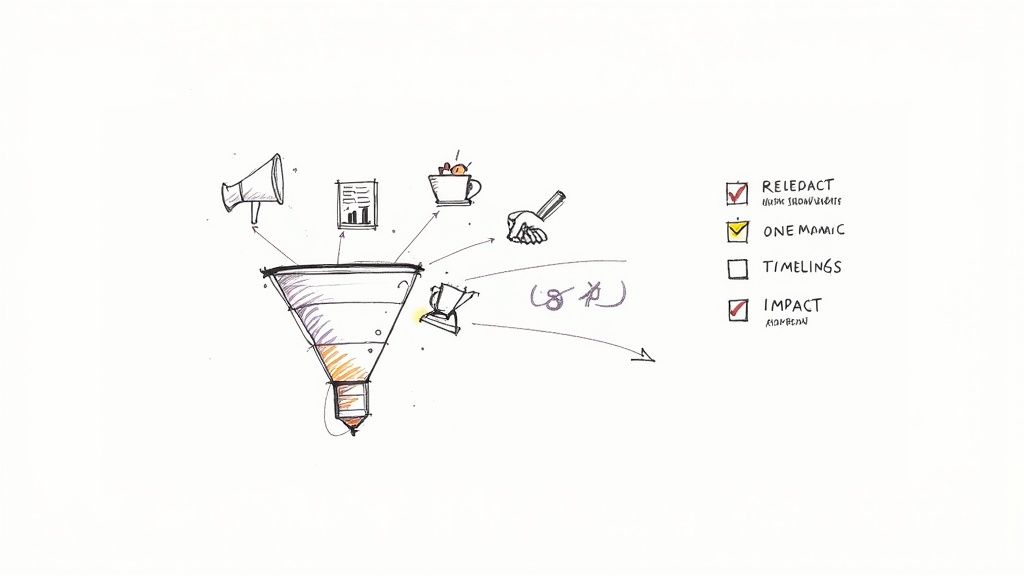
Let's get one thing straight: a perfect format is useless if your story is a snooze. This is the biggest trap for startups—confusing a company update with actual news.
Journalists get hundreds of pitches a day. Yours has seconds to grab them. The hard truth? Nobody cares that you redesigned your website. To get media coverage, you have to find an angle that offers real value to a journalist's audience.
Think like an editor. They’re constantly asking, "Why would my readers care about this right now?" Your job is to answer that question for them. This shift turns a boring announcement into a story that demands to be told.
What Actually Counts as News
A real news hook is rarely just about your product. It taps into a broader trend, solves a painful problem, or offers a fresh take no one else has. Don't just announce a product launch; reframe it. Did your new tool help a client get a jaw-dropping result? That’s a story. Did you analyze user data and uncover a surprising industry trend? Even better.
Here are angles that consistently cut through the noise:
Release Original Data: Publish a unique industry study or survey. Journalists crave fresh stats.
Announce a Key Partnership: Team up with a well-known company to gain instant credibility by association.
Hit a Major Milestone: Just hit 10,000 users? Processed your first $1 million? Concrete numbers are a powerful hook.
Offer Expert Commentary on a Trend: Is everyone talking about a new AI regulation? Have your founder offer a sharp, contrarian take.
Vet Your Story with This Checklist
Before you write a word, run your idea through this sanity check. If you can't say "yes" to at least a few of these, your angle isn't ready.
Is it timely? Does it connect to a current event, hot trend, or industry conversation?
Is it impactful? Does this news affect a significant number of people or businesses?
Is it unique? Are you offering something genuinely new—a first-of-its-kind product, exclusive data, or a surprising take?
Is it human? Is there a compelling personal story behind it?
Is it concrete? Can you back it up with hard numbers, specific results, or verifiable data?
Knowing your audience is everything. You build customer profiles, right? Do the same for journalists. Apply the thinking from our guide on how to create buyer personas to your media contacts.
Using Data to Make Your Story Irresistible
Data is your secret weapon. It elevates your story from a self-serving announcement to credible, authoritative news.
In a PR market set to hit $133.82 billion by 2027, data-driven stories are non-negotiable. In fact, 95% of digital PR pros use data in their campaigns because it works. Find more insights about the rise of data in PR on newswirejet.com.
Don't just make claims—prove them. Instead of saying your product "improves efficiency," say it "cuts project completion time by an average of 35% based on a study of 500 users."
This data-backed approach makes your pitch more compelling and gives journalists a concrete hook for their own headlines.
Writing Your Press Release with Impact
You've got a newsworthy angle. Now it's time to write. Your goal is to translate your big idea into a crisp, powerful document a journalist can actually use. Think of it this way: write it so well they can copy and paste entire sections into their article.
Master the Tone and Style
The gold standard for journalism is Associated Press (AP) style. The biggest rule? Write in the third person with objective language.
Instead of, "We are so excited to launch our new app," say, "Company X today announced the launch of its new app." This simple shift from "we" to "they" transforms a sales pitch into something that sounds like real news.
Also, use the active voice. It has energy and gets straight to the point.
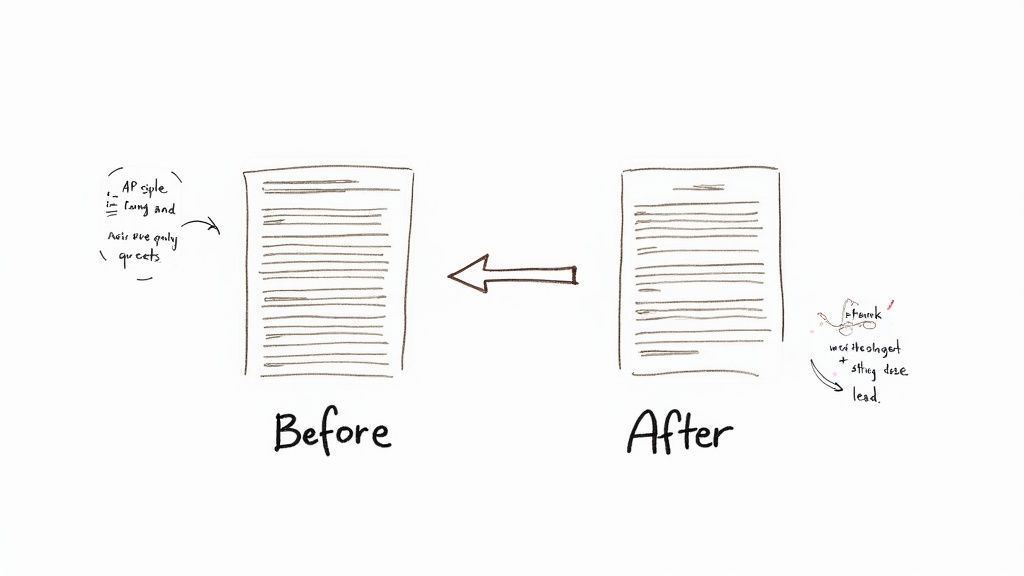
Before (Passive): "A new feature was developed by our team."
After (Active): "Our team developed a new feature."
The active version is punchier and more direct. It creates momentum—exactly what you want for an exciting announcement.
From Weak to Powerful Sentences
Turn bland, jargon-filled sentences into clear, impactful statements. Kill the fluff and get straight to the action and the outcome.
Example 1: The Vague Corporate Babble
Weak: "Our company will be leveraging its core competencies to deliver a synergistic solution that enhances user workflows."
Powerful: "The new software cuts user project time by 30% by automating manual data entry."
Example 2: The Understated Milestone
Weak: "We recently acquired a number of new customers, reflecting positive market reception."
Powerful: "The startup onboarded over 10,000 new customers last quarter, signaling rapid market adoption."
The powerful versions use specific numbers and strong verbs. Good writing is about clarity and proof. To sharpen your skills, check out our guide on the fundamentals of copywriting in marketing.
Journalists are on a deadline. They don't have time to decipher corporate jargon. Write for skimmers, using short sentences and paragraphs that deliver information fast.
The Role of AI in Modern Press Release Writing
AI is now a core part of the PR pro's toolkit. AI-powered tools can hammer out a first draft, check for AP style mistakes, and even generate headline ideas to get you started.
Think of AI as your co-pilot. It handles the boring stuff—structure, formatting—so you can focus on nailing the story and the unique angle. It's estimated that 61% of press releases in 2025 will be AI-assisted, showing just how integrated this tech has become. This shift makes writing faster and enables more targeted messaging. You can read more about press release trends on mediaboard.com.
Boost Engagement with Multimedia
A text-only press release is a huge missed opportunity. Journalists are always hunting for visuals to make their stories pop. Including high-quality multimedia dramatically increases your chances of getting picked up.
Make their job easy. Include a link to a cloud folder (Google Drive or Dropbox) with key assets.
High-Resolution Logos: Offer color and monochrome versions on a transparent background.
Product Screenshots or Photos: Show your product in action.
Founder Headshots: A professional, well-lit headshot adds a human touch.
Short Video (Optional): A 30-60 second video demo or founder clip can be a game-changer for online publications.
Give them everything they need upfront, and you make it incredibly easy for them to build a richer story around your news.
Getting Your Press Release in the Right Hands
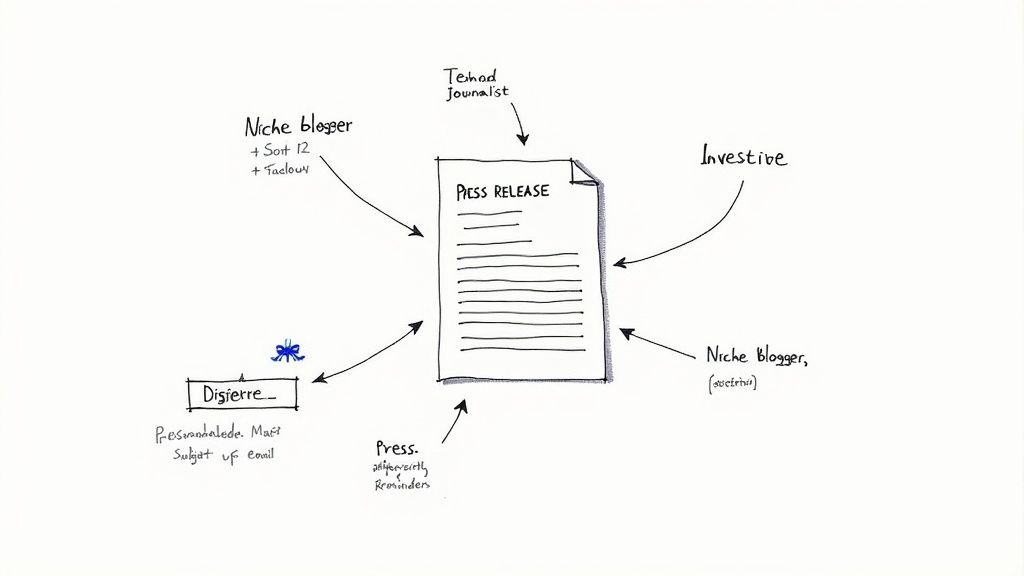
You've written a killer press release. Now comes the part where most startups fail: getting it to the people who can turn it into a story. Writing the release is only half the battle. Strategic distribution is what separates coverage from deletion.
You have two main paths: the wide net of a newswire service or the surgical precision of direct outreach.
Newswire Vs. Direct Outreach: A Comparison
A newswire service (like PR Newswire) blasts your release to a massive network of newsrooms. It's a "set it and forget it" approach that guarantees wide syndication, but it often lacks genuine engagement. Your release just lands in a generic inbox.
Direct outreach is the opposite. You hand-pick a curated list of journalists who cover your specific niche and send them a personalized pitch. It’s more time-consuming but infinitely more effective for landing meaningful coverage.
Here’s a quick breakdown to help you decide.
Feature | Newswire Services | Direct Outreach |
|---|---|---|
Reach | Very broad; hits thousands of outlets. | Highly targeted; focuses on key journalists. |
Impact | Often results in copy-paste pickups on smaller sites. | Can lead to original stories and featured articles. |
Effort | Low; upload and the service does the rest. | High; requires research and personalization. |
Cost | Can be expensive, from hundreds to thousands. | Free, but requires a major time investment. |
For most startups, a targeted direct outreach strategy is the clear winner. It costs nothing but your time and builds media relationships that pay off for years.
Building Your Targeted Media List
Stop thinking about "the media" and start thinking about individual journalists. Who specifically writes about the problem your startup solves? Who covers your competitors? Those are the people you want on your list.
Scour Industry Blogs: Read the top five blogs in your niche and find the writers covering relevant topics.
Use Social Media Search: On X (formerly Twitter), search for keywords related to your industry and find journalists discussing them.
Analyze Competitor Coverage: A quick Google News search for your competitor's last launch reveals a pre-qualified list of reporters.
Once you have names, find their contact info. Check their author bio, look for a personal blog, or use a tool like Hunter.io to find professional email addresses. Always prioritize a direct email over a generic "tips@" inbox.
Crafting the Perfect Pitch Email
Your pitch email is not your press release. It's a short, sharp, personalized message to convince a journalist to open your press release. Keep it brutally concise.
Here’s a formula that works:
A Subject Line That Doesn't Scream "Spam": Make it personal and intriguing. Try: [Topic They Cover] + [Your Unique Angle]. Example: "Re: your article on SaaS pricing – new data on startups overpaying by 40%."
A Hyper-Personalized Opening: Reference a recent article they wrote. This proves you've done your homework. "Hey [Name], loved your piece on AI in marketing automation."
The One-Sentence Pitch: Get straight to the point. "We just launched a tool that helps bootstrapped founders cut their marketing costs by 40%."
The Call to Action: Make the next step clear. "I’ve attached a press release with all the details. Happy to provide a demo or connect you with our founder."
A journalist's inbox is a battlefield. Your pitch must be a sniper shot, not a grenade. A short, relevant, personalized email will always outperform a generic blast.
This targeted approach is just one of many effective content distribution strategies. Once your release is ready, ensure it reaches the right people. For more outreach tips, discover 12 easy PR lists to get on for massive brand growth.
Common Press Release Questions Answered
Even with a great angle and perfect format, practical questions always pop up. Let's clear up the common sticking points so you can send your release with confidence.
What Is the Ideal Length for a Press Release?
400 to 500 words. That's it. One page, max.
This is the sweet spot: enough space to cover the 5 Ws, but short enough for a journalist to scan in under a minute. Anything longer will be ignored. Your first paragraph should be a tight summary; the rest just adds supporting details.
Should I Include Images or Videos?
Yes. Sending a release without them is a massive mistake. High-quality multimedia is non-negotiable if you want to get picked up.
But don't attach huge files. Instead, host everything in a shared Google Drive folder or a media kit page on your site and drop the link directly into your release.
Your media kit should include:
Your company logo (high-res, transparent background).
Sharp product screenshots or professional photos.
Headshots of your founder and anyone quoted.
A 30-60 second video demo if relevant.
When Is the Best Day and Time to Send It?
The consensus is mid-week, mid-morning.
Your best bet is Tuesday, Wednesday, or Thursday. Mondays are for catch-up, and on Fridays, everyone's already checked out. Aim for 9 AM to 11 AM in the journalist's local time zone to avoid the morning email avalanche and the afternoon slump.
Always watch the news cycle. If a massive industry story breaks, hold off for a day. Don't try to shout over a hurricane.
How Do I Measure the Success of My Press Release?
Getting published is just the start. Success is what happens after. You must connect your PR to business results.
Media pickups are the obvious first metric, but dig deeper into the data.
Website Traffic: Check your analytics for referral traffic from the articles.
Brand Mentions: Use a free tool like Google Alerts to track new mentions of your company.
SEO Impact: Look for new, high-quality backlinks. Did your keyword rankings get a bump?
Business Goals: The big one. Did you get more demo requests, sign-ups, or sales? That's your true ROI.
At Viral Marketing Lab, we provide bootstrapped founders with the tools, templates, and playbooks needed to execute effective marketing without the big budget. From SEO guides to outreach scripts, get everything you need to grow your startup at https://viralmarketinglab.com.