Copywriting for Websites That Sells
Great website copy isn’t about fancy words. It's psychology meets sales strategy, designed to walk visitors from "just curious" to "take my money." The goal: make your audience feel so understood that buying from you is the only logical next step.
This guide gives you the frameworks to make that happen. No fluff. Just action.
Why Your Website Copy Is an Unfair Advantage
Let's get one thing straight: your website isn’t an online brochure. It's your #1 salesperson, working 24/7. Your copy is its pitch.
Too many founders burn cash on a slick design but treat the words as an afterthought. They plug jargon and vague promises into a template and wonder why it falls flat. Massive mistake.
Effective copywriting for websites is your conversion engine. It turns browsers into buyers. Period.
It Builds an Immediate Connection
Your copy is the first real conversation a visitor has with your brand. It's your shot to prove you get their problem better than they can describe it. When the words on the page mirror the thoughts in their head, you create instant trust.
Ditch the bland: "Our software streamlines workflows." Instead, hit a nerve: "Tired of juggling five apps to manage one project?"
See the difference? The second option speaks directly to their pain. This isn't just writing; it's empathy as a weapon.
The job of your copy is to make the visitor feel seen, heard, and understood. Nail that, and the sale becomes a conclusion, not a pitch.
Copy Drives Every Important Action
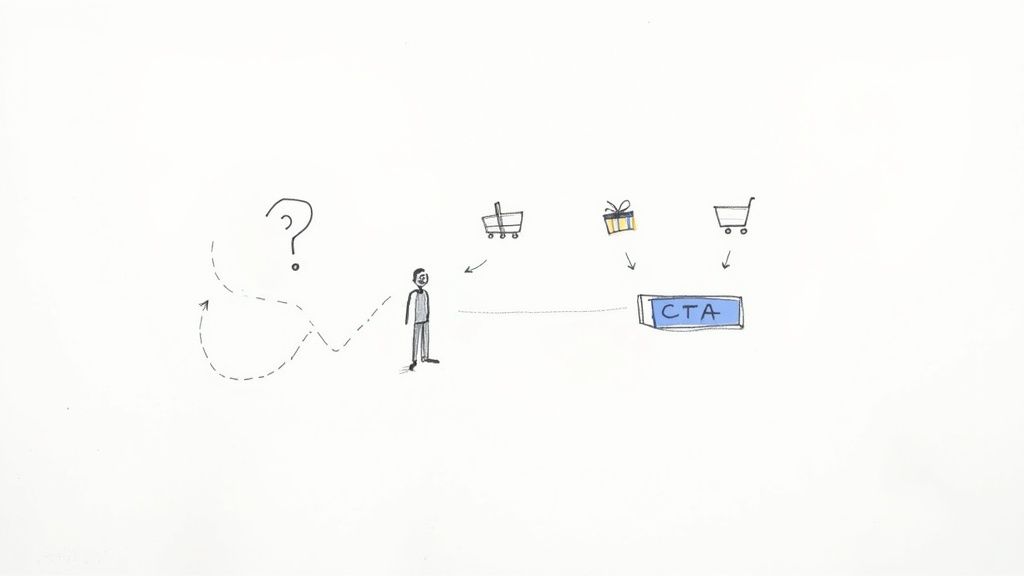
Every click, signup, and purchase is triggered by words. From the headline that grabs attention to the CTA button that closes the deal, copy does all the heavy lifting.
A beautiful site with weak copy is a sports car with no engine. It looks impressive, but it’s going nowhere.
Headlines: A killer headline can boost conversions over 20% by promising a specific, desirable outcome.
Product Descriptions: Benefit-focused descriptions don’t list features; they paint a picture of the customer's life after they buy.
Calls-to-Action (CTAs): A simple word change in a CTA—like "Get My Free Plan" instead of "Sign Up"—can dramatically lift clicks.
This guide helps you move from theory to action. You'll learn how to write website copy that’s authentic and brutally effective.
Stop just writing words. Start building a conversion machine.
Decoding Your Customer's Mindset
Let’s get one thing straight: great copy isn’t written. It’s assembled. The raw materials are the exact words and frustrations your customers already use.
Your job isn't to be a creative genius. It's to be a detective.
The most powerful website copy reads your customer’s mind. But there's no magic—just sleeves-rolled-up research. Stop guessing what people want to hear. Start listening.
Ditch The Persona Guesswork
Traditional buyer personas are a creative writing exercise. "Marketing Molly, 34, loves yoga and struggles with work-life balance." Nice story, but mostly fiction.
Forget inventing characters. Gather real data from actual people. For a deeper dive, our guide on how to create buyer personas shows you how to ground them in reality, not assumption.
Your goal is a "Voice of Customer" document. It’s your single source of truth—a collection of direct quotes, recurring pain points, and desired outcomes. With this, you’ll never stare at a blank page again.
The best copy isn't clever—it's observant. It echoes the customer's own thoughts back to them so clearly they feel completely seen. That’s how you build trust.
Where To Find Your Customer's Language
The internet is a massive, unfiltered focus group. You just need to know where to look. Stop brainstorming in a vacuum. Start hunting for clues.
Here are the goldmines for raw, unfiltered customer insights:
Review Sites like G2, Capterra, and Trustpilot: Go straight to the 3-star reviews for your competitors. Why? Because 1-star is pure rage and 5-star is hype. The 3-star reviews are nuanced and honest, detailing specific frustrations and what they wished the product did. Look for "I was hoping it would..." or "The biggest problem was..."
Online Forums (Reddit, Quora): Find the subreddits or Quora topics where your people hang out. Search for questions, rants, and pleas for help. People are brutally honest here, giving you the raw language they use to describe their biggest challenges.
Your Own Customer Support Tickets: Your support inbox is a treasure trove. What questions pop up constantly? Where do people get stuck? This feedback is pure gold for your FAQ, product pages, and homepage.
This isn't a one-off task. It’s an ongoing process that fuels all your marketing. And it's valuable—the global copywriting market is projected to hit USD 42.83 billion by 2030. According to Mordor Intelligence, this deep research is what separates the pros from the amateurs.
This table breaks down how to dig up those golden nuggets of customer language.
Actionable Audience Research Methods
Method | What to Look For | Where to Look |
|---|---|---|
Competitor Review Mining | 3-star reviews, feature requests, specific frustrations, and mentions of "switching from" or "switching to." | G2, Capterra, Trustpilot, SaaS-specific review sites. |
Social Listening | Questions, complaints, slang, and desired solutions within niche communities. | Reddit (e.g., r/saas), Quora, niche Facebook Groups, industry forums. |
Customer Interviews | The story behind why they bought, the "aha!" moment, and the exact problem they hoped to solve. | 5-10 calls with your best (and newest) customers. |
Support Ticket Analysis | Recurring questions, points of confusion, and features they can't find. | Your help desk software (Zendesk, Intercom, Help Scout). |
On-Site Surveys | Hesitations from visitors who don't convert, asking "What's stopping you from signing up today?" | Tools like Hotjar or a simple pop-up survey. |
Use these methods consistently. Build a direct pipeline into your customers' minds. Make your copy resonate on a deeper level.
Turning Research Into Resonant Copy
Once you've collected this raw data, organize it. Don't summarize. Pull out exact, word-for-word quotes.
Use a simple spreadsheet with three columns:
Data Type | Direct Quote Example | Key Takeaway |
|---|---|---|
Pain Points | "I waste hours every Monday manually pulling reports from three different systems." | The user's primary frustration is wasted time and manual, repetitive work. |
Desired Outcomes | "I just want a single dashboard where I can see everything at a glance." | The user is looking for a unified, simplified view of their data. |
Hesitations | "I've tried tools like this before, but they were too complicated to set up." | The user is skeptical about ease of implementation and has been burned before. |
This simple framework transforms messy notes into a messaging arsenal.
Suddenly, your copy writes itself. Your homepage headline hits the pain point: "Stop Wasting Mondays on Manual Reports." Your features page highlights the outcome: "Your All-in-One Dashboard is Here." And your body copy smashes the hesitation: "Set Up in Under 5 Minutes. No Coding Required."
This is how you write copy that connects instantly. It’s not about being a clever wordsmith; it’s about being a diligent listener.
Crafting a Message That Sticks
You know your customer. Now give them one knockout reason to choose you. This isn't a laundry list of features. It's about nailing your Unique Value Proposition (UVP)—a clear, punchy promise of the value you deliver that nobody else can touch.
Forget clever taglines. Your UVP is the strategic heart of your message. It must instantly answer three questions:
What problem do you solve?
What's the specific outcome?
Why are you the only choice?
Get this right, and every word you write has a sharp, persuasive edge. Get it wrong, and you’re just more noise.
From Vague Claims to a Powerful Promise
Most startups stumble with weak, feature-focused messaging. It’s a natural mistake. You built the thing, so you want to talk about what it does.
But customers don't buy features. They buy better versions of themselves.
Reframe. Instead of, "We offer a cloud-based project management tool with Gantt charts," a killer UVP translates that into a real-world benefit: "The only project management tool that gives agency owners a real-time view of profitability on every project."
The first is a description. The second is a solution.
Your UVP isn't what your product is. It's what your customer can become by using it. Sell the transformation.
This shift from features to benefits is everything. It flips your copy from being about you to being about them. That’s where conversions live.
Proven Formulas for a High-Impact UVP
You don't have to invent a brilliant UVP from thin air. Use proven formulas to structure your thinking. Here are two battle-tested frameworks to get you started:
The "For [Target Customer] Who [Has a Problem], We Provide [Solution] That [Key Differentiator]" Formula: This classic forces clarity on your audience, their pain, and your unique edge.
Example: For bootstrapped founders who struggle with inconsistent lead flow, we provide a library of marketing templates that helps them launch campaigns in under an hour.
The "We Help [Target Customer] Do [Desired Outcome] By [Our Unique Method]" Formula: This jumps straight to the end result and hints at your secret sauce.
Example: We help e-commerce brands double their repeat customer rate by using AI-powered email sequences that feel genuinely personal.
Use these as a launchpad. Tinker. The goal isn't a rigid template, but a tool for clarity. Of course, a cohesive message goes beyond words; professional branding design services can help you build a solid visual and conceptual foundation.
Real-World UVPs That Win
Let's look at a couple of brands that nail their UVP.
Notion: Their homepage often leads with, "Your wiki, docs, and projects. Together." It’s brilliant. It speaks directly to the chaos of juggling multiple tools and offers a single, elegant solution. The benefit isn't a feature; it's clarity.
Slack: Their core UVP has always been about making work "simpler, more pleasant, and more productive." This hits the emotional frustration of corporate communication—endless email chains, lost files—and promises a better way to work.
Your UVP is the anchor for your entire site. With an estimated 4.62 billion indexed web pages out there, a fuzzy value prop is a death sentence. Websites with compelling headlines see an average conversion rate lift of 25% simply because they immediately tell visitors, "You're in the right place."
This is your compass. Ensure your headline, descriptions, and buttons all sing the same persuasive song.
A Page-by-Page Copywriting Blueprint
Alright, you’ve done the research. You’ve nailed your UVP. Now it's time to build the damn thing, page by page.
Think of each page as a specialized salesperson. Each has one job. The homepage is the greeter. The about page is the trust-builder. The pricing page is the closer. Use the same script for all of them, and you'll lose sales.
The Homepage: Your First Impression
You get three seconds. That’s it. In that time, your homepage must answer three questions: Where am I? What can I do here? Why should I care?
Fail, and they're gone. The back button is merciless.
Your goal isn't to dump everything on them. It's to grab their attention, make your value clear, and guide them to the next step. Your UVP does the heavy lifting here—put it front and center in your H1 headline. Don't be clever. Be clear.
Above the Fold: Prime real estate. Needs your UVP headline, a clarifying sub-headline, a strong visual, and one obvious call-to-action (CTA).
Problem/Solution: Briefly twist the knife on their main pain point. Then, introduce your product as the clear solution. Use their words.
Social Proof: Slap on logos of clients people recognize. Drop in a powerful customer quote. Flash an impressive number like "Trusted by 10,000+ founders." Build instant credibility.
Your homepage is a traffic controller. Guide different visitors to the pages that matter most to them.
The About Page: Building a Human Connection
Secretly, your 'About' page is a high-powered sales page. Why? People buy from people they know, like, and trust. This is your chance to drop the corporate jargon and tell a real story.
Don't just list your company history. Frame your origin story around your customer. What problem ticked you off so much you had to build a solution? This narrative builds empathy and makes your brand feel real.
Your 'About' page shouldn’t be a resume. It should be a manifesto. It tells people why you do what you do and attracts customers who share your values.
Make your story their story. Show them you get their struggle because you've been there. This is also the perfect spot to show the faces behind the brand. Team photos and short bios humanize your company instantly.
Service and Product Pages: From Features to Benefits
Here’s the golden rule: lead with benefits, support with features. So many startups get this backward. They list what their product does. Mistake. Translate every feature into a tangible outcome for the customer.
Don’t say: "Our software has a built-in analytics dashboard."
Say: "Make smarter decisions, faster. Get a clear, real-time view of your performance with our one-click analytics dashboard."
See the difference? The second version connects the feature (dashboard) to the benefit (smarter, faster decisions). It paints a picture of a better future.
For a deeper dive, check out our guide on how to optimize landing pages. It's packed with actionable frameworks.
This infographic breaks down how to turn your product's guts into a compelling story.
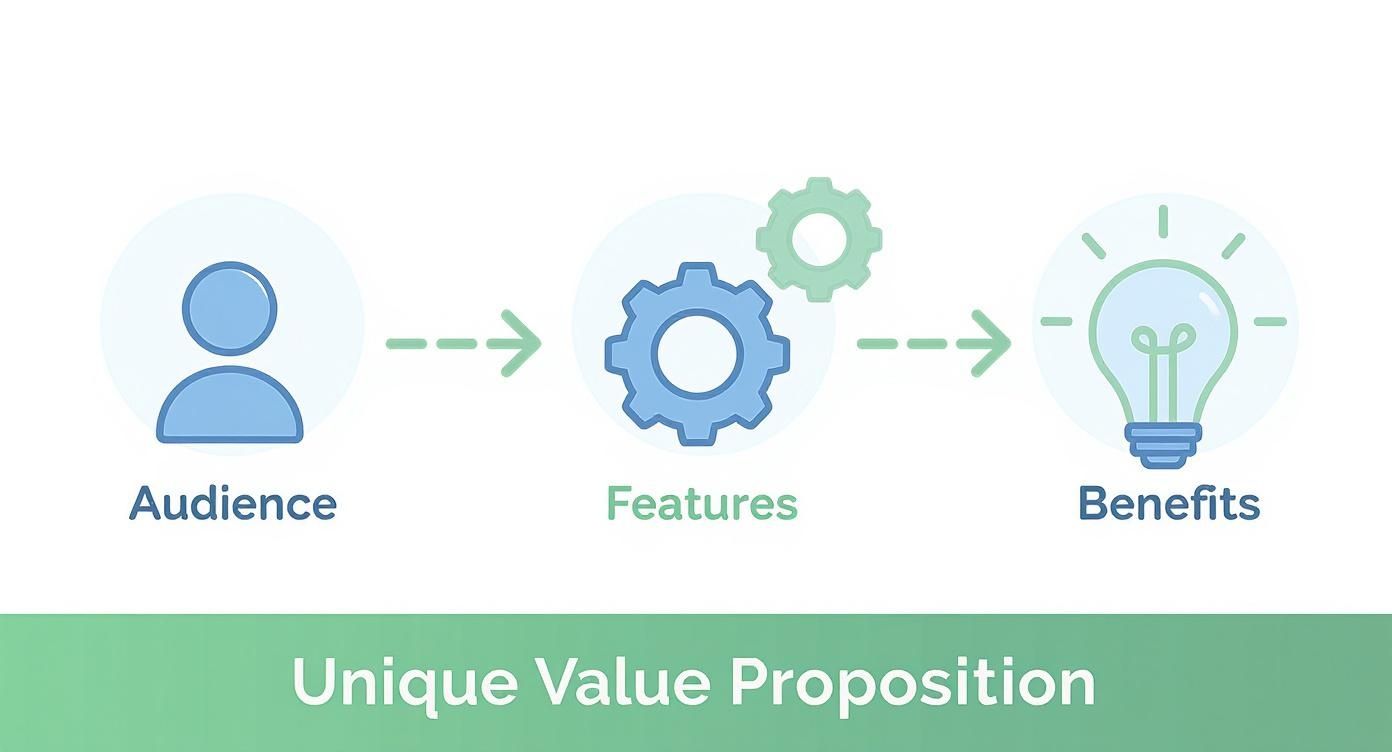
It all starts with knowing what your audience wants. Once you have that, turning features into benefits that resonate is easy.
The Pricing Page: Sealing the Deal
Your pricing page is the last stop before the sale. The copy here must do two things: justify the cost by framing the value, and crush any last-second doubts.
Clarity is everything. Ditch confusing tier names like "Pro" or "Premium." Name them after the user: "For Freelancers," "For Teams," "For Agencies." Help people see where they fit.
For each plan, use bullet points to hammer home the key benefits, not just features. If one plan is the clear winner, use a "Most Popular" tag to make the decision easier and reduce anxiety.
Get ahead of their worries. Add a short FAQ on the page to answer the obvious questions: What's the cancellation policy? How does billing work? Can I integrate with X? Remove every single obstacle between them and the "Buy Now" button.
Integrating SEO Without Sounding Robotic
Let's kill a myth: SEO and great copywriting aren't enemies. They're best friends. What’s the point of amazing copy if no one finds it? That's just a well-written diary.
The goal is to attract the right visitors. SEO is how you do it.
Stop thinking of SEO as a chore. See it for what it is: a direct pipeline into your customer’s brain. It uncovers the exact words they type into Google when they're desperate for your solution.
Frame it that way, and SEO becomes a tool for empathy.
Find the Keywords Your Customers Actually Use
You don't need expensive tools to find a goldmine of high-intent keywords. Just do some scrappy detective work. Find the phrases people use when they're ready to buy.
Here's where to start digging:
Google Autocomplete: Type a core service into the search bar (like "project management software for...") and watch Google's suggestions. These are the most common searches happening right now.
"People Also Ask" Box: After you search, scroll down. This box is a cheat sheet for the exact questions your audience is asking. Instant subheadings.
Reddit and Quora: Search these forums for phrases like "how do I find," "best tool for," or "any recommendations for." You'll find the raw, unfiltered language of people looking for help.
Don't just find one magic keyword. Build a cloud of related terms—your main keyword, secondary variations, and question-based phrases. This signals to Google that you're an authority.
Weave Keywords in Naturally
You've got your list. Now for the art. Old-school "keyword stuffing" will get you penalized. Today, it’s about strategic, natural placement.
Write for humans first, then tweak for search engines. It’s a subtle dance. Don't jam your keyword into every sentence. Place it where it makes sense, where it would pop up in a real conversation.
Your copy should never sacrifice clarity for a keyword. If a sentence sounds clunky, rewrite it. The reader's experience is always priority one.
Think of your primary keyword as the main theme of a song. Your secondary keywords are the supporting melodies. They work together to create something cohesive and clear.
Master the On-Page Essentials
A few key spots on your website carry extra SEO weight. Nailing these tells Google exactly what your page is about, giving your killer copy the visibility it deserves.
Your quick-hit checklist:
Title Tag: The blue link in Google search results. Keep it under 60 characters. Put your main keyword near the front. Example: Website Copywriting Guide for Startups | Viral Marketing Lab
Meta Description: The summary under the title. Under 160 characters. It doesn't boost rankings, but a killer one convinces people to click. Treat it like ad copy.
Headers (H1, H2, H3): Your H1 is your page title and must feature your primary keyword. Use H2s and H3s for subheadings, sprinkling in secondary and question-based keywords. This organizes content for both people and bots.
Image Alt Text: The text that describes an image if it fails to load. Make it a simple, descriptive phrase. If you can fit a keyword in naturally, great. Example: Infographic of a page-by-page copywriting blueprint.
Testing and Optimizing Your Copy for Results
Let's be honest: your first draft is never the final word. The best website copy is a living process of continuous improvement. Stop guessing. Start measuring what actually works.
Think of your initial copy as a baseline, not a masterpiece. This mindset separates the good from the great. The goal is to make small, data-driven tweaks that compound into massive wins. You don't need a huge budget or a data science team.
You just need to be curious and listen to what your users' actions are telling you.
Embrace Simple A/B Testing
A/B testing is dead simple. Show Version A of your copy to half your audience and Version B to the other half. See which one performs better against a single goal, like more clicks or signups.
The trick: test only one element at a time. If you change the headline, button color, and body copy, you’ll have no idea which change made the difference.
Start with your highest-impact pages, like your homepage or pricing page. Small changes here have a huge effect on your bottom line.
What to Test for Maximum Impact
Focus your energy on the elements that influence a visitor's split-second decisions.
High-impact areas to test first:
Headlines: This is your biggest lever. Test a benefit-driven headline against a pain-point-focused one. "Manage Projects Effortlessly" vs. "Tired of Project Chaos?"
Calls-to-Action (CTAs): The text on your buttons matters. Test "Get Your Free Trial" against "Start Building Now." See what inspires action.
Social Proof: Experiment with testimonials. Does a quote from a well-known brand beat one that details a specific, impressive result?
The best copywriters are humble enough to let data prove them wrong. Your favorite headline might be a dud with your audience. Only testing reveals the truth.
Key Metrics to Watch in Google Analytics
You don’t need complex software. A free tool like Google Analytics is all you need to see if your copy is working.
Watch these vital metrics:
Bounce Rate: The percentage of visitors who land and leave without clicking. A high bounce rate could mean your headline failed to grab them.
Time on Page: Are people actually reading? If the average time is only a few seconds on a long sales page, your copy isn't engaging enough.
Conversion Rate: The ultimate measure of success. It tracks the percentage of visitors who complete a key action, like signing up. This tells you if your copy is truly persuasive.
Frequently Asked Questions
How Long Should My Website Copy Be?
This is the million-dollar question, isn't it? The honest answer is: there's no magic word count. Stop focusing on length and start focusing on clarity.
Your homepage might only need 300-500 words to nail your value prop and guide people where they need to go. But a detailed service or product page? That could easily run over 1,000 words to dismantle every objection and build the trust needed for a sale.
The only rule that matters is this: your copy should be as long as it needs to be to get the job done, and not a single word longer.
Can I Write My Own Website Copy?
Absolutely. In fact, when you're just starting out, you probably should. A bootstrapped founder who deeply understands their customer's pain will almost always write better copy than an expensive agency that doesn't get your business.
You're closer to the problem than anyone. The most critical skill here isn't being a "writer"—it's being a sharp listener who can translate what your product does into what your customer gets.
How Often Should I Update My Website Copy?
Think of your copy as a living part of your product, not a static brochure. Review it every six months, minimum.
More importantly, update it anytime something changes. Launch a new feature? Tweak your messaging. Pivot your positioning? Your copy must reflect that. Get a burst of insightful customer feedback? Use their exact words on your site. Your copy should always be a perfect mirror of your current value proposition.
At Viral Marketing Lab, we build the playbooks and templates bootstrapped founders need to write high-converting copy without the guesswork. Ready to turn your words into revenue? Grab our resources and get started.