8 Actionable Cold Email Examples That Get Replies in 2025
Cold emailing feels like shouting into the void. Why? Because over 90% of outreach is generic, self-serving, and instantly deleted. Most emails demand a meeting without offering a shred of value. This isn't another post of stale templates; it's a strategic playbook built to get you replies.
We're dissecting 8 battle-tested cold email examples that work. No fluff. You'll get the templates and the psychology behind them. For each example, we'll break down:
The Core Strategy: Why it cuts through the noise.
Actionable Takeaways: Tactics you can steal immediately.
A/B Test Ideas: Simple tweaks to skyrocket your response rates.
This article gives you the scripts. Mastering the principles behind them is how you build a pipeline. For a deeper dive into campaign architecture, check out an in-depth cold email marketing guide.
Let's ditch the ignored folder and start building a pipeline that actually converts.
1. The Problem-Agitate-Solve (PAS) Cold Email
The PAS framework is a copywriting classic that hits hard in cold email. It works because it weaponizes a core human driver: pain avoidance. Instead of leading with your solution, you pinpoint a problem, twist the knife, and then offer the cure.
This approach manufactures relevance on the spot, stopping your email from hitting the trash. It’s a proven persuasive structure that compels a response.
How It Works: The Breakdown
PAS is a lethal three-step sequence:
Problem: State a specific pain point. Do your homework. Make it resonate with their role or industry.
Agitate: This is the kill shot. Don't just state the problem; amplify it. Use data or a sharp question to highlight the consequences. What is this costing them in time, money, or sanity?
Solve: Introduce your product as the logical escape route. Focus on the core benefit, not a feature list.
Strategic Insight: Agitation is what makes PAS deadly. By twisting the knife, you turn a minor annoyance into an urgent business fire they have to put out.
Example: SaaS for Workflow Inefficiency
Subject: An idea about [Prospect's Company]'s content workflow
Hi [First Name],
Noticed your team is consistently publishing great content on your blog.
Managing that pipeline often creates hidden bottlenecks—feedback loops and manual updates eating up to 10 hours per week for marketing managers.
That's a full day torched every week that could be spent on strategy instead of chasing approvals. This is how deadlines get missed and marketing goals slip.
Our platform, [Your SaaS Name], automates the entire workflow, cutting management time by 80%.
Open to a 15-minute call next week to explore how we can reclaim that lost day for your team?
Actionable Takeaways
Be Specific with Pain: "Inefficient workflows" is weak. "Feedback loops eating up 10 hours a week" is a punch to the gut.
A/B Test Your Agitation: Does a financial cost ("$5,000 in wasted hours") hit harder than a time cost ("10 hours per week")? Test and find out.
Keep the Solution Punchy: The "Solve" is one or two sentences. You're selling the next step, not the entire product.
For a deeper dive into structuring these messages, learn how to write cold emails that get replies on ViralMarketingLab.com.
2. The Short and Direct Cold Email
In a world of overflowing inboxes, brevity is a superpower. This email gets straight to the point in three sentences, max. It respects the recipient's time, making it deadly for reaching busy execs and for high-volume campaigns.
Its power lies in its clarity and confidence. By stripping away all fluff, these concise cold email examples force you to lead with your knockout punch.

How It Works: The Breakdown
This model is built on radical simplicity:
The Hook: Lead with your most impressive result or sharpest question. The first sentence must earn the right to the second.
The Ask: State exactly what you want. A brief call. A demo. A simple "yes/no." No ambiguity.
The Easy CTA: Make the next step frictionless. A calendar link or a one-word-answer question.
Strategic Insight: This works because it mirrors how busy people communicate. It feels less like a sales pitch and more like a quick, valuable message from a peer, lowering their guard instantly.
Example: Agency Prospecting for a Competitor's Client
Subject: Question about [Prospect's Company]
Hi [First Name],
I saw you're using [Competitor Service]. We just helped [Mutual Competitor] boost their ROAS by 35% last quarter with our approach.
Open to a 15-minute chat to see if we could drive similar results for you?
Actionable Takeaways
Weaponize Social Proof: Name-dropping a direct competitor is the fastest path to credibility. Adding a hard metric (35% ROAS increase) makes it lethal.
Optimize Your Subject Line: With a short email, the subject line does all the work. Test direct questions ("Question about [Company]") versus benefit-driven lines ("Improving your ROAS").
Make the CTA Effortless: Don't make them work. A calendar link crushes "Let me know what time works." A simple question beats asking them to navigate your site.
For more templates that prioritize brevity and directness, explore these powerful cold outreach email templates on ViralMarketingLab.com.
3. The Value-First Cold Email
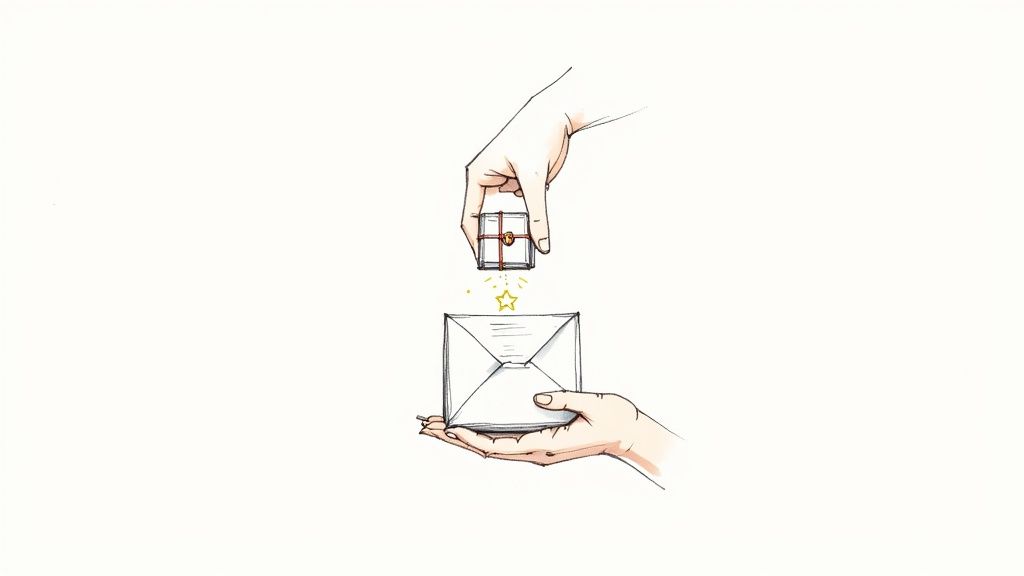
The Value-First approach flips the sales script. Instead of asking for anything, you give something useful away for free. This strategy is built on reciprocity; provide genuine value upfront, and you build trust that makes a future conversation almost inevitable.
This method immediately positions you as a helpful expert, not just another salesperson. These cold email examples are designed to start relationships, making them hyper-effective for high-value targets.
How It Works: The Breakdown
The Value-First model is a three-part play focused on generosity:
Research & Identify: Find a specific trigger event—a new launch, a recent article, a company goal.
Provide Value: Offer a relevant piece of value directly related to your research. This isn't a veiled pitch. It's a custom insight, a link to a killer resource, or a helpful intro.
Low-Friction Ask: The call-to-action is minimal and pressure-free. Don't ask for a demo. Ask for their opinion on the resource or just say you hope it's helpful.
Strategic Insight: The key is that the value must be genuine and standalone. If the "freebie" is useless without your product, it’s just a disguised pitch. Make them think, "If their free stuff is this good, their paid service must be incredible."
Example: Offering a Free Resource
Subject: A few thoughts on your new [Initiative/Product Name] launch
Hi [First Name],
Saw the announcement about your expansion into [New Market]. Impressive strategy.
Having worked with companies entering this space, the biggest unforeseen hurdle is often [Specific Challenge]. I compiled a short guide on navigating this, including a checklist we used to help [Similar Company] avoid those early pitfalls.
Find it here: [Link to resource].
Hope your team finds it useful.
Actionable Takeaways
Make the Value Custom: A generic blog post link is weak. Better: "I read your post on X. It made me think of this specific data point on page 7 of our new report that proves your argument."
Keep the Ask Soft: The goal is goodwill. "Hope this helps" can be more powerful than "Are you free to chat?" Follow up a week later with a harder ask.
Track Value-Type Performance: Test your value. Do prospects respond better to data reports, tactical checklists, or intros? Let the data dictate your strategy.
4. The Curiosity-Driven Cold Email
This email exploits a powerful human impulse: the need to close an information gap. Instead of a direct pitch, you create intrigue by hinting at exclusive information the prospect is missing.
This approach short-circuits the brain's "ignore sales email" filter. It frames the interaction as a revealing conversation, not a sales pitch, making it one of the most compelling cold email examples for cutting through the noise.
How It Works: The Breakdown
The framework leverages a "curiosity gap" to force a reply:
Hook: Start with a bold question or a surprising piece of data that leaves out a key detail.
Context: Briefly connect the hook to their business. Why should they care? Ground the curiosity in business value.
Payoff (Tease): Hint at the valuable answer you possess. Make them feel that a quick reply is the only way to get the missing piece of the puzzle.
Strategic Insight: The key is to create a professional "itch" in the prospect's mind. The hook can't be random; it must be a specific piece of information they feel compelled to know.
Example: Competitive Intelligence SaaS
Subject: A question about your Q3 content strategy
Hi [First Name],
I was analyzing content performance in your space and noticed three of your main competitors just shifted their strategy to a new topic cluster that's generating massive organic traffic.
My analysis suggests this pivot is targeting a high-intent customer segment your content is currently missing.
Our platform uncovers these competitor content gaps and gives you the data to exploit them.
Curious to know who the three competitors are and what topic they're winning with?
Actionable Takeaways
Make the Payoff Worthwhile: The info you reveal after they reply must be genuinely valuable. If the hook is a trick, you've burned that bridge forever.
Use Pattern Interrupts: Open with a question that breaks their routine, like "What if you could 10x your team's output without hiring?" instead of a boring intro.
Test Curiosity in Subject Lines: The hook starts in the subject line. A/B test different questions or intriguing statements to see what drives the highest open rates.
For more ideas on crafting compelling hooks, explore strategies on writing better email subject lines on ViralMarketingLab.com.
5. The Social Proof Cold Email
This email leverages a powerful persuasion principle: people trust what others are already doing. Instead of telling a prospect you’re great, you show them that people just like them already think you are. This builds instant credibility and lowers the risk of engaging.
By referencing well-known customers or impressive results from similar companies, these cold email examples bypass the "who are you?" skepticism and get straight to "how did you do that for them?"

How It Works: The Breakdown
This framework establishes trust by association.
Relevant Hook: Open by acknowledging the prospect or their company.
Introduce Social Proof: Directly present the success story. Name a competitor or similar company and state the specific, metric-driven result you achieved for them.
Connect to Prospect: Explicitly connect that result back to the prospect. Suggest that a similar outcome is possible for them.
Simple Call-to-Action: Propose a brief, low-friction next step to discuss how they can get the same results.
Strategic Insight: Relevance is everything. Naming a Fortune 500 client is useless if you're emailing a startup. The best social proof makes the prospect think, "That company is my direct competitor; if it works for them, it will work for me."
Example: B2B Marketing Agency
Subject: Question about [Prospect's Company]'s SEO strategy
Hi [First Name],
I was analyzing keyword rankings for [Prospect's Competitor], one of our clients, and saw their organic traffic has grown 65% in the last six months since we redesigned their content strategy.
They were facing the same challenges with ranking for high-intent keywords in your space.
Given you both target a similar audience, I believe we could implement a parallel strategy to drive significant growth for [Prospect's Company] before Q3 ends.
Open to a brief call next Tuesday to walk through the 3-step framework that got them those results?
Actionable Takeaways
Get Permission: Always get your client's approval before using them as a case study. If you can't name them, use descriptions like "a leading e-commerce brand in your niche."
Lead with the Metric: "Increased lead flow by 40%" is more powerful than "We helped Company X increase their lead flow."
Test Your Proof: A/B test different success stories. Does a direct competitor's success perform better than an industry leader's? Let your reply rates be the judge.
6. The Personalized Story Cold Email
Humans are wired for stories. This email leverages that by opening with a brief, relevant narrative instead of a pitch. This approach disarms the prospect, humanizes you, and creates an emotional connection that makes your message memorable.
By framing your value prop within a relatable story, these cold email examples transform a sales pitch into a shared experience, capturing attention in a way a feature list never could.
How It Works: The Breakdown
This narrative technique follows a simple flow:
The Hook: Start with a short, compelling story—a personal anecdote, a case study, or an industry observation. It must relate directly to the prospect's world.
The Bridge: Connect the story to a specific challenge the prospect likely has. Show how the narrative's lesson applies to them.
The Solution: Introduce your product as the tool that enables the story's positive outcome. Position it as the logical next chapter for the prospect.
Strategic Insight: A good story bypasses the logical "sales filter" and speaks directly to the emotional brain. The goal isn't just to be remembered, but to be felt.
Example: SaaS for E-commerce Analytics
Subject: A story about [Similar Company]'s Q4 rush
Hi [First Name],
I was talking with the head of marketing at [Similar Company Name], and she said they almost missed their Q4 revenue target because their analytics platform crashed during the holiday rush. Her team was flying blind for the first two days of Black Friday.
It's that terrifying scenario where you have the traffic but can't get the data to optimize conversions, leaving thousands in revenue on the table.
Our platform, [Your SaaS Name], is built to provide scalable, real-time analytics for high-traffic e-commerce events, ensuring you never miss a conversion opportunity.
Do you have 15 minutes next week to discuss how you're preparing to avoid a data bottleneck this year?
Actionable Takeaways
Make the Hero Relatable: The protagonist of your story should be someone the prospect sees as a peer.
Use Sensory Details: Don't say "they had a problem." Say "flying blind for the first two days of Black Friday." Make the story vivid.
Keep it Micro: This isn't a novel. Your story is a two or three-sentence hook. Set the stage, deliver the punchline, and move on.
7. The Pattern Interrupt Cold Email
This is an audacious strategy designed to jolt a prospect out of their inbox-clearing autopilot. It uses an unexpected question, unusual formatting, or a surprising statement to break their pattern of ignoring sales emails.
It works by leveraging curiosity and novelty. When an email looks and sounds completely different, it triggers a different cognitive response, compelling them to read just to figure out what's going on. These cold email examples are for high-stakes outreach where blending in is a death sentence.
How It Works: The Breakdown
A pattern interrupt intentionally defies convention:
Unconventional Opening: Start with a provocative question or a self-aware statement like "This is a cold email."
Creative Formatting: Use single-word sentences.
Or short line breaks.
To make the email visually distinct.
Surprising CTA: Instead of "book a call," use "Just reply 'curious'" or "Feel free to tell me I'm wrong."
Strategic Insight: A pattern interrupt isn't about being weird for its own sake. The "interrupt" must quickly pivot to a clear value proposition. The novelty buys you 3 seconds; what you do with it determines if you get a reply or a spam report.
Example: SaaS for E-commerce Analytics
Subject: Quick question about [Prospect's Company]
Hi [First Name],
This email will take you 27 seconds to read.
Most e-commerce founders I speak with look at their analytics daily.
But they can't answer one question:
"Which marketing channel is bringing in our most profitable customers?"
Not just the most revenue, but the highest LTV:CAC ratio. Our platform visualizes this exact data so you can double down on what's actually working.
If you can already answer that question with 100% certainty, feel free to ignore this. If not, open to seeing how it works?
Actionable Takeaways
Know Your Audience: This tactic is best for modern industries like tech or e-commerce. It will likely bomb with traditional sectors like law or finance.
Connect the Interrupt to the Value: The surprise must be a bridge to your message. "27 seconds to read" works because it promises brevity, which the email then delivers.
Test the Aggressiveness: A subject line like "Don't open this email" is high-risk, high-reward. Test it against something more subdued like "Am I making a mistake?"
8. The Referral or Warm Introduction Cold Email
While not technically "cold," this is one of the most effective ways to contact a high-value prospect. It uses a mutual connection as a bridge, transforming an unsolicited message into a trusted recommendation. The credibility of the referrer is transferred to you, dramatically increasing your chance of a reply.
This method bypasses the initial skepticism that kills most outreach. By starting with a familiar name, these cold email examples borrow authority and create an immediate sense of obligation to respond.
How It Works: The Breakdown
The referral email is built on trust from the first line:
Lead with the Connection: Immediately state who referred you and why. Put the mutual connection's name in the subject line.
State the "Why": Explain why the referrer thought a connection would be mutually beneficial. This proves you aren't just name-dropping.
Deliver a Concise Pitch: Briefly state your value proposition, tailored to the problem you know the prospect faces.
Make the Ask Clear: End with a simple, low-friction call to action.
Strategic Insight: The power here is social proof. When someone we trust recommends something, we are far more likely to trust it ourselves. The referrer has already done the heavy lifting for you.
Example: SaaS Sales Introduction
Subject: Intro from [Referrer's Name] re: [Specific Goal]
Hi [First Name],
[Referrer's Name] suggested I reach out. We were discussing ways to improve sales team productivity, and your name came up.
She mentioned you're looking to scale outbound at [Prospect's Company] without adding more headcount.
Our platform helps sales teams automate prospecting, which typically doubles reply rates without expanding the team.
Open to a 15-minute chat next week to see if this could help you hit your Q3 goals?
Actionable Takeaways
Get Permission First: Always ask your mutual connection for permission before using their name. An unexpected referral can backfire.
Name-Drop in the Subject: Put the referrer's name in the subject line ("Intro from Jane Doe") to guarantee an open.
Make the Referrer Look Good: Frame the intro in a way that highlights the referrer's helpfulness. This encourages them to refer you again.
8 Cold Email Strategies Compared
Template | 🔄 Implementation Complexity | ⚡ Resource Requirements / Scalability | ⭐ Expected Effectiveness / Key advantage | 📊 Typical Outcomes | 💡 Ideal Use Cases / Tips |
|---|---|---|---|---|---|
The Problem-Agitate-Solve (PAS) Cold Email | Medium–High: needs thoughtful copy and sequencing | Moderate time per prospect; templates help scale | ⭐⭐⭐⭐ — strong engagement through emotional resonance | Higher reply rates and qualified conversations when pain is accurate; risk of pushback if overdone | 💡 Use for targeted B2B outreach; include specific metrics and a soft CTA |
The Short and Direct Cold Email | Low: concise structure, easy to implement | ⚡ Very scalable and fast for high-volume lists | ⭐⭐⭐⭐ — excellent for busy recipients and quick responses | Higher open/response rates; lower depth of qualification | 💡 Front-load value, use clear CTA (calendar/yes-no); test subject lines |
The Value-First Cold Email | Medium–High: requires genuine, relevant value creation | Resource-intensive to personalize; harder to scale at volume | ⭐⭐⭐⭐ — builds trust and higher-quality conversations | Better long-term engagement and higher-quality meetings; ROI harder to track initially | 💡 Use for key accounts; make value obvious and follow up to convert |
The Curiosity-Driven Cold Email | Medium: needs strong hook and tight payoff | Moderate effort per message; subject-line testing required | ⭐⭐⭐⭐ — drives opens via intrigue but must deliver payoff | Exceptional open rates; mixed conversion if payoff is weak | 💡 Use for executive targets; ensure promise is fulfilled quickly |
The Social Proof Cold Email | Medium: needs valid references and metrics | Moderate data collection; can scale with updated templates | ⭐⭐⭐⭐ — increases credibility and reduces perceived risk | Improved trust and conversion for risk-averse prospects | 💡 Use relevant, recent case studies; get permission before naming clients |
The Personalized Story Cold Email | Medium–High: storytelling skill and relevance required | Time-consuming to craft authentic stories; low volume scaling | ⭐⭐⭐⭐ — memorable, builds emotional connection | Strong recall and rapport; variable response depending on fit | 💡 Keep stories brief and relevant; end with a reflective question |
The Pattern Interrupt Cold Email | Medium: creative formatting and tone control needed | Low-to-moderate production; novelty wears off if repeated | ⭐⭐⭐ — grabs attention but can alienate conservative buyers | High opens; conversion varies, risk of seeming unprofessional | 💡 Use sparingly, know your audience, and retain clarity of message |
The Referral or Warm Introduction Cold Email | Low: structured template, straightforward to implement | Low per-message effort but depends on quality of referrals | ⭐⭐⭐⭐⭐ — highest trust and conversion due to warm intro | Much higher response and close rates; better LTV for referred leads | 💡 Name referrer early, get permission, and systematize referral requests |
From Examples to Execution: Your Next Move
We’ve dissected eight powerful frameworks, not just copy-paste templates. You now have a strategic playbook of cold email examples designed for action. The path from cold lead to signed deal isn't about one "perfect" email. It's built on psychological triggers and relentless testing.
The core lesson is this: a successful cold email is never about you. It's about their problems (PAS), their time (Short and Direct), their goals (Value-First), or their curiosity (Pattern Interrupt). Your email is just the vehicle.
The Bridge Between Knowledge and Action
Reading about strategies is easy. Execution is what separates stagnant pipelines from explosive growth. The difference between a deleted email and a reply comes down to a few critical variables.
Your actionable checklist:
Start with One Framework: Don't master all eight at once. Pick the one that fits your goal. Solving a burning pain? Use PAS. Targeting busy execs? Master the Short and Direct.
Personalize Beyond
{FirstName}: Real personalization is referencing a recent LinkedIn post or a company announcement. This is the single fastest way to prove you've done your homework.Embrace the Follow-Up: 80% of deals close between the 5th and 12th contact. A single brilliant email is rarely enough. Your follow-up sequence is where the real work happens.
Track Everything: You can't improve what you don't measure. Track opens, replies, and meetings booked. Low opens mean a weak subject. High opens but low replies mean your body copy failed.
Scaling Your Outreach Intelligently
Once you validate a template, it's time to scale without sacrificing the quality that made it work. This is where technology becomes your ally. After mastering the craft, explore the best email outreach tools to execute and scale your campaigns. These platforms automate follow-ups, manage prospects, and provide the analytics you need to optimize.
Mastering the cold email is a superpower. It unlocks conversations that would otherwise be impossible. The cold email examples in this guide are your starting blocks. Now, go run the race.
Ready to move beyond individual emails and build a complete, automated outreach machine? The templates in this article are just the beginning. At Viral Marketing Lab, we provide comprehensive blueprints and systems for scaling your outreach and turning cold traffic into predictable revenue. Explore Viral Marketing Lab to get the frameworks that build empires.