SWOT Analysis Examples: A Practical Guide with Real-World Cases

A SWOT analysis is one of the most widely used tools in business strategy — and also one of the most frequently misunderstood. When done well, it gives a business a clear picture of where it stands and what it should do next. When done poorly, it becomes a list of vague statements that tells nobody anything useful.
This guide explains what a SWOT analysis actually is, how to build one that drives real decisions, and then walks through six real-world SWOT analysis examples across different industries — from global tech giants to small businesses.
What Is a SWOT Analysis?
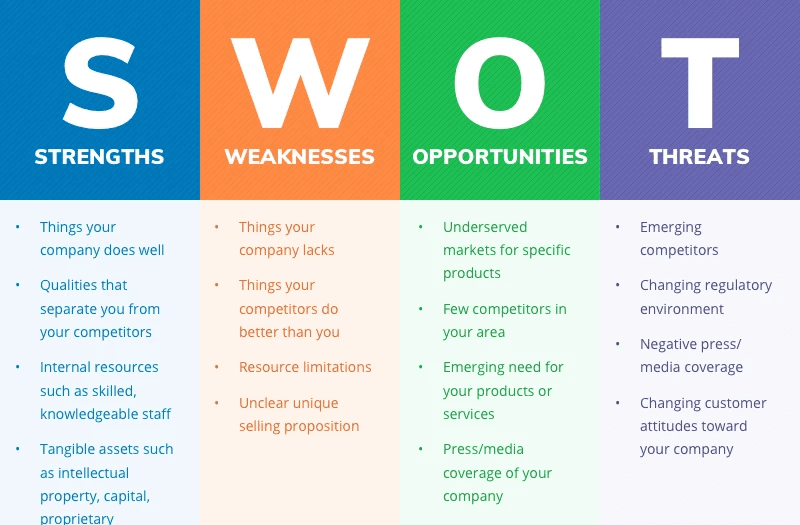
SWOT stands for Strengths, Weaknesses, Opportunities, and Threats. It is a business analysis framework used to evaluate an organization, product, brand, or strategy by examining internal factors (strengths and weaknesses) and external factors (opportunities and threats).
Strengths are internal advantages — things the organization does well or has that others do not. Weaknesses are internal limitations — areas where the organization is vulnerable or underperforming. Opportunities are external conditions the organization could take advantage of. Threats are external conditions that could harm the organization.
The power of the SWOT framework is in how these four elements interact. The most useful SWOT analysis does not just list items in each category — it looks at how strengths can be used to exploit opportunities, how weaknesses expose the organization to threats, and what strategy makes sense given the full picture.
How to Build a SWOT Analysis
Be Specific, Not Generic
The most common failure in SWOT analysis is vagueness. Saying a company's strength is great customer service or that its weakness is limited budget tells you almost nothing useful. A strong SWOT analysis names specific capabilities, quantifies where possible, and grounds each point in evidence.
Separate Internal from External
Strengths and weaknesses are inside the organization — they are things you have some control over. Opportunities and threats are outside the organization — they are conditions in the market, the competitive landscape, regulation, or technology that you cannot control but must respond to. Keeping this distinction clear prevents the analysis from becoming muddled.
Use It to Drive Decisions
A SWOT analysis is a tool, not an endpoint. After completing it, the next step is to identify strategic priorities: Which strengths should we invest in? Which weaknesses need fixing? Which opportunities are worth pursuing right now? Which threats require defensive action? The analysis is most valuable when it leads directly to strategy.
SWOT Analysis Example 1: Netflix
Strengths
Netflix has one of the largest and most engaged streaming audiences in the world, with over 260 million subscribers globally. Its recommendation algorithm is technically sophisticated and drives significant watch time. The brand is recognized worldwide, and its original content library — from Stranger Things to The Crown — creates content that is unavailable on any competing platform.
Weaknesses
Netflix spends billions of dollars per year on content, creating significant cash flow pressure. It has no sports rights, which is an increasingly important driver of streaming subscriptions. Its password-sharing crackdown, while financially logical, generated significant customer friction and negative press.
Opportunities
International markets, particularly in Asia and Africa, represent major growth opportunities where streaming penetration remains low. The launch of an ad-supported tier opens a new segment of more price-sensitive customers. Gaming is an adjacent category Netflix has begun exploring, which could increase platform stickiness.
Threats
The streaming market has become extremely competitive, with Disney+, HBO Max, Amazon Prime, and Apple TV+ all competing for the same subscribers and talent. Consumer spending on subscriptions is under pressure, and churn rates are rising across the industry. The potential for regulation around data use and content moderation could also create operational challenges.
SWOT Analysis Example 2: Nike
Strengths
Nike is one of the most recognizable brands in the world. Its Swoosh logo and Just Do It tagline carry enormous brand equity built over decades. Nike's athlete endorsement portfolio — including relationships with top performers across basketball, football, tennis, and soccer — gives it unmatched credibility in sports culture. Its direct-to-consumer business has grown significantly, improving margins and customer data access.
Weaknesses
Nike relies on third-party manufacturers, primarily in Asia, which creates supply chain vulnerability to geopolitical tension, labor issues, and logistics disruptions. Premium pricing limits accessibility in developing markets. Past controversies around labor practices in supply chain factories continue to create reputational risk.
Opportunities
The growing global middle class in markets like India and Southeast Asia represents a significant growth opportunity. The athleisure trend has expanded the occasions where athletic wear is socially acceptable, broadening Nike's potential market. Sustainability-focused product lines could attract environmentally conscious consumers and differentiate Nike from fast-fashion competitors.
Threats
Adidas, Under Armour, and emerging brands like On Running and Hoka continue to gain market share. Counterfeit products remain a significant problem that dilutes brand value and revenue. Economic downturns tend to drive consumers toward cheaper alternatives, which affects premium athletic brands disproportionately.
SWOT Analysis Example 3: Amazon
Strengths
Amazon's logistics and fulfillment network is arguably the most sophisticated in the world. AWS (Amazon Web Services) is the global leader in cloud computing and generates a disproportionate share of Amazon's profit. Amazon Prime creates enormous customer loyalty and cross-sells across shopping, video, music, and grocery. The company's ability to enter and disrupt new markets — from pharmacy to healthcare to satellite internet — is unmatched.
Weaknesses
Amazon's retail business operates on extremely thin margins, making it vulnerable to cost increases. The company faces ongoing scrutiny from regulators around the world for anti-competitive practices. Worker conditions in Amazon warehouses have been a persistent source of negative press and labor organizing activity.
Opportunities
Healthcare is a massive industry where Amazon has made early moves with Amazon Pharmacy and One Medical. AI and machine learning represent significant opportunities to enhance both AWS offerings and consumer-facing products. International e-commerce expansion, particularly in markets where Amazon's penetration is still relatively low, offers substantial growth potential.
Threats
Antitrust regulation in the US and EU poses a genuine threat to Amazon's current business model and could force structural changes. Competition from Walmart, Target, and Shopify in e-commerce is intensifying. In cloud computing, Microsoft Azure and Google Cloud are growing faster than the overall market, gradually narrowing AWS's lead.
SWOT Analysis Example 4: A Local Coffee Shop
Strengths
A well-established local coffee shop typically has a loyal customer base that values the personal, community-oriented experience it provides. Staff know regular customers by name. The shop sources from a specific local roaster that provides unique flavor profiles unavailable at chains. Its location on a busy commuter street provides high foot traffic.
Weaknesses
A single-location coffee shop has limited purchasing power compared to chains, resulting in higher ingredient costs. It relies heavily on the owner-operator, creating vulnerability if that person is unavailable. Marketing budget is minimal, and the shop has limited social media presence compared to competitors with dedicated marketing staff.
Opportunities
Growing consumer interest in specialty coffee and coffee origin stories provides an opportunity to position the shop as an educator and curator. Adding a simple loyalty program could increase visit frequency. Partnering with local businesses for corporate catering could add a revenue stream that does not depend on foot traffic.
Threats
A Starbucks or another well-funded chain opening nearby could draw price-sensitive customers away. Rent increases in urban areas are a persistent threat to independent food and beverage businesses. Changing work-from-home patterns affect commuter coffee routines, which this shop's location depends on.
SWOT Analysis Example 5: Tesla
Strengths
Tesla's brand is synonymous with electric vehicles and technological innovation. Its Supercharger network is the most extensive fast-charging infrastructure in the world, giving it a practical advantage over competitors. Direct-to-consumer sales eliminate dealership margins and give Tesla full control of the customer experience. Its software update capability means Tesla vehicles improve after purchase in ways traditional car manufacturers cannot match.
Weaknesses
Tesla's manufacturing quality and quality control have been criticized repeatedly, with reports of panel gaps, build inconsistencies, and fit-and-finish issues. Its customer service infrastructure has not scaled as fast as sales growth. CEO Elon Musk's public behavior and associations have created reputational risks that can spill over into brand perception.
Opportunities
Global EV adoption is accelerating, particularly in Europe and China. Tesla's energy storage and solar products could become a significant business as the energy transition accelerates. Full self-driving technology, if approved for commercial deployment, could unlock a robotaxi business model worth far more than vehicle sales.
Threats
Traditional automakers — Ford, GM, Volkswagen, Hyundai — have launched competitive EVs with the manufacturing scale, dealer networks, and brand recognition to challenge Tesla's market position. Chinese EV manufacturers like BYD now outsell Tesla in China and are expanding internationally. Government incentive structures that favor domestic manufacturing in various markets could disadvantage Tesla in certain geographies.
SWOT Analysis Example 6: Spotify
Strengths
Spotify has the largest music streaming audience in the world with over 600 million monthly active users. Its recommendation and discovery features — Discover Weekly, Daily Mixes, and playlist personalization — are widely considered best in class and drive high listener engagement. Its podcast business has added a second content category that increases time-on-platform and advertiser appeal.
Weaknesses
Spotify's per-stream royalty payments to rights holders are extremely small, but the cumulative cost of music licensing is enormous and limits profit margins significantly. The company has not been consistently profitable. Its negotiating power with major labels is constrained by the fact that it needs their content more than they need any single distributor.
Opportunities
Audiobooks are a growing format that Spotify has entered, potentially adding a third content category. Expansion in markets like India, Africa, and Latin America where internet penetration is growing rapidly represents significant user growth potential. AI-powered tools for music creation could position Spotify as a platform for artists, not just listeners.
Threats
Apple Music and YouTube Music are backed by companies with far greater financial resources and bundling capabilities. If major labels decided to pull content from Spotify or launch their own streaming services, it would fundamentally threaten the platform. The growing use of AI-generated music raises complex royalty questions that could reshape how Spotify's licensing model works.
Using SWOT Analysis in Your Own Business
A SWOT analysis is most valuable when it is specific, evidence-based, and connected to real strategic decisions. The examples above cover companies of very different sizes and industries, but in each case the same framework reveals different insights because the specific facts are what matter.
For your own SWOT analysis, gather input from multiple people in your organization — different roles will surface different strengths and blind spots. Research your competitors and your market before filling in the opportunities and threats sections. And once the analysis is complete, use it: prioritize, decide, and act. A SWOT analysis that sits in a document and never influences a decision is just an exercise. One that shapes strategy is a genuine business tool.


