Microsoft Copilot Autopilot in 2026: The Super App Founders Need to Understand
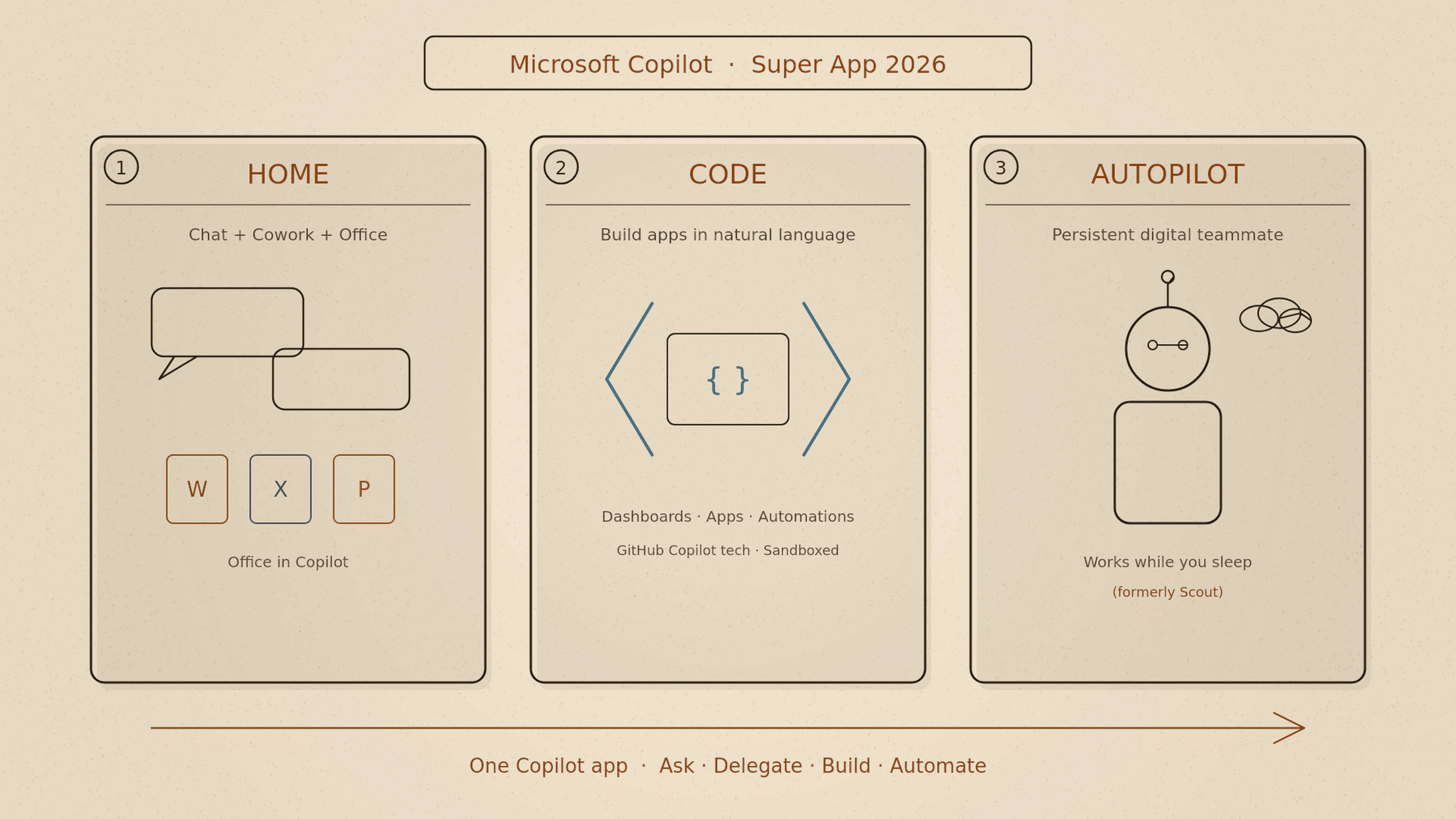
On September 25, 2026, Microsoft officially unveiled a redesigned Copilot app built around three surfaces: Home, Code, and Autopilot. Press and Microsoft itself frame it as a “super app” for work — less a single chatbot, more a place to ask, delegate, build, and automate inside the Microsoft 365 stack.
The piece founders should not skim past is Autopilot (formerly Scout): a persistent, cloud-hosted “digital teammate” that can keep working when you are offline. It sits beside everyday Copilot Chat and the already-shipping Cowork agent, with a separate economics story: everyday chat stays on a user subscription license (USL); long-running agentic work moves to usage-based billing (UBB) in Copilot Credits.
This guide is a practical SEO brief for founders and marketers: what shipped, what is still preview, how Autopilot differs from chat, what pricing publicly means, and how this stacks against ChatGPT / Claude / Gemini agent pitches — without inventing stats or quotes.
Featured image: Copilot’s three-tab “super app” — Home (Chat + Cowork + Office), Code (natural-language apps), Autopilot (persistent agent, formerly Scout).
TL;DR
Announcement: September 25, 2026 — Jared Spataro (CMO, AI at Work) on the Official Microsoft Blog (https://blogs.microsoft.com/blog/2026/09/25/introducing-the-new-copilot-with-home-code-and-autopilot/); also covered by The Verge (https://www.theverge.com/news/1000532/microsoft-copilot-super-app-chat-coding-autopilot), Reuters (https://www.reuters.com/technology/microsoft-revamps-copilot-with-code-generation-agentic-ai-tools-2026-09-25/), and InfoWorld (https://www.infoworld.com/article/4226836/microsofts-new-copilot-unifies-enterprise-context-for-code-and-chat.html).
Product shape: One Copilot app with tabs for Home, Code, and Autopilot. Microsoft and press call this a “super app”; Spataro compares the ambition to how Office defined PC-era work.
Home: Chat + Cowork in one starting point, plus Office in Copilot (real Word / Excel / PowerPoint docs). A Today dashboard is coming (private preview in October).
Code: Natural-language apps, trackers, dashboards, automations — powered by the same underlying tech as GitHub Copilot, sandboxed, tenant-hosted. Copilot Managed Runtime is in public preview for governed hosting.
Autopilot: Renamed from Scout (Build / June 2026). Persistent, proactive agent with its own identity, memory, computer, and workspace; cloud-hosted so it works while you sleep; @mentionable in Teams/Outlook with permissions, audit, and governance.
Rollout: Home and Code start through Microsoft’s Frontier program in the coming weeks (Code also preview for Microsoft 365 Premium and Pro later this year). Autopilot expands to private preview at the end of September 2026.
Pricing (public): Chat + Copilot across Microsoft 365 apps → USL. Cowork, Code, Autopilot, long-running agentic capabilities, and frontier models (e.g. Astra, Fable) → UBB (Copilot Credits). Pay-as-you-go has been stated at $0.01 per Copilot Credit in Microsoft’s Cowork GA materials; Autopilot-specific per-task rate cards are not separately published.
Founder angle: If your team already lives in Microsoft 365, this is Microsoft’s bid to own agentic work with enterprise identity — not a consumer chatbot shootout with Claude or ChatGPT.
What Microsoft actually announced (not the rumor mill)
Per the Microsoft Blog post (https://blogs.microsoft.com/blog/2026/09/25/introducing-the-new-copilot-with-home-code-and-autopilot/) and the Source EMEA summary (https://news.microsoft.com/source/emea/2026/09/new-microsoft-copilot-brings-home-code-and-autopilot-together/):
Home — Chat + Cowork + Office in one place
Home is the new default starting point. Chat stays the fast conversational surface (questions, lookups, drafts). Cowork is for work you delegate end-to-end — Microsoft’s examples include an RFP response, launch kit, customer briefing, or financial close package.
Office in Copilot means Word, Excel, and PowerPoint creation and editing happen inside Copilot with real, editable, team-sync’d files — not orphaned paste jobs. Microsoft also says Copilot will eventually route a request to Chat, Cowork, or Code without the user picking a mode first.
Coming next on Home: Today — a proactive command center across mail, calendar, Teams threads, meetings, and tasks (private preview in October, also planned for Outlook and Teams).
Code — apps for people who do not write apps
Code lets users describe an app, tracker, dashboard, automation, or workflow in natural language. Microsoft positions it as a fourth unit of knowledge work alongside the document, spreadsheet, and deck: small purpose-built solutions.
It runs in a sandboxed environment, can be hosted inside the tenant, and is grounded with Microsoft IQ. Professional developers keep using GitHub Copilot day-to-day, with more connectivity into the Copilot platform.
Alongside Code, Microsoft introduced Copilot Managed Runtime (public preview) — governed hosting inside the Microsoft 365 tenant for apps built in Cowork, Code, and Copilot Studio (Managed Runtime post (https://www.microsoft.com/en-us/copilot/blog/copilot-studio/build-where-you-want-run-with-confidence-now-microsoft-hosts-and-manages-the-code-created-by-copilot/)).
Autopilot — Scout, renamed and cloud-first
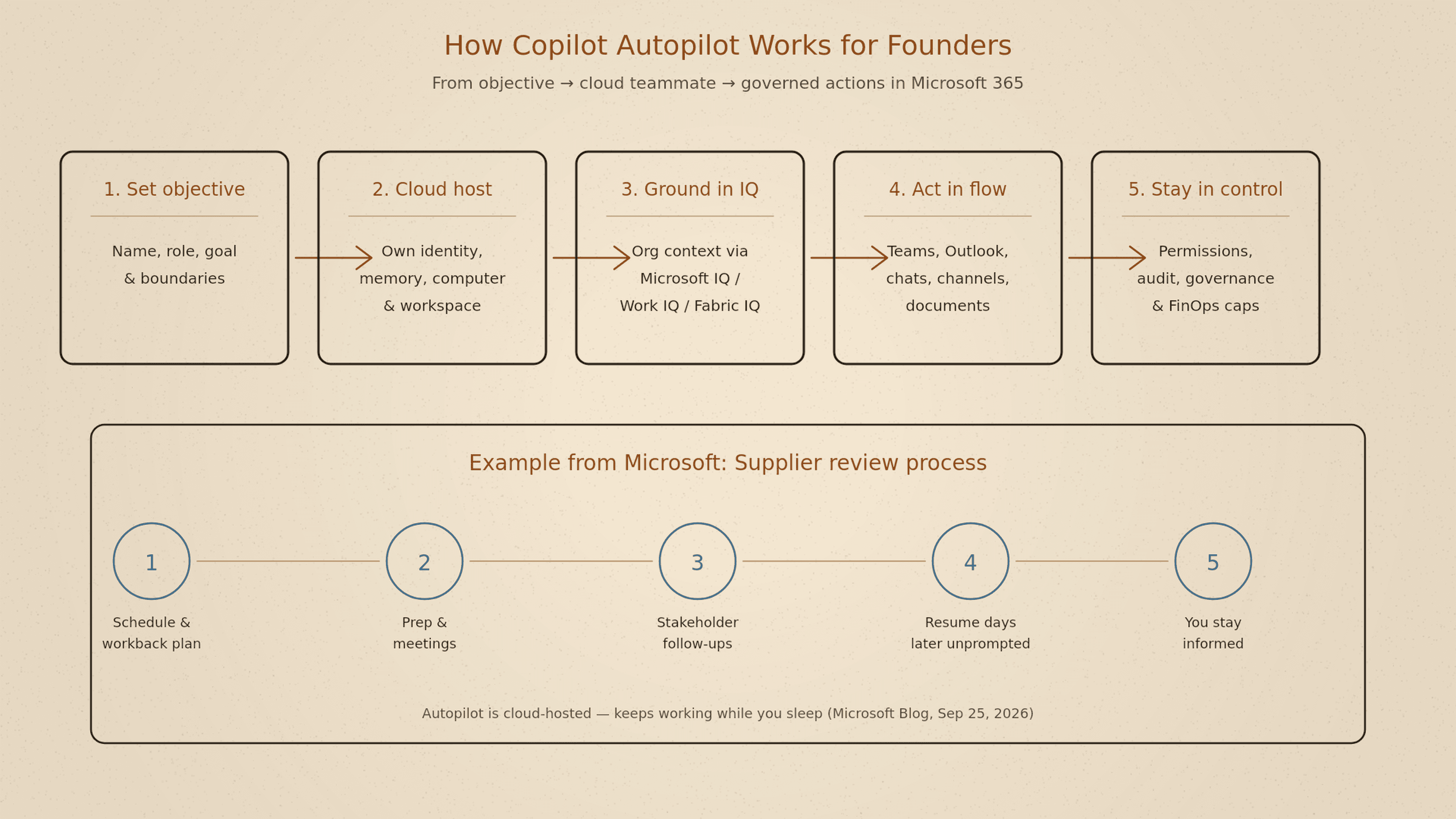
Autopilot, previously called Scout, is described as a digital teammate: give it a name, role, and goal, and it watches channels, follows up on threads, runs recurring work, and can pick a project back up days later without waiting for a new prompt.
Microsoft’s concrete example: managing a full supplier review — schedule and workback plan, prep, meetings, follow-ups, and stakeholder outreach. Autopilot is cloud-hosted, so it keeps working while you sleep. It lives in the tenant with its own identity, memory, computer, and workspace, grounded on Microsoft IQ, and shows up where people already work so you can @mention it like a colleague — with permissions, audit, and governance.
The Verge (https://www.theverge.com/news/1000532/microsoft-copilot-super-app-chat-coding-autopilot) notes Scout began as a desktop experience; Autopilot is framed as the cloud equivalent that can keep running overnight. Scout itself was introduced earlier in 2026 as Microsoft’s first “Autopilot” category agent (June Scout post (https://www.microsoft.com/en-us/copilot/blog/2026/06/02/introducing-microsoft-scout-your-always-on-personal-agent/)) — the September launch consolidates that idea into the Copilot app under the Autopilot name.
Context layer and FinOps
The same announcement expands grounding via Fabric IQ (Power BI semantic models — GA in Chat and Cowork) and Work IQ / Dynamics 365 + Power Platform data (public preview rolling out over the next month), plus a unified plugin registry.
On spend: Microsoft is pushing FinOps for AI — cost management in Agent 365 expanding to Code and Managed Runtime (Copilot Studio agents planned for October), admin spending policies, model-family controls, and end-user visibility into credit usage inside Copilot.
Autopilot vs Copilot Chat (and vs Cowork)
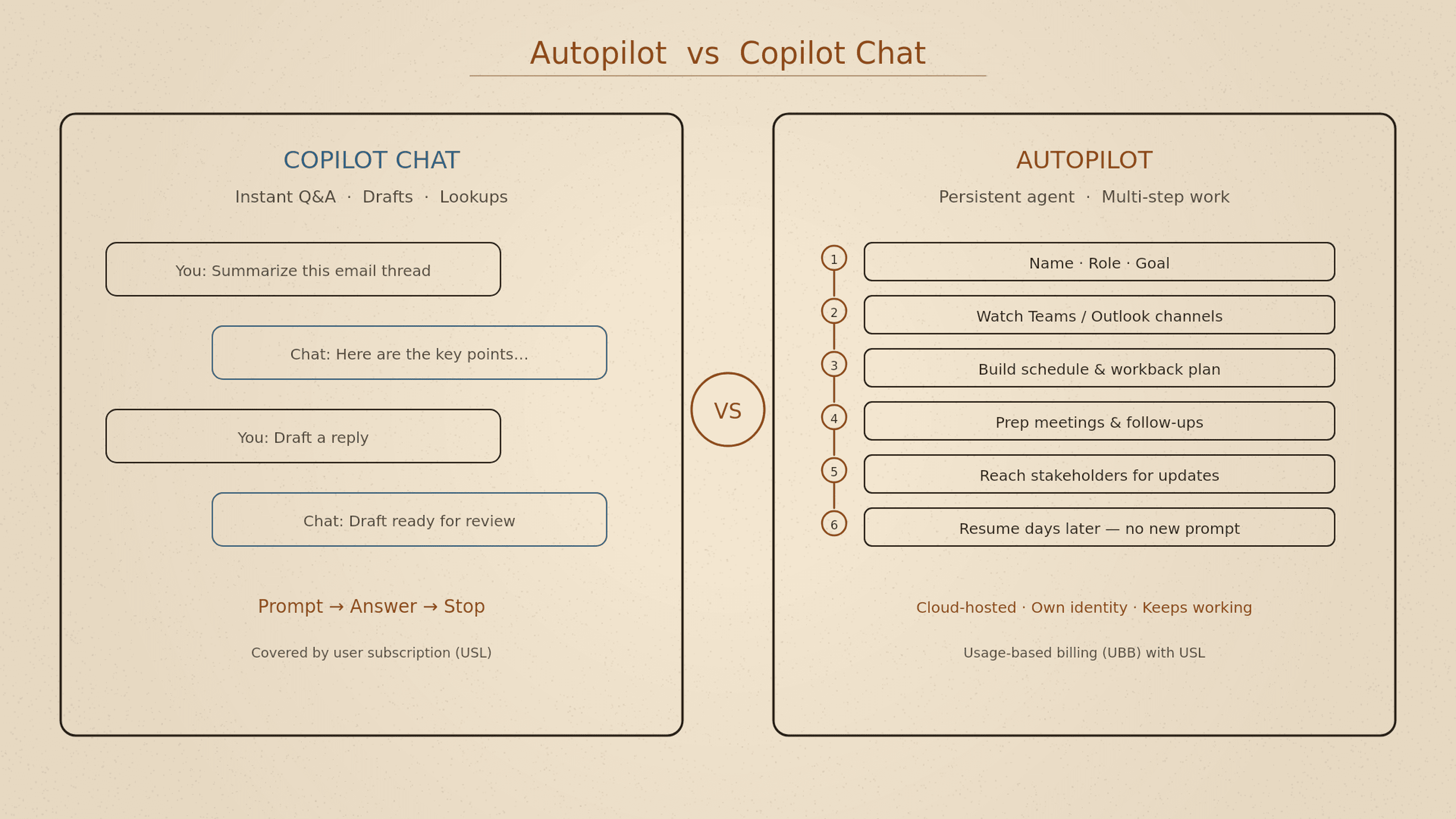
Founders keep mixing three verbs. Microsoft’s own framing separates them:
Surface · Job · Cadence · Where it “lives” — Chat · Instant Q&A, drafts, lookups · Prompt → answer → stop · Conversation — Cowork · Delegate a complex multi-step job; get a finished package · Task → completed result · Agent run you kick off — Autopilot · Persistent teammate with ongoing objectives · Continues across days; no constant prompting · Cloud identity + workspace in your tenant


