Marketing Ethics: Principles, Challenges, and Best Practices for Responsible Marketing
Introduction
Marketing ethics examines the moral principles guiding promotional practices, advertising, and customer relationships. As marketers gain sophisticated tools for targeting, persuasion, and data collection, ethical considerations become increasingly critical. Unethical marketing damages brand reputation, erodes consumer trust, invites regulation, and harms society.
This guide explores core marketing ethics principles, common ethical dilemmas, frameworks for ethical decision-making, and best practices for responsible marketing.
Primary Keyword: Marketing ethics Secondary Keywords: Ethical marketing, marketing ethics principles, responsible marketing, ethical advertising Keyword Clusters: Ethical principles, common dilemmas, decision frameworks, best practices

Core Marketing Ethics Principles
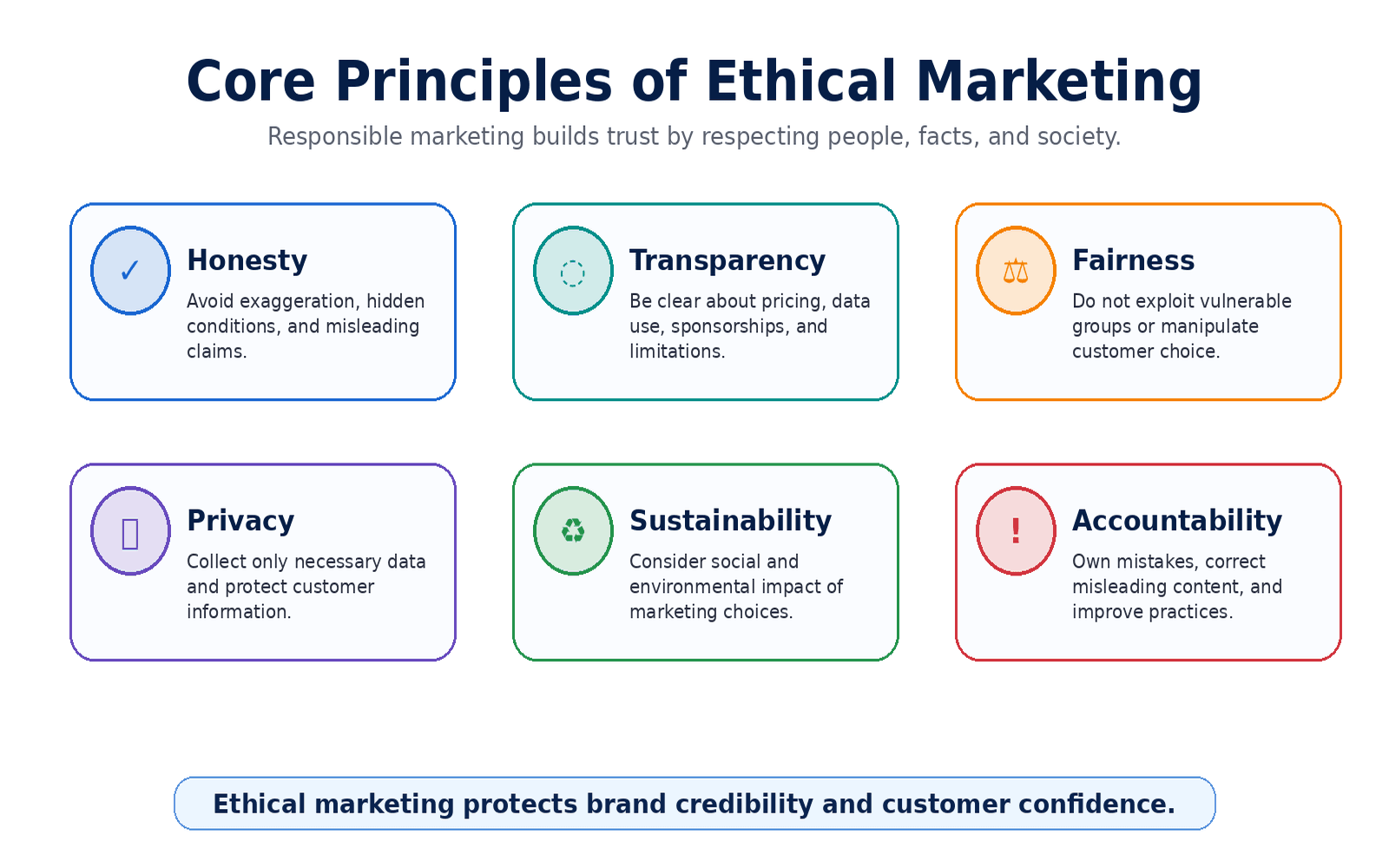
Honesty and Truthfulness
Present products accurately without deception, avoid misleading claims or omissions, honor commitments made in marketing, disclose material information affecting decisions.
Example: Stating "clinically proven" requires actual clinical studies, not just customer testimonials.
Transparency
Clear about data collection and usage, honest about pricing and fees, transparent about sponsored content, open about business practices and policies.
Example: Instagram influencers must disclose paid partnerships with #ad or #sponsored tags.
Fairness
Avoid exploiting vulnerable populations, compete fairly without disparagement, respect competitors and intellectual property, equitable treatment of all customers.
Example: Not targeting predatory loans to financially struggling individuals.
Respect for Privacy
Collect only necessary data, secure personal information properly, honor opt-out preferences, comply with privacy regulations (GDPR, CCPA).
Example: Requiring explicit consent before adding people to email lists.
Social Responsibility
Consider broader societal impact, environmental sustainability in practices, truthful representation in advertising, avoid promoting harmful products/behaviors.
Example: Not marketing unhealthy food to children despite profitability.
Common Ethical Dilemmas in Marketing

Targeting Vulnerable Populations
Dilemma: Children, elderly, financially distressed, or other vulnerable groups may lack defenses against persuasive marketing.
Ethical Question: Is it acceptable to market to those who can't fully evaluate claims or resist manipulation?
Guidelines: Enhanced protections for children, clear disclosures for elderly, avoid exploitation of desperation, consider power imbalances.
Data Privacy and Surveillance
Dilemma: Effective targeting requires customer data, but collection raises privacy concerns.
Ethical Question: How much data collection is acceptable? When does personalization become creepy?
Guidelines: Transparency about collection, meaningful consent, data minimization, strong security, honor deletion requests.
Deceptive Pricing
Dilemma: Shrinkflation, drip pricing, fake urgency, misleading discounts increase revenue but deceive customers.
Ethical Question: Where's the line between strategic pricing and deceptive practices?
Guidelines: Clear total pricing upfront, honest scarcity claims, real comparison prices, transparent fee structures.
Greenwashing
Dilemma: Environmental claims boost sales, but exaggerating or fabricating sustainability credentials misleads consumers.
Ethical Question: How much environmental benefit justifies "eco-friendly" claims?
Guidelines: Substantiate all claims, avoid vague terms without proof, disclose limitations, third-party certifications.
Native Advertising and Influencer Marketing
Dilemma: Content blending into editorial or social feeds may not be recognized as advertising.
Ethical Question: When does integrated content cross into deceptive advertising?
Guidelines: Clear "sponsored" or "ad" disclosures, maintain editorial independence, transparent partnerships, FTC compliance.
Ethical Decision-Making Frameworks

The "Front Page Test"
Ask: Would I be comfortable if this marketing practice appeared on the front page of a major newspaper with my name attached?
Application: If the answer is no, the practice likely crosses ethical lines regardless of legality.
Stakeholder Analysis
Process: Identify all affected parties (customers, employees, competitors, society), consider impact on each stakeholder, weigh competing interests, choose path minimizing harm while achieving objectives.
Example: Data collection decision considers customer privacy, business needs, employee responsibilities, regulatory environment.
The Golden Rule
Apply: Would I want to be marketed to this way if I were the customer?
Power: Simple, intuitive test catching obvious ethical violations.
Limitation: May not address systemic issues or vulnerable populations.
Utilitarianism (Greatest Good)
Approach: Choose action producing greatest overall benefit for greatest number.
Application: Weighing individual customer privacy against collective benefits of personalized services.
Caution: Can justify harming minorities for majority benefit combine with other frameworks.
Rights-Based Approach
Principle: Respect fundamental rights regardless of outcomes.
Application: Customer rights to privacy, truthful information, fair treatment override profit considerations.
Example: Not selling customer data even if profitable because it violates privacy rights.
Regulations and Guidelines

Federal Trade Commission (FTC) Act
Prohibits deceptive or unfair practices, requires substantiation of claims, regulates endorsements and testimonials, enforces truth in advertising.
Children's Online Privacy Protection Act (COPPA)
Restricts data collection from children under 13, requires parental consent for collection, limits marketing to children.
CAN-SPAM Act
Governs commercial email, requires opt-out mechanisms, prohibits deceptive headers/subject lines, mandates sender identification.
General Data Protection Regulation (GDPR)
EU regulation affecting global businesses, strict consent requirements, data minimization principles, right to deletion, substantial penalties for violations.
California Consumer Privacy Act (CCPA)
California privacy law with broad application, consumer rights to know/delete/opt-out, disclosure requirements for data collection.
Industry-Specific Ethical Considerations
Pharmaceutical Marketing
Direct-to-consumer advertising restrictions, balanced presentation of risks and benefits, off-label promotion prohibitions, relationships with healthcare providers.
Financial Services
Suitability requirements, risk disclosures, predatory lending prohibitions, fiduciary duties in some contexts.
Alcohol and Tobacco
Age restrictions on marketing, content limitations, placement restrictions, health warning requirements.
Food Marketing
Nutritional claim substantiation, serving size accuracy, marketing to children restrictions, allergen disclosures.
Technology and Social Media
Algorithm transparency, data usage disclosures, age verification, content moderation, misinformation responsibilities.
Building an Ethical Marketing Culture
Leadership Commitment
Ethics start at the top executives must model ethical behavior, prioritize ethics in decision-making, reward ethical conduct, address violations swiftly.
Clear Policies and Guidelines
Written ethics code, specific scenario guidance, regular policy updates, accessible reference materials, translation to practical situations.
Training and Education
Regular ethics training for all marketers, case study discussions, scenario-based learning, industry regulation updates, ethical reasoning development.
Accountability Mechanisms
Clear reporting channels for concerns, protection for whistleblowers, consequences for violations, regular audits and reviews, ethics committees for complex decisions.
Stakeholder Engagement
Customer feedback mechanisms, transparency reports, third-party audits, industry collaboration on standards, responsiveness to concerns.
Benefits of Ethical Marketing
Trust and Loyalty: Customers reward trustworthy brands with loyalty, repeat purchases, and referrals.
Brand Reputation: Ethical reputation attracts customers, employees, and partners while deterring negative publicity.
Reduced Legal Risk: Proactive ethics prevents violations, reducing regulatory actions and lawsuits.
Employee Satisfaction: People want to work for ethical companies, improving retention and attraction.
Long-Term Sustainability: Short-term gains from unethical practices rarely outweigh long-term costs.
Competitive Advantage: Ethics differentiate brands in crowded markets where consumers increasingly value responsible businesses.
Frequently Asked Questions
Is ethical marketing less profitable? Not necessarily. While unethical shortcuts may boost short-term results, ethical marketing builds sustainable competitive advantages through trust, loyalty, and reputation. Long-term profitability typically favors ethical approaches.
How do I handle pressure to cross ethical lines? Document concerns, reference company ethics policies, propose ethical alternatives achieving objectives, escalate to appropriate leaders, consider external reporting if illegal, protect yourself with written communication.
What if competitors use unethical tactics? Don't match unethical behavior to compete. Instead, differentiate on ethics, report violations to regulators when appropriate, educate customers about differences, build coalition for industry standards.
Are all marketing regulations ethical requirements? No. Legal compliance is minimum standard ethics often require more than legal minimums. Something can be legal but unethical. Use ethics frameworks beyond just regulatory compliance.
How do I balance sales goals with ethics? Reframe ethics as enabling long-term goals rather than conflicting with them. Set ethical boundaries explicitly, design incentives rewarding ethical achievement, accept that some opportunities aren't worth pursuing unethically.
Should marketing to children be prohibited? Controversial topic. Strong arguments exist for significant restrictions given children's vulnerability. At minimum, enhanced protections, truthfulness, avoiding exploitation of developmental limitations are essential. Many companies voluntarily avoid marketing to young children.
Conclusion
Marketing ethics requires balancing business objectives with moral obligations to customers, society, and other stakeholders. Core principles honesty, transparency, fairness, privacy, social responsibility guide ethical marketing practices despite pressure for short-term gains through questionable tactics.
Ethical dilemmas are inevitable in marketing. The key is approaching them systematically through established frameworks, considering all stakeholders, respecting fundamental rights, and choosing paths that withstand public scrutiny. Building ethical culture requires leadership commitment, clear policies, ongoing training, and accountability mechanisms.
The long-term benefits of ethical marketing trust, loyalty, reputation, sustainability far outweigh short-term gains from cutting ethical corners. As consumers become more sophisticated and regulations tighten, ethical marketing transitions from nice-to-have to business necessity.
Begin strengthening marketing ethics by reviewing current practices against established principles, identifying potential ethical risks, developing clear guidelines, training teams thoroughly, and fostering culture where ethics are valued over expedience. Your brand reputation, customer relationships, and long-term success depend on getting ethics right.


