Top 10 Free AI Text Humanizers to Make Your Content Sound Natural in 2026

Introduction

Artificial intelligence has revolutionized content creation, enabling writers to produce drafts faster than ever. However, AI-generated text often carries telltale signs repetitive phrasing, overly formal tone, predictable structure, and lack of personality that readers instinctively recognize as machine-written.
This presents a significant challenge for content creators, students, and professionals who use AI writing assistants but need output that sounds genuinely human. Whether you're refining AI-generated drafts, ensuring academic integrity, or simply making content more engaging, AI text humanizers have emerged as essential tools.
These specialized applications transform robotic AI writing into natural, conversational prose that connects with readers. They adjust sentence rhythm, vary vocabulary, inject personality, and eliminate the mechanical patterns that signal automated generation.
This comprehensive guide examines the 10 best free AI text humanizers available in 2026. You'll discover which tools excel at different writing styles, understand how humanization technology works, and learn strategies for creating AI-assisted content that maintains authenticity while leveraging automation's efficiency.
Understanding AI Text Humanizers: The Technology Behind Natural Writing

AI text humanizers use sophisticated natural language processing to identify and modify patterns characteristic of machine-generated content. These tools analyze sentence structure, vocabulary diversity, transition patterns, and stylistic elements.
What They Detect and Modify:
Repetitive sentence structures
Overused transitional phrases
Overly formal or academic tone
Predictable vocabulary choices
Lack of contractions and casual language
Uniform sentence length patterns
Advanced humanizers employ AI models trained on millions of human-written examples, learning the subtle variations, imperfections, and stylistic choices that characterize authentic writing. They don't just replace words they restructure sentences, adjust rhythm, and inject the natural variation humans instinctively create.
The goal isn't deception but refinement. Most users employ AI for initial drafts, then humanize the output to match their personal voice and writing style.
1. Undetectable.AI: Advanced Humanization Technology
Undetectable.AI leads the market with sophisticated algorithms specifically designed to transform AI-generated content into natural-sounding prose. The free tier offers limited monthly humanizations but delivers professional-quality results.
Key Features:
Multiple writing style options (general, academic, marketing, story)
Real-time AI detection scoring
Readability level adjustment
Purpose-specific optimization
Before/after comparison view
The platform first analyzes your text with multiple AI detection tools, showing how likely it is to be flagged as AI-generated. Then it applies targeted humanization, adjusting patterns while preserving meaning and intent.
What sets Undetectable.AI apart is purpose-specific optimization. Academic writing receives different treatment than marketing copy or creative stories, ensuring the humanized output fits your specific use case.
Best Used For: Professional content requiring high-quality humanization with style customization.
2. HIX Bypass: Comprehensive AI Humanization
HIX Bypass offers a generous free tier with advanced humanization capabilities that bypass most AI detection systems. The tool focuses on creating content that sounds authentically human while maintaining original meaning.
Core Capabilities:
Advanced paraphrasing that varies sentence structure
Tone adjustment (formal, casual, professional)
Grammar and spelling correction during humanization
Plagiarism-free output guarantee
Multi-language support
The humanization process goes beyond simple word replacement. HIX Bypass restructures entire paragraphs, varies sentence rhythm, and introduces natural imperfections that characterize human writing.
For students and academics, the tool specifically addresses common AI writing patterns that trigger detection in educational settings.
Best Used For: Academic writing and content requiring sophisticated bypass capabilities.
3. QuillBot's AI Detector and Humanizer: Integrated Solution
QuillBot, already renowned for paraphrasing, integrated AI detection and humanization capabilities. The free version provides limited monthly uses but leverages QuillBot's proven natural language processing.
What It Offers:
AI detection scoring before humanization
Multiple paraphrasing modes that humanize text
Grammar checking integrated throughout
Synonym suggestions for variety
Sentence restructuring options
QuillBot's humanization works through its paraphrasing engine. The "Natural" and "Creative" modes specifically target AI-like patterns, introducing variation and personality that makes content sound human-written.
The integrated workflow detect, humanize, grammar-check streamlines the editing process significantly.
Best Used For: Writers already using QuillBot who want integrated AI humanization.
4. StealthWriter: Bypassing AI Detection Systems
StealthWriter specifically targets AI detection systems, analyzing how various detectors identify machine-generated content and adjusting accordingly. The free version offers daily humanization credits.
Specialized Features:
Tests output against multiple AI detectors
Real-time bypass success scoring
Maintains original meaning and intent
Adjustable humanization intensity
Export options for different formats
The tool's strength lies in its continuous testing. As AI detection systems evolve, StealthWriter updates its algorithms to maintain bypass effectiveness.
Users can adjust humanization intensity based on their needs light touches for already decent AI output or heavy restructuring for obviously robotic text.
Best Used For: Content that must bypass specific AI detection systems.
5. Smodin AI Writer Rewriter: Multi-Tool Platform

Smodin combines AI writing, rewriting, and humanization in one platform. The free tier includes text humanization capabilities alongside other writing tools.
Integrated Tools:
AI content humanizer
Plagiarism checker
Citation generator
Text summarizer
Multi-language support (100+ languages)
For users needing multiple writing assistance tools, Smodin's integrated approach eliminates switching between platforms. Generate content with AI, humanize it, check for plagiarism, and add citations all in one place.
The humanization specifically addresses academic writing patterns, making it popular among students who use AI for research assistance.
Best Used For: Academic projects requiring multiple writing tools beyond humanization.
6. NetusAI: Paraphrasing with Humanization
NetusAI positions itself as an AI paraphraser that specifically creates undetectable output. The free version provides limited monthly characters but powerful humanization.
Distinctive Features:
Multiple paraphrasing modes with humanization
AI detection probability scoring
Summary generation with human touch
Chrome extension for seamless workflow
Customizable paraphrasing strength
NetusAI's approach combines traditional paraphrasing with AI humanization. The result is content that's both original and natural-sounding, addressing two concerns simultaneously.
The tool particularly excels at maintaining technical accuracy while humanizing complex topics important for professional and academic content.
Best Used For: Technical content requiring both paraphrasing and humanization.
7. Writehuman: Focused Humanization Tool
Writehuman specializes exclusively in making AI text sound human, avoiding feature bloat to perfect one function. The free tier offers generous daily humanizations.
What Makes It Effective:
Simple, focused interface
Fast processing
Preserves original structure while humanizing
Multiple language support
No registration required for basic use
By focusing solely on humanization rather than bundling multiple tools, Writehuman delivers exceptional results in its specific domain. The processing is fast, and the output consistently sounds natural.
The no-registration option for basic use makes it perfect for quick humanization tasks without commitment.
Best Used For: Quick, straightforward humanization without complicated workflows.
8. Humbot: Advanced AI Bypass Technology
Humbot employs machine learning specifically trained to identify and modify AI writing patterns. The free version includes daily humanization limits with professional-quality output.
Advanced Capabilities:
Analyzes writing against 8+ AI detectors simultaneously
Shows detection probability for each system
Customizable humanization levels
Maintains SEO keywords during humanization
Batch processing for multiple documents
For content creators concerned about SEO, Humbot's ability to preserve keyword placement while humanizing is invaluable. You maintain search optimization while ensuring content sounds natural.
The multi-detector analysis reveals which AI detection systems might flag your content, allowing targeted humanization.
Best Used For: SEO content requiring humanization without losing keyword optimization.
9. Conch AI: Student-Focused Humanization
Conch AI specifically targets academic writing, helping students humanize AI-assisted research papers and essays. The free tier includes limited monthly humanizations with academic focus.
Academic Features:
Citation preservation during humanization
Academic tone maintenance
Reference formatting retention
Paragraph-by-paragraph processing
Academic integrity focus
Conch AI understands that students often use AI for research assistance and initial drafts but need final output that reflects their own voice and thinking. The humanization maintains academic rigor while introducing natural variation.
The tool also provides tips for improving writing skills rather than just fixing AI output educational rather than purely corrective.
Best Used For: Academic essays and research papers requiring student-appropriate humanization.
10. GPTinf: Specialized Detection Bypass
GPTinf focuses specifically on bypassing GPT-detection tools, continuously updating as detection systems evolve. The free trial provides limited humanizations but demonstrates capability.
Specialized Functions:
Targets GPT-specific detection patterns
Regular updates matching detector evolution
Maintains content quality and coherence
Adjustable bypass strength
Before/after detection comparison
As one of the most commonly detected AI writing sources, GPT-generated content often needs specialized humanization. GPTinf specifically addresses the patterns GPT models create.
The tool's continuous updates ensure effectiveness as detection technology improves, playing an ongoing cat-and-mouse game with detectors.
Best Used For: Content specifically generated by GPT models requiring detection bypass.
How to Use AI Humanizers Effectively
Simply running AI text through a humanizer doesn't guarantee quality results. Strategic use requires understanding both tools and writing principles.
Best Practices for Humanization:
Start with quality AI output. Garbage in, garbage out applies to humanization. Well-structured, coherent AI writing humanizes better than poorly generated content.
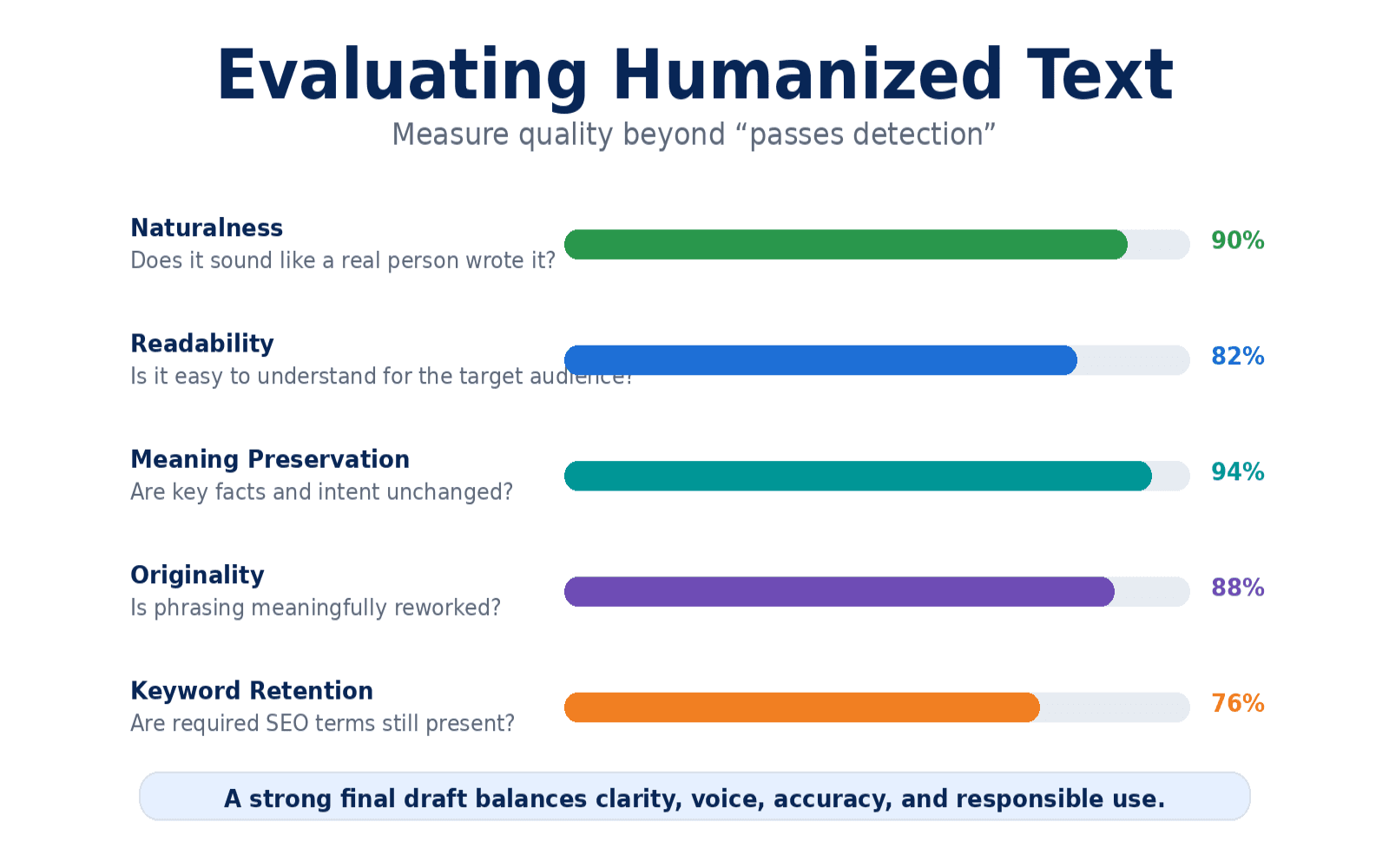
Review and edit humanized text. Humanizers improve AI writing but don't replace human judgment. Read through humanized content, fix awkward phrasings, and ensure accuracy.
Maintain your personal voice. After humanization, add personal anecdotes, specific examples, and distinctive phrases that reflect your unique perspective and style.
Don't rely solely on humanization. Use AI and humanizers as assistants in your writing process, not replacements for original thinking and expression.
Check multiple times. Run important content through both the humanizer and AI detectors multiple times, refining until detection probability is acceptably low.
Understanding the Limitations
AI text humanizers aren't perfect solutions and come with important considerations.
Technical Limitations:
May occasionally change meaning subtly
Sometimes create grammatically correct but awkward phrasings
Can't add genuine expertise or insights
Limited effectiveness on highly technical content
Variable results depending on original AI quality
Ethical Considerations:
Academic institutions increasingly prohibit AI-generated work even if humanized
Professional contexts may require disclosure of AI assistance
Humanizers facilitate, but don't eliminate, the ethical questions around AI writing
Understanding these limitations helps you use humanizers appropriately as editing tools rather than shortcuts to authenticity.
The Future of AI Writing and Humanization
The relationship between AI writing, detection, and humanization continues evolving rapidly. Detection systems improve, humanizers adapt, and the line between human and machine writing blurs further.
Emerging Trends:
More sophisticated detection analyzing writing patterns at deeper levels
Humanizers using advanced AI to create more natural output
Integration of humanization directly into AI writing tools
Regulatory frameworks around AI content disclosure
Educational institutions adapting to AI-assisted writing reality
Rather than viewing this as purely adversarial, progressive approaches recognize AI as a writing tool requiring new literacy skills knowing when to use AI assistance, how to maintain authenticity, and where human creativity remains irreplaceable.
Frequently Asked Questions
Are AI text humanizers ethical to use? Ethics depend on context. Using humanizers to refine AI-assisted drafts for personal projects is generally acceptable. Using them to disguise completely AI-written academic work or professional content where original authorship is expected raises ethical concerns. Always check specific policies for your situation.
Can AI detectors identify humanized text? Advanced humanizers significantly reduce detection probability, but no tool guarantees complete undetectability. Detection systems continually improve, creating an ongoing technological race. Combining humanization with manual editing provides the best results.
Will using AI humanizers improve my writing skills? Not directly. Humanizers fix AI output but don't teach writing principles. However, analyzing what changes humanizers make can reveal patterns to avoid in your own writing when using AI assistance.
Are free AI humanizers as effective as paid versions? Free versions typically have usage limits but often use the same core technology as paid tiers. For occasional use, free humanizers are quite effective. High-volume professional use may justify paid subscriptions for unlimited access.
Can AI humanizers work with languages other than English? Several humanizers support multiple languages, though effectiveness varies. English generally receives the most sophisticated humanization due to larger training datasets. Major languages like Spanish, French, and German also receive good support.
How do I choose the best AI humanizer for my needs? Consider your primary use case: Undetectable.AI for professional content, Conch AI for academic writing, Humbot for SEO content. Test several tools with the same text to compare results and find which best matches your writing style.
Conclusion
AI text humanizers represent a pragmatic response to the reality that artificial intelligence now assists with content creation across industries and education. Rather than pretending AI doesn't exist or isn't used, these tools help creators produce more natural, engaging content while leveraging automation's efficiency.
The best approach combines AI writing assistance, humanization tools, and human editing into an integrated workflow. AI provides structure and speed, humanizers refine patterns and tone, and human judgment ensures quality, accuracy, and authenticity.
Among the free options available, Undetectable.AI, HIX Bypass, and QuillBot offer the most sophisticated humanization for different use cases. Specialized tools like Conch AI for academics or Humbot for SEO content provide targeted solutions for specific needs.
The key is viewing humanizers as editing tools rather than magic solutions. They improve AI-generated content, making it sound more natural and engaging, but they don't replace the need for human creativity, expertise, and judgment in creating truly valuable content.
As AI writing technology advances, the line between human and machine writing will continue blurring. The writers who succeed will be those who master using AI tools strategically while maintaining the irreplaceable human elements unique perspectives, emotional connection, and genuine expertise that no algorithm can replicate. AI humanizers are simply one tool in this evolving toolkit, helping bridge the gap between efficiency and authenticity.


